

Individual Entrepreneur or LLP in Kazakhstan: Choosing the Right Form in 2026
21 октября, 2026
Since 2026, the simplified-regime rate has been the same 4% of income for an individual entrepreneur and for a partnership alike. What a wrong choice of form costs you now depends not on the rate but on three other things: whether you are admitted to the preferential regime, how much extra you pay when taking profit out, and what you risk personally.
During the first year of business, an individual entrepreneur (IE — Kazakhstan’s form of sole proprietorship) and a limited liability partnership (LLP) look almost identical. The gap opens once a partner or investor appears: only a partnership lets you give them a stake. Comparisons written in 2024–2025 are now misleading, because the rules behind them stopped applying on 1 January 2026. That day, Code of the Republic of Kazakhstan No. 214-VIII “On Taxes and Other Mandatory Payments to the Budget” of 18 July 2025 (the Tax Code) took effect, and the previous code, No. 120-VI of 25 December 2017, was repealed.
The core problem
“I’ve moved to Almaty, I’m a Russian citizen. My accountant suggests an IE because the tax is lower. My partner insists on an LLP, where his Moscow company would get a share. And friends say a foreigner can’t be an IE at all. Whose advice is right?”
Foreign entrepreneurs ask questions like this more often than any other.

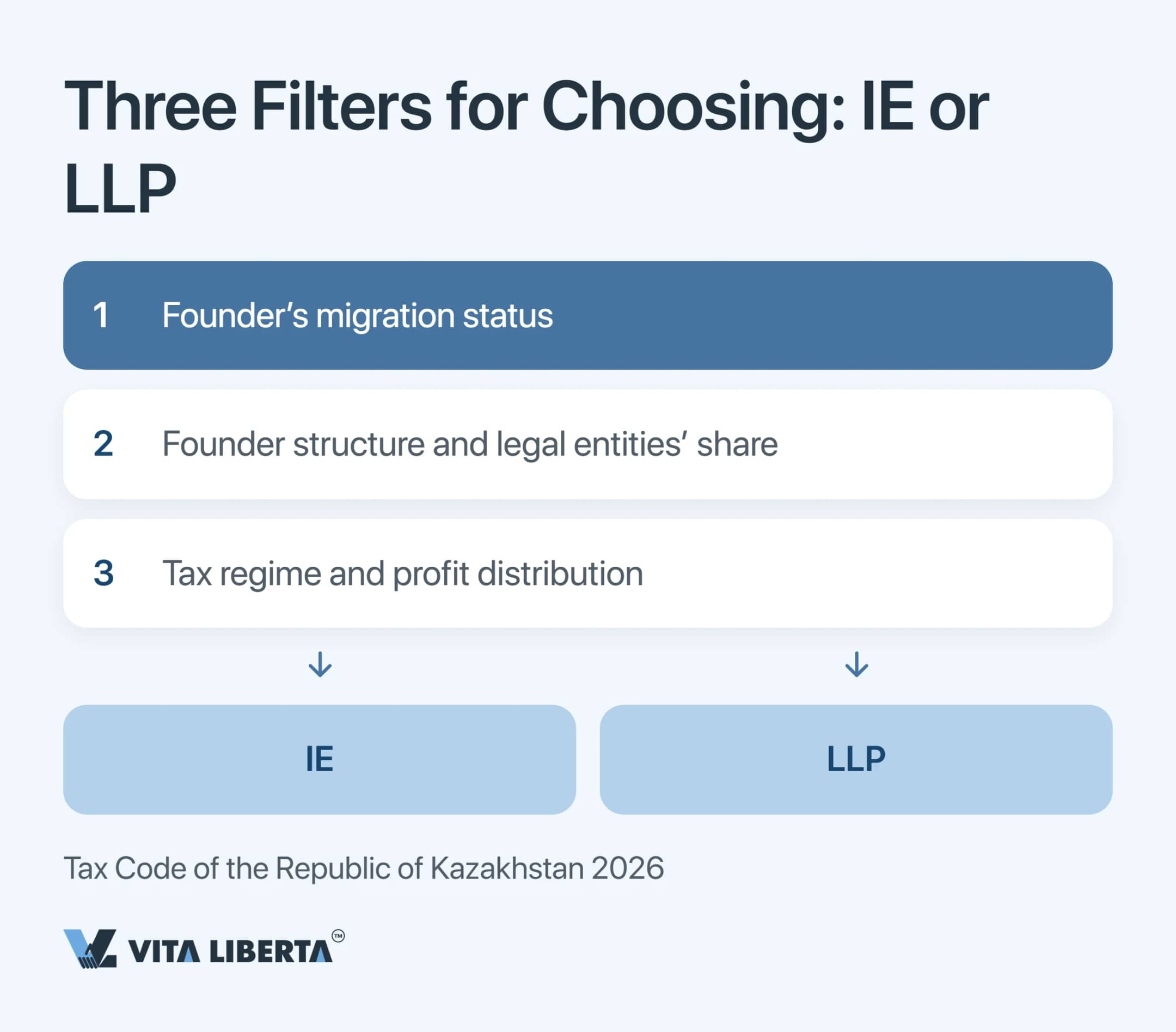
Can a Foreigner Become an IE? Migration Status Decides
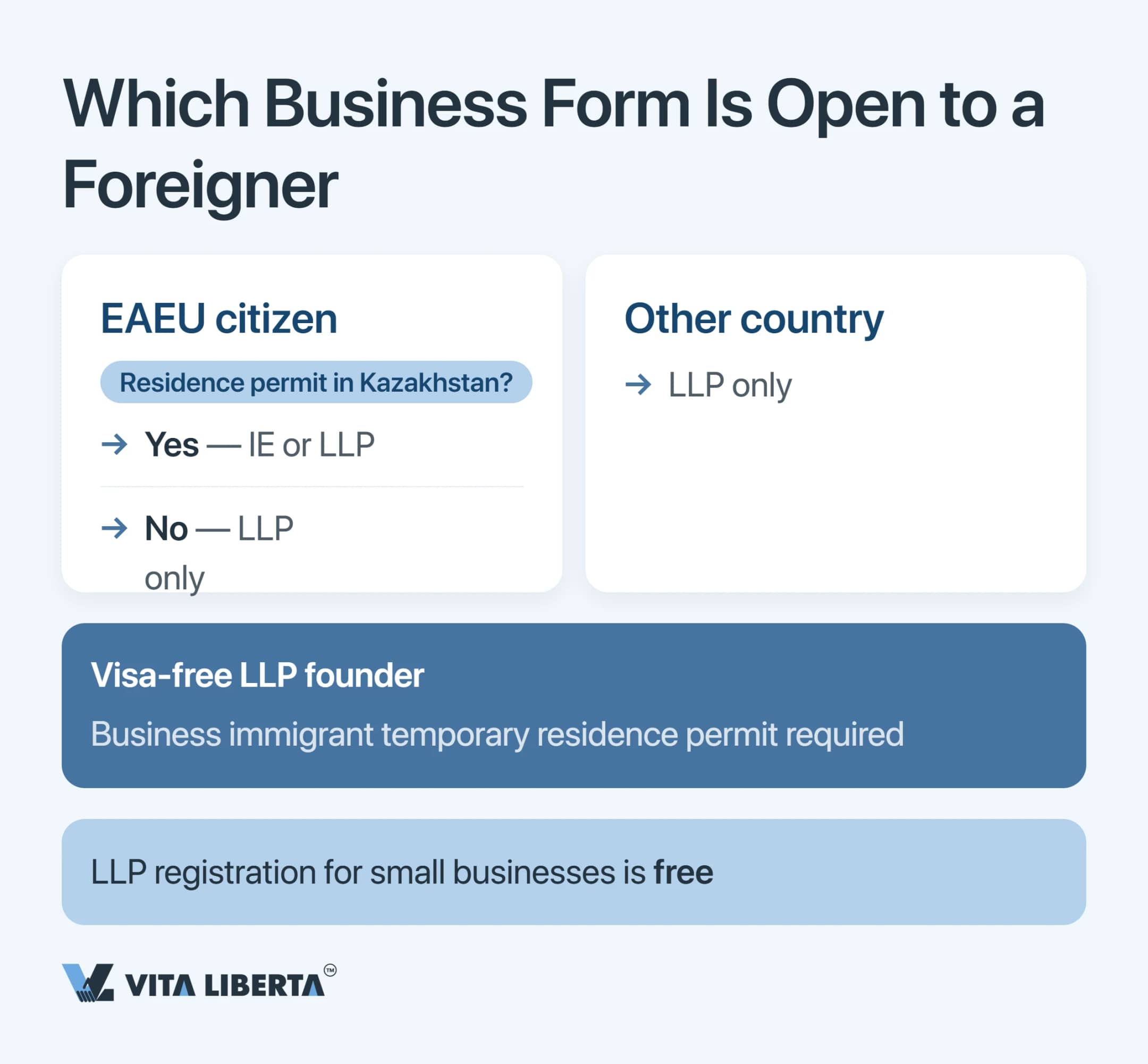
An IE is not an organisation: it is a private individual who has taken on a tax status. That is why eligibility turns on migration status. Filing the start-of-business notification on eGov costs nothing, yet a foreigner’s options are narrow. Without a Kazakh residence permit, registration is impossible, and the right to operate as an IE itself comes from Kazakhstan’s international treaties — the State Revenue Committee (SRC, КГД), for example, confirms this right for Russian citizens permanently residing in the country.
An LLP is easier to access: a foreign national without a residence permit, or a foreign company, can be its founder. An individual founder still has to obtain business-immigrant status — a business-immigrant temporary residence permit (TRP) when entering visa-free, or a category C5 visa when a visa is required. For a small business, registering an LLP is free of charge.
Bottom line: for most non-residents, migration status picks the legal form, and comparing tax rates is no longer the question.
Tax Burden Under the 2026 Code: Where the Two Forms Meet and Where They Split
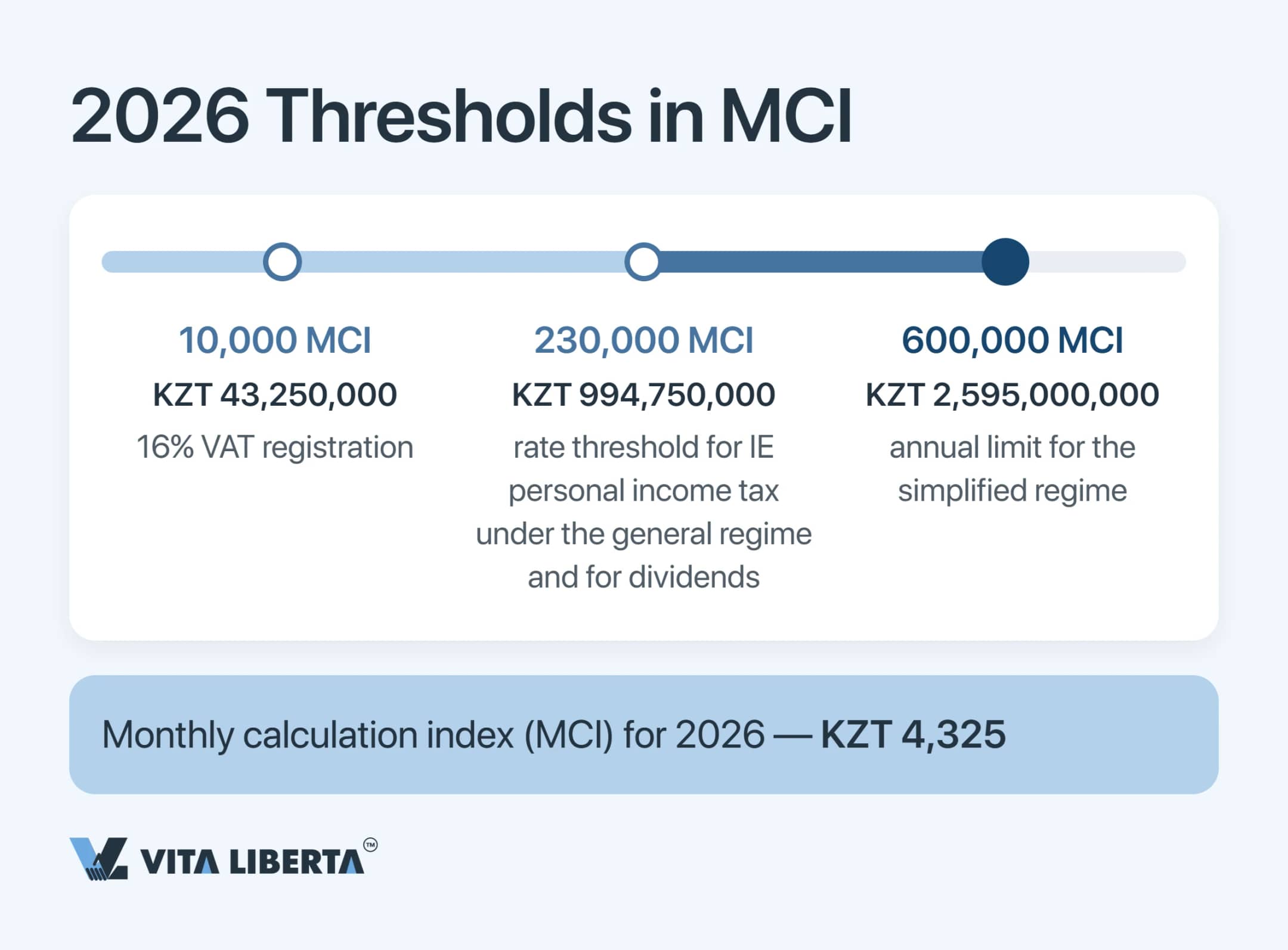
The reform levelled IEs and LLPs on the simplified regime; the differences have shifted to the general regime and to how payouts to the founder are taxed. The Code sets its thresholds in monthly calculation indices (MCI). In 2026, one MCI equals KZT 4,325.
Simplified Declaration: 4% and a Locked Door
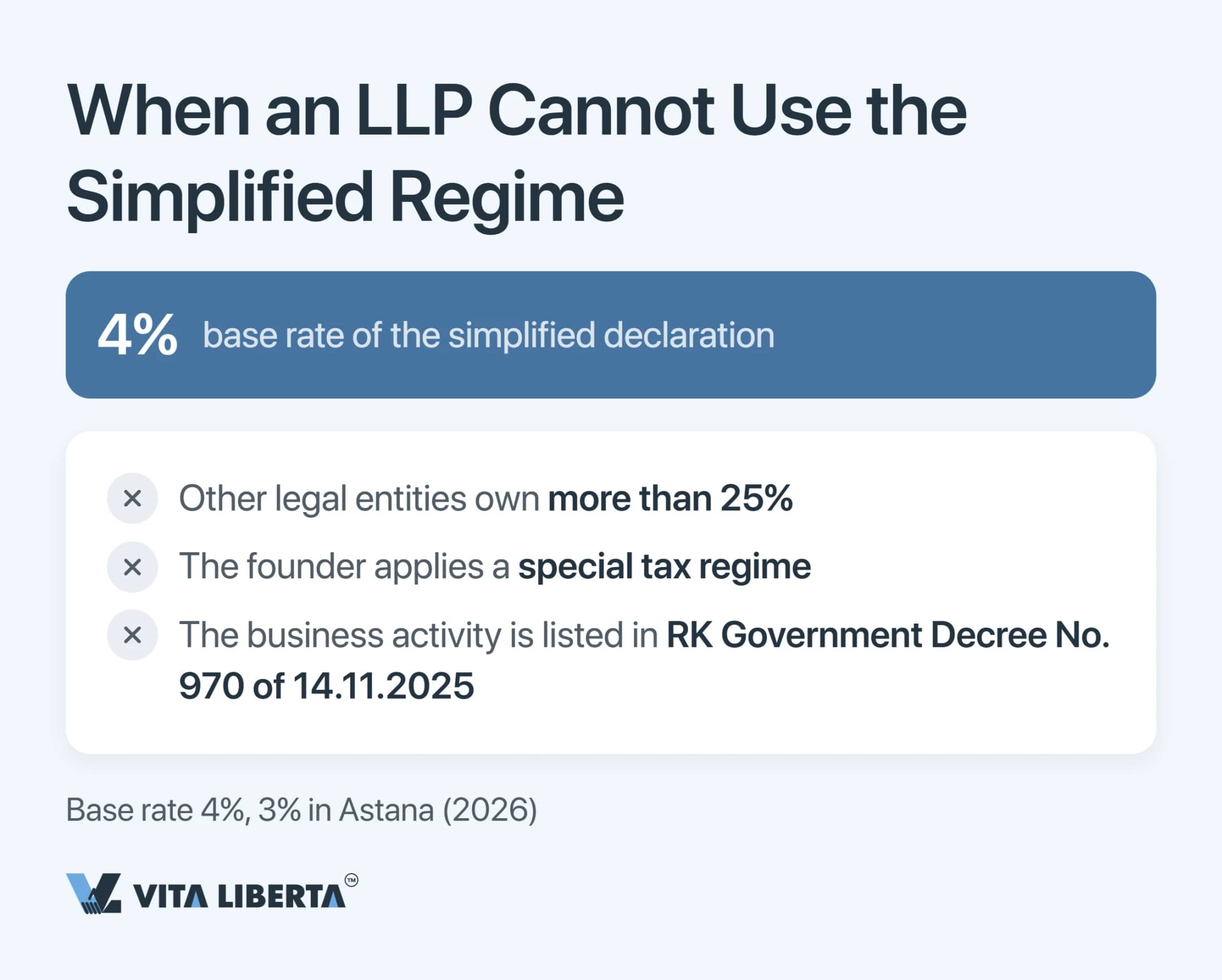
The special tax regime (STR) based on a simplified declaration carries a 4% rate on income, regardless of whether you are an IE or an LLP. A regional maslikhat (local representative council) may raise or cut the rate by no more than half. Astana’s maslikhat, for instance, lowered it to 3% from 1 January 2026 by Decision No. 349/46-VIII of 28 November 2025. Annual income on the regime is capped at 600,000 MCI, which at the 2026 MCI comes to exactly KZT 2,595,000,000. Taxpayers on this regime pay no social tax and do not register for VAT.
This is where the most common mistake happens: Article 723(2) of the Tax Code keeps three kinds of LLPs off the simplified regime:
This is where the most common mistake happens: Article 723(2) of the Tax Code keeps three kinds of LLPs off the simplified regime:
- one in which other legal entities own more than 25%;
- one whose founder is on a special tax regime himself;
- one whose participant also holds an interest in another legal entity on a special regime.
General Regime: a Progressive IIT Scale vs a Flat CIT
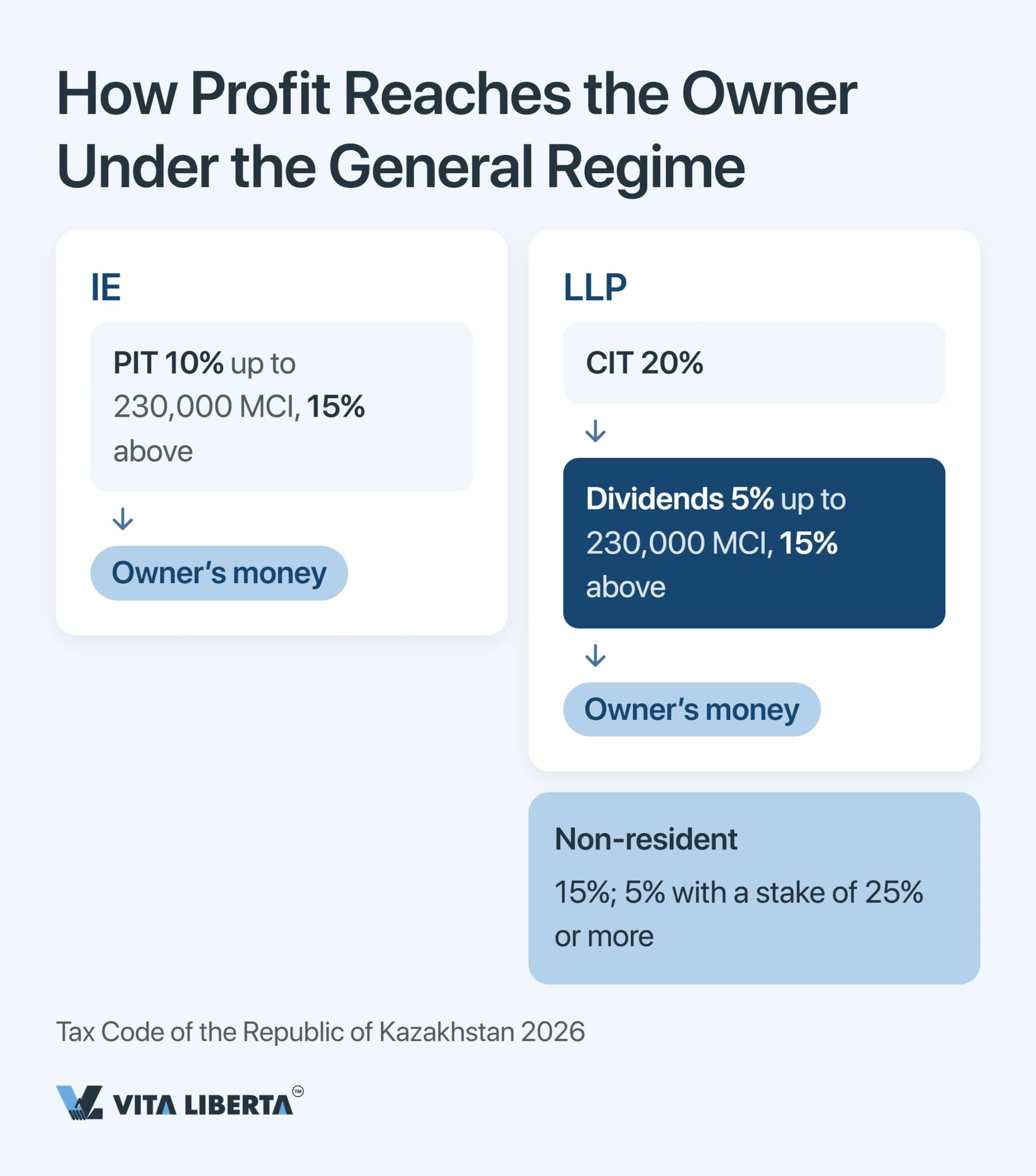
On the general tax regime, an IE pays individual income tax (IIT, ИПН) on a scale: 10% on income up to 230,000 MCI and 15% on everything above it. An LLP pays corporate income tax (CIT, КПН) at a flat 20%.
Social tax works differently, too. An LLP charges it at 6% on employees’ salaries after deducting mandatory pension contributions (OPV) and compulsory social health insurance contributions (VOSMS), and the base cannot be lower than 14 MCI per person. An IE pays a fixed monthly amount instead of a percentage: 2 MCI for himself (KZT 8,650) plus 1 MCI for each employee.
On VAT the forms are equal: once turnover exceeds 10,000 MCI (KZT 43,250,000), VAT registration is mandatory, and the tax is charged at 16%.
Taking Profit Out: the Tax an IE Never Pays
An LLP’s profit belongs to the partnership, and the founder receives it only as dividends. The exemption for holding an interest for more than three years was abolished back on 1 January 2023 and did not return in the 2026 Code.
So with a stake of 25% or more, Kazakhstan’s domestic 5% is the better rate up to the 230,000 MCI threshold, while the treaty’s 10% is better on the excess.
- Resident founder: 5% on dividends up to 230,000 MCI (KZT 994,750,000) per year and 15% on the excess.
- Non-resident founder: as a general rule, 15% of the payout goes to withholding tax. With at least a quarter of the capital, the first 230,000 MCI of dividends per year are taxed at 5%, and anything above at 15% again.
- Residents of Russia: the Convention for the avoidance of double taxation (DTT) of 18 October 1996 applies, under which dividend tax cannot exceed 10%.
So with a stake of 25% or more, Kazakhstan’s domestic 5% is the better rate up to the 230,000 MCI threshold, while the treaty’s 10% is better on the excess.
| Parameter | IE | LLP | What to check |
| Which foreigners qualify | A foreigner with a residence permit who is granted the right to be an IE by an international treaty (e.g. a Russian citizen) | A foreign national or company; an individual needs a business-immigrant TRP or a C5 visa | Verify migration status in advance, before filing documents |
| Simplified regime | 4% of income, cap 600,000 MCI | 4% of income, cap 600,000 MCI | If legal entities own more than 25%, the LLP is not admitted |
| General regime | IIT on a 10% / 15% scale | 20% CIT plus dividend tax | Calculate the full burden including dividends |
| Social tax | 2 MCI a month for yourself and 1 MCI a month per employee | 6% of employees’ salaries after OPV and VOSMS | Not charged on the simplified regime |
| Taking profit out | No additional tax | Resident: 5% / 15%; non-resident: 15%, or 5% / 15% with a stake of 25%+ | The threshold is 230,000 MCI; check the non-resident rate against the DTT |
Choose your business form without tax traps
- Migration status assessment
- Comparison of tax scenarios
- Review of capital ownership structure

Liability and Growth: What a Legal Entity Offers
What the Owner Risks Personally
An IE answers for business debts with all of his personal assets, whereas an LLP participant risks only what he contributed to the charter capital. This protection has limits. If a participant or director drove the partnership into bankruptcy, a court may impose subsidiary liability on him. And when a bank lends to an LLP, it often requires the participant’s personal guarantee — for that debt, limited liability no longer works.
Partners, Investors and Selling the Business
An IE can be neither sold nor divided into shares: the status is inseparable from the owner’s individual identification number (IIN). An LLP can take on a partner, sell an interest or attract a foreign investor, and during KYC the bank studies precisely this chain of ownership. Consultants working in Almaty note that what holds up the launch of an LLP with foreign participation is not eGov registration but disclosing beneficial owners to the bank. An IE cannot simply be converted into an LLP: contracts, employees and accounts have to be moved to the new legal entity.
Four Scenarios and the Form That Fits
| Scenario | Form | Check before registering |
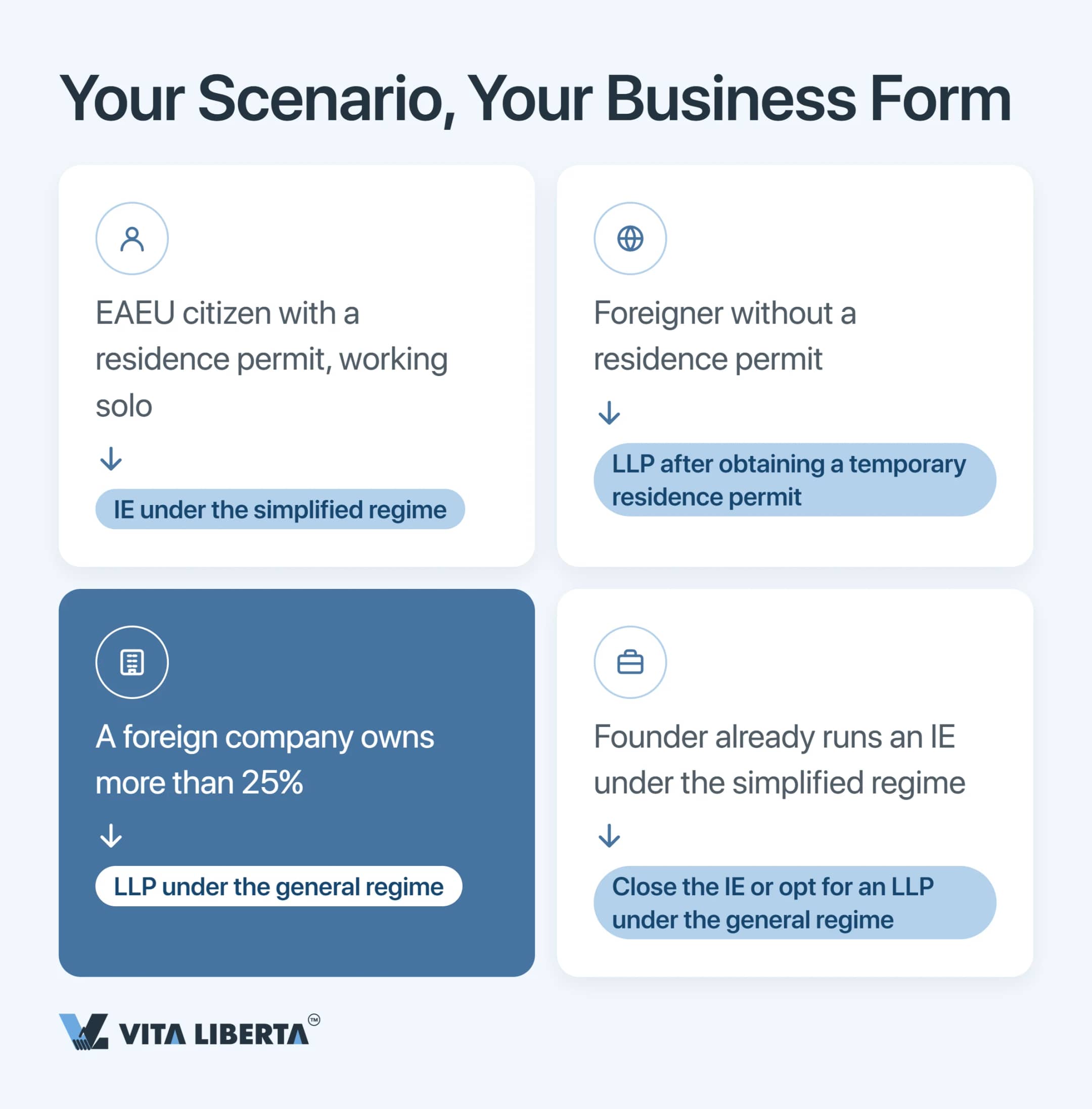
| Foreigner without a residence permit | LLP | Obtain a business-immigrant TRP (visa-free entry) or a C5 visa (visa entry) before applying on eGov |
| A foreign company owns more than 25% | LLP on the general regime | The total burden: 20% CIT and dividend tax, taking the DTT into account |
| The founder already runs an IE on the simplified regime | Either close the IE or keep the LLP on the general regime | A special regime cannot apply to both the founder and the partnership at the same time |
| A solo entrepreneur — a foreigner with a residence permit and the right to be an IE | IE on the simplified declaration | The rate set by the maslikhat and the list of prohibited activities (Government Decree No. 970 of 14 November 2025) |
The costliest mistake foreigners make is running the numbers under the old code. Three outdated figures still turn up in reviews: a VAT threshold of 20,000 MCI, a simplified-regime cap of 24,038 MCI and a 3% rate presented as nationwide. Tip: before filing your notification, open the Reference Control Bank of Regulatory Legal Acts (adilet.zan.kz), find your region’s maslikhat decision and see what period it covers. Some maslikhats set the rate for one year, others for an indefinite term.
Important: if other legal entities, including a foreign parent company, own more than 25% of the partnership, the simplified regime is closed to it from day one, and CIT is calculated at 20% straight away.
Important: if other legal entities, including a foreign parent company, own more than 25% of the partnership, the simplified regime is closed to it from day one, and CIT is calculated at 20% straight away.
Open an LLP in Kazakhstan without mistakes
- Choosing a tax regime
- Registration on eGov
- Support with opening a bank account
IE or LLP: Strategic Takeaways
The central paradox of 2026: IEs and LLPs share the same simplified rate, but not the same access to it. Access is determined not by the size of the business but by who the founders are and what their migration status is.
In other words, the business form is not just a line in an eGov application. It is the first decision about how the company will be divided and sold, and how it will pay its founder.
- An IE suits a resident. For a foreigner without a residence permit, this form is closed.
- An LLP is chosen to fit the ownership structure. If legal entities own more than 25%, or the founder is on an STR himself, the partnership ends up on the general regime.
- Do the maths before registering: 4% of turnover versus 20% CIT plus another 5–15% on dividends.
In other words, the business form is not just a line in an eGov application. It is the first decision about how the company will be divided and sold, and how it will pay its founder.
IE vs LLP in Kazakhstan: 5 Key Questions Answered
My LLP is wholly owned by a foreign parent company — can it use the simplified regime, and what happens to the tax burden?
I already work as an IE on the simplified regime and plan to open an LLP — can I run both, and what should I watch out for?
As a non-resident LLP founder, how much tax will I pay on dividends, and what does the rate depend on?
My business is registered in Astana — what simplified-regime rate do I pay, and where is it confirmed?
Вся представленная на сайте информация, касающаяся стоимости оказываемых услуг носит информационный характер и ни при каких условиях не является публичной офертой, определяемой положениями ст. 395 ГК РК. Интернет-сайт vitaliberta.kz составлен с вниманием к деталям в отношении законодательных требований, в том числе путем анализа судебной практики. Несмотря на это, компания ТОО "Вита Либерта" не может гарантировать безошибочность и точность содержащейся на сайте информации.