

Education
NPO Registration in Kazakhstan —
Turn Your Socially Beneficial Ideas into Reality!

Submit your application right now and get a free consultation for successful NPO registration!
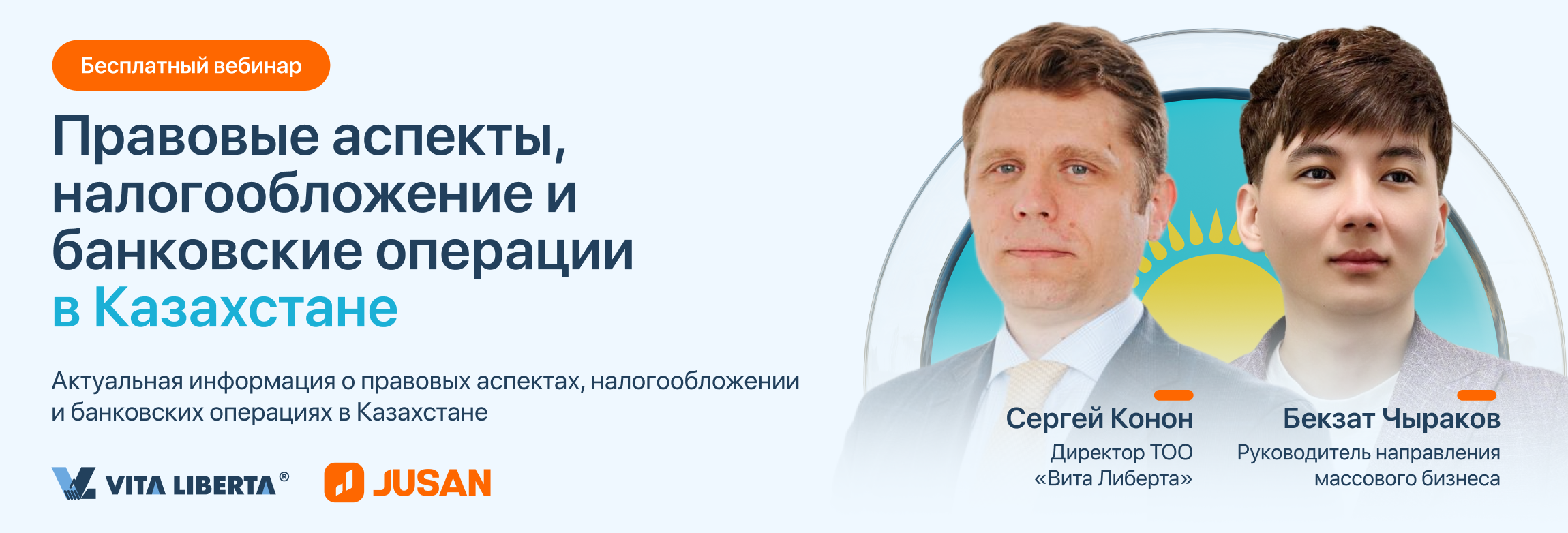
Webinar: A Comprehensive Guide to Legal Aspects, Taxation, and Banking Operations in Kazakhstan
Join our webinar "Legal Aspects, Taxation, and Banking Operations in Kazakhstan" and get comprehensive information from experts at Vita Liberta and Jusan Bank. Learn all the important nuances of successfully doing business in Kazakhstan and ask your questions live! Don't miss the opportunity to increase your competence and confidence in your affairs.
Choose an NPO Registration Package
Full
From 150,000 KZT
Consulting on the choice of legal form (OPF), requirements, and documentation
Clarification of the NPO's goals for inclusion in the constituent documents
Consultation on the exact composition and verification of documents required for NPO registration
Drafting the Resolution of the Sole Founder (if one participant) or the Minutes of the General Meeting of Founders (if multiple participants)
Drafting the Charter or the Memorandum of Association (in the case of multiple founders)
Consultation on the payment of the state registration fee for the NPO
Name clearance check for the NPO
Selection of General Classifier of Types of Economic Activities
Completion and submission of the application for state registration of the NPO
Drafting the Order on the appointment of the Managing Director/Executive Director
Premium
From 590,000 KZT
Consulting on the choice of legal form (OPF), requirements, and documentation
Clarification of the NPO's goals for inclusion in the constituent documents
Consultation on the exact composition and verification of documents required for NPO registration
Drafting the Resolution of the Sole Founder (if one participant) or the Minutes of the General Meeting of Founders (if multiple participants)
Drafting the Charter or the Memorandum of Association (in the case of multiple founders)
Consultation on the payment of the state registration fee for the NPO
Name clearance check for the NPO
Selection of General Classifier of Types of Economic Activities codes
Completion and submission of the application for state registration of the NPO
Drafting the Order on the appointment of the Managing Director
Consultation on the legalization of documents (if foreign participants are involved) and their verification
Escort to the PSC (Public Service Center) for submitting an application to obtain an IIN (Individual Identification Number) for an individual (Managing Director or Founder)
Escort to the PSC (Public Service Center) for submitting an application to obtain an EDS (Digital Signature) for an individual (Managing Director of the NPO).
Registration of the NPO Director in the mobile citizens database
Preparation for submitting a temporary residence permit (TRP) application on the grounds of "Business Migrant"
Selection of a suitable office premises for the NPO
Negotiation and drafting of the preliminary lease agreement in the Founder's (Director's) name
Re-registration of the lease agreement to the NPO (after registration)
Approval of your stamp design and its production
Submission of an application for the registration certificate (public key certificate) of the EDS for the NPO's executive head
Business Professional
From 850,000 KZT
Consulting on the choice of legal form (OPF), requirements, and documentation
Clarification of the NPO's goals for inclusion in the constituent documents
Consultation on the exact composition and verification of documents required for NPO registration
Drafting the Resolution of the Sole Founder (if one participant) or the Minutes of the General Meeting of Founders (if multiple participants)
Drafting the Charter or the Memorandum of Association (in the case of multiple founders)
Consultation on the payment of the state registration fee for the NPO
Name check for the NPO
Selection of OKED codes (General Classifier of Types of Economic Activities)
Completion and submission of the application for state registration of the NPO
Drafting the Order on the appointment of the Managing Director
Consultation on the legalization of documents (if foreign participants are involved) and their verification
Escort to the PSC (Public Service Center) for submitting an application to obtain an IIN (Individual Identification Number) for an individual (Managing Director or Founder)
Escort to the PSC (Public Service Center) for submitting an application to obtain an EDS (Digital Signature) for an individual (Managing Director of the NPO)
Registration of the Director on the Egov.kz portal
Registration of the NPO Director in the mobile citizens database
Preparation for submitting a temporary residence permit (TRP) application on the grounds of "Business Migrant"
Selection of a suitable office premises for the NPO
Negotiation and drafting of the preliminary lease agreement in the Founder's (Director's) name
Re-registration of the lease agreement to the NPO (after registration)
Approval of your stamp design and its production
Submission of an application for the registration certificate (public key certificate) of the EDS for the NPO's executive head
Documentary support for opening a settlement account for the NPO and a current account for the Director, including corporate and personal cards
Registration of a new Legal Entity user on the "Electronic Government" Portal
Drafting of an Employment Contract and Job Description for the Director
Assistance with phone number verification for the Director of an LLP (if necessary)
Legal support for opening a settlement account for the NPO in a bank of your choice
Legal support for opening a personal account and bank card for the Managing Director of the NPO
Consulting on separate accounting and the necessity of VAT registration
Registration on the state portal of the IS ESA (Electronic Invoices Information System)
Setup of a database for your NPO in "1C: Accounting" software
Accounting support for 1 (one) month
Preparation of the NPO's Accounting Policy
HR record-keeping for the NPO Director for 1 (one) month
Preparation of Internal Labor Regulations
Legal support for the NPO for 1 (one) month
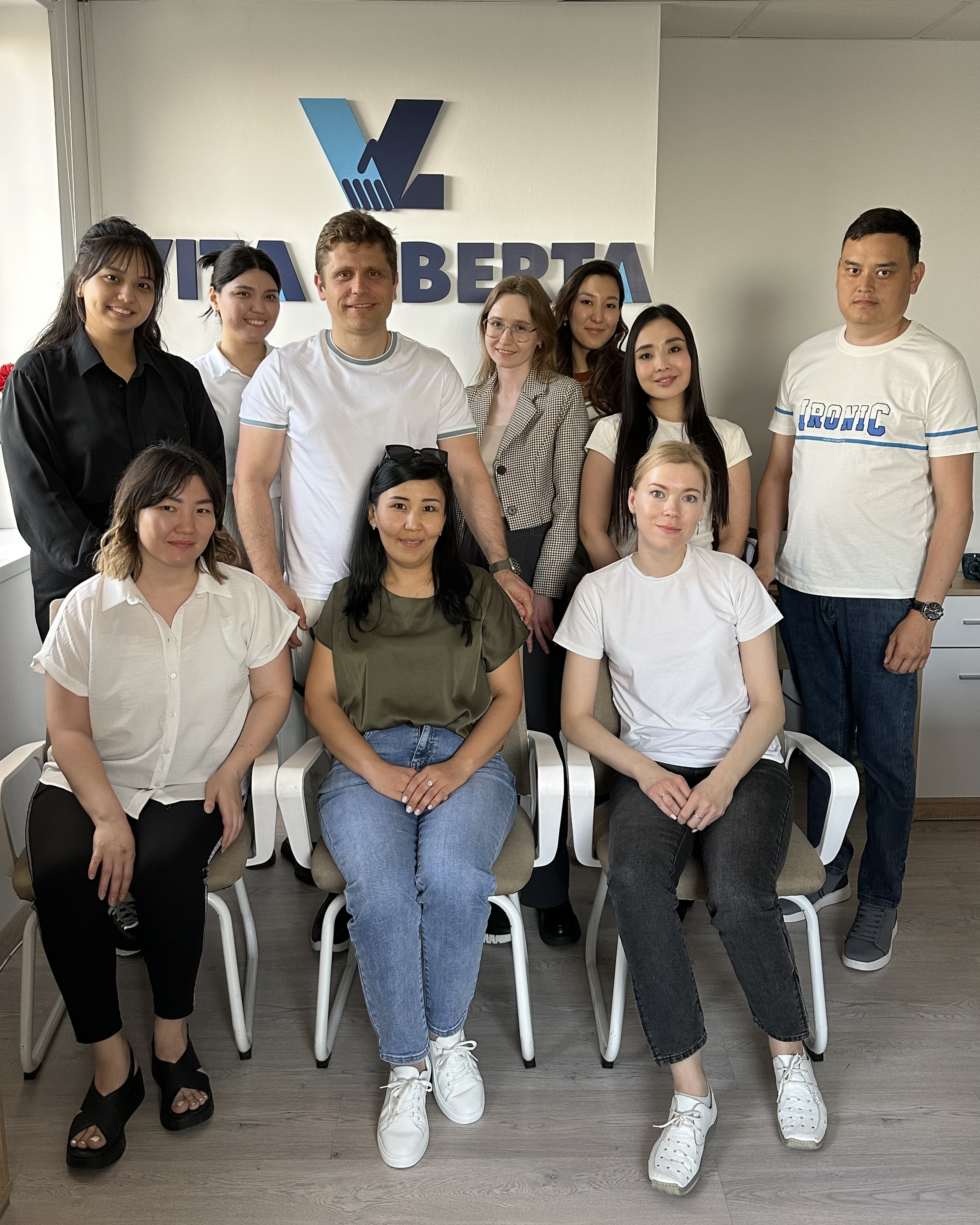
Professional LLP Registration and Support – We Are Always in Touch
We value teamwork and achieve the highest results by applying an individual approach to each client

Madina
Head of the Legal Department, expert in LLP registration and business support

Aneliya
The chief lawyer is a professional with deep knowledge of Kazakhstani legislation
Education
M. S. Narikbaev KAZGUU University, Master of Laws

Aniya
A lawyer is your reliable assistant in matters of business registration and management
Education
M. S. Narikbaev KAZGUU University, Master of Laws

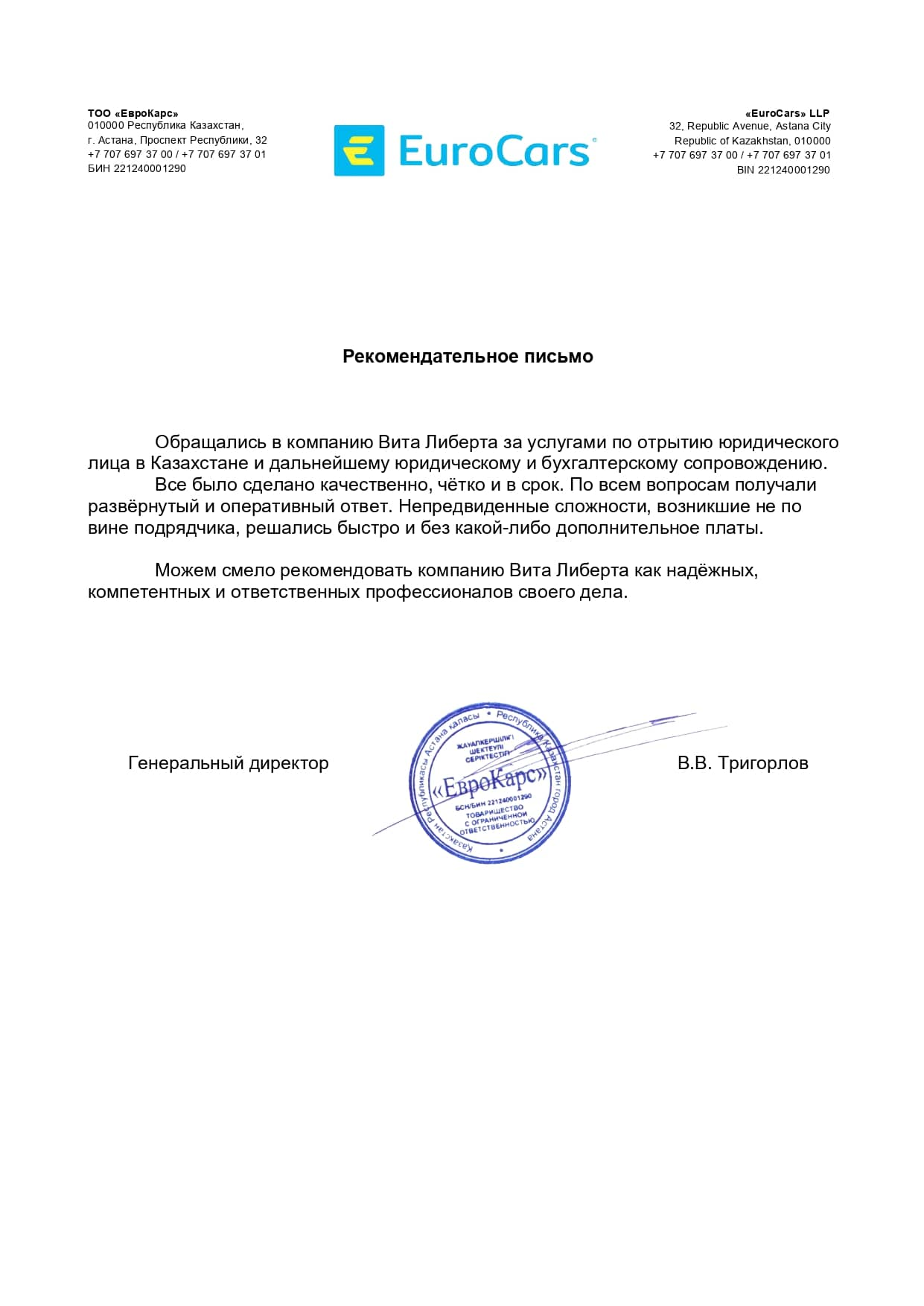
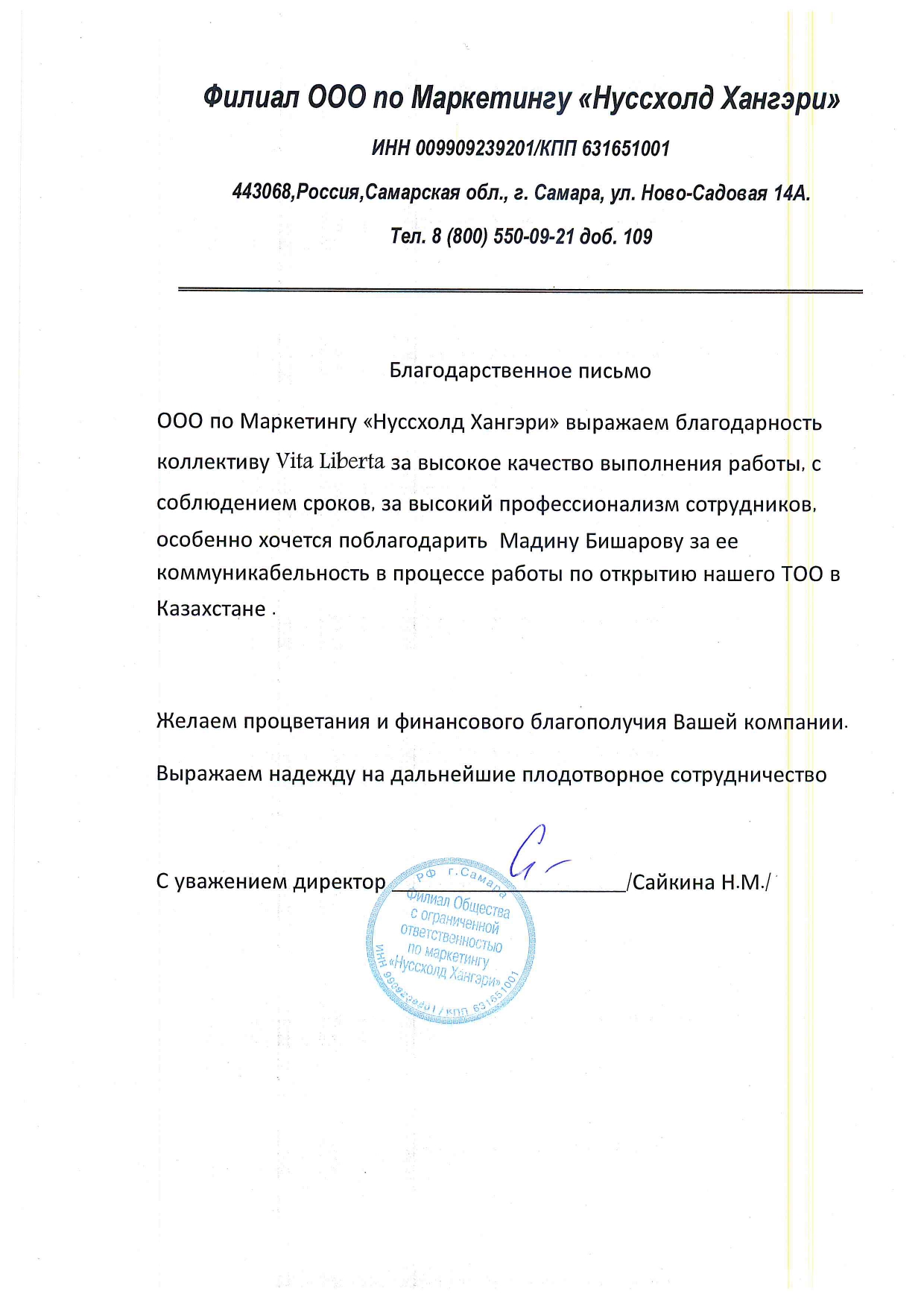
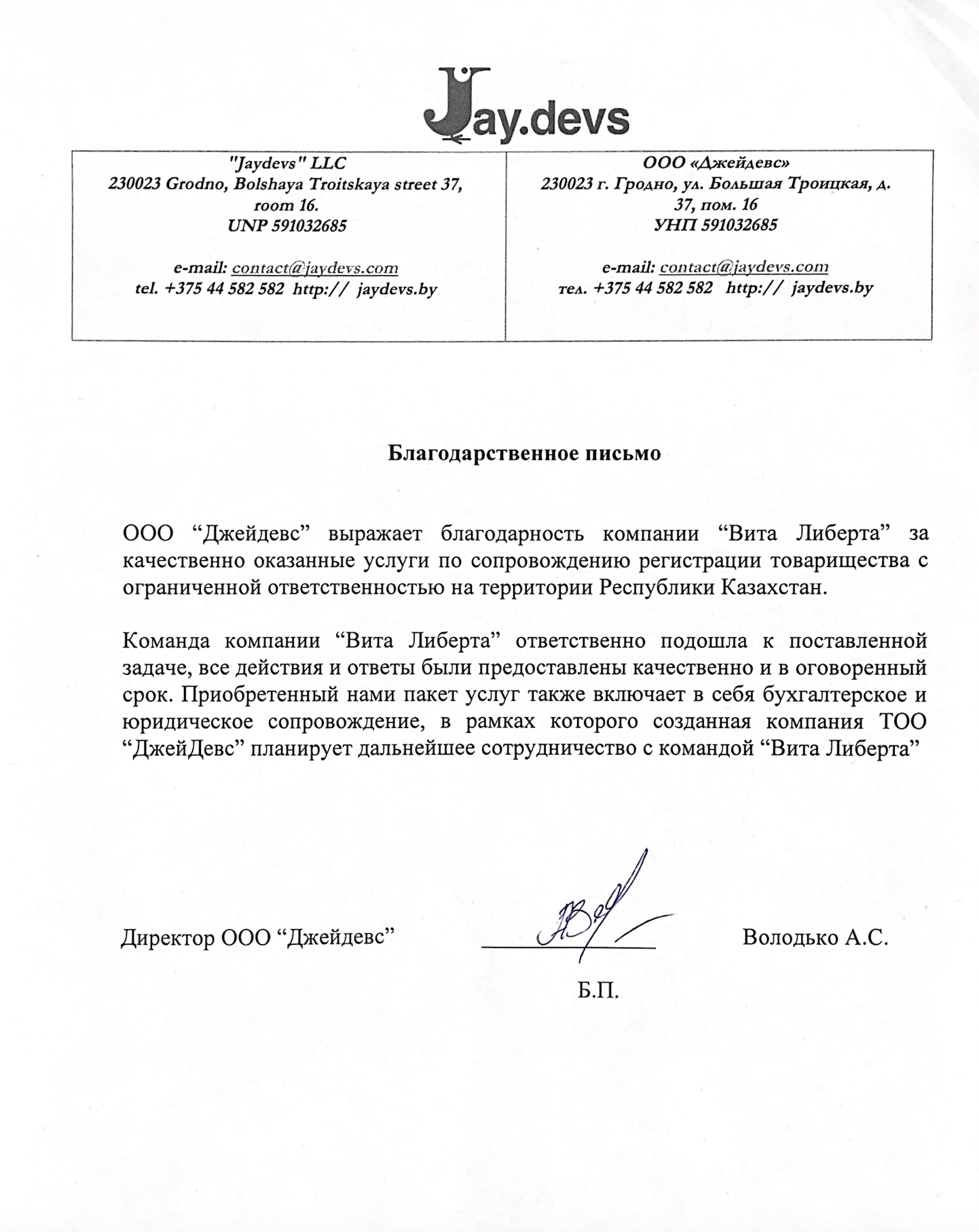
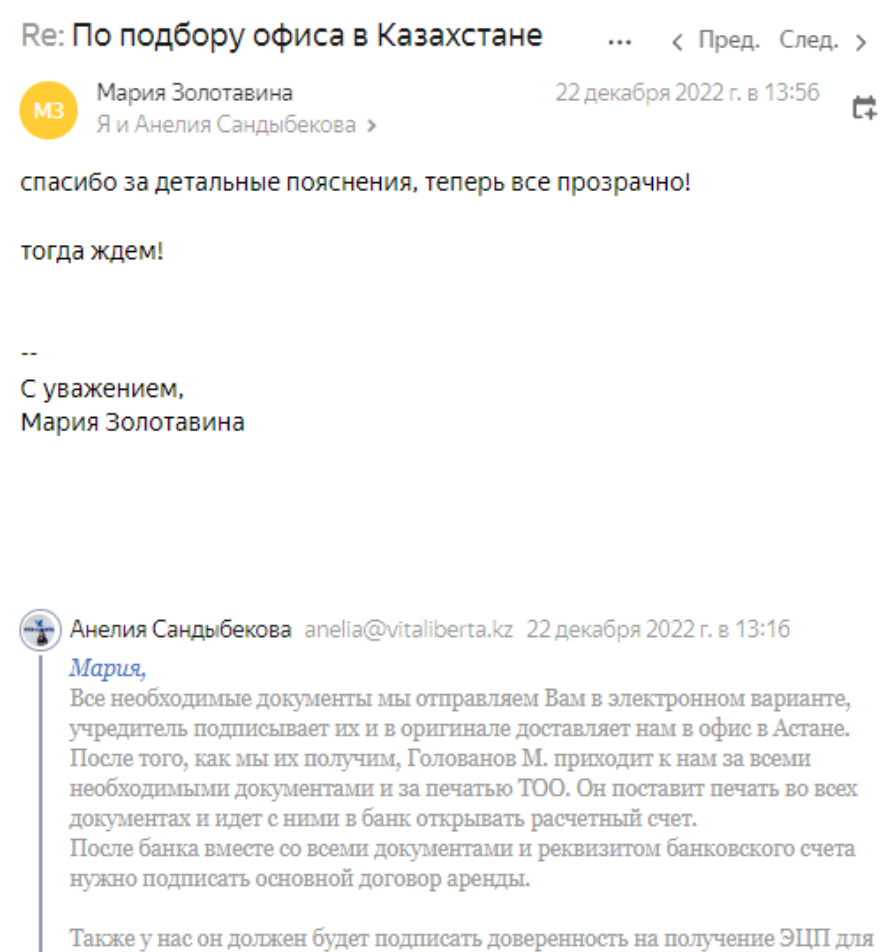
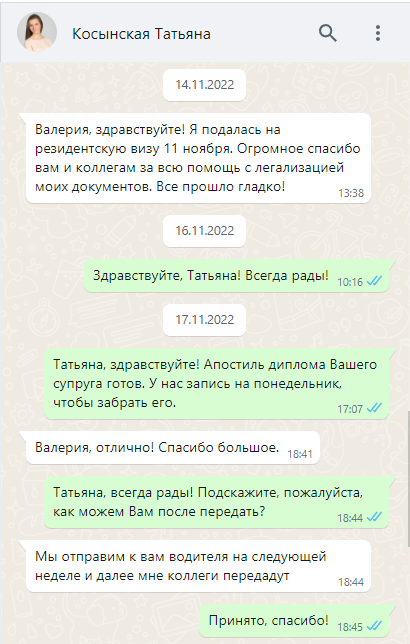
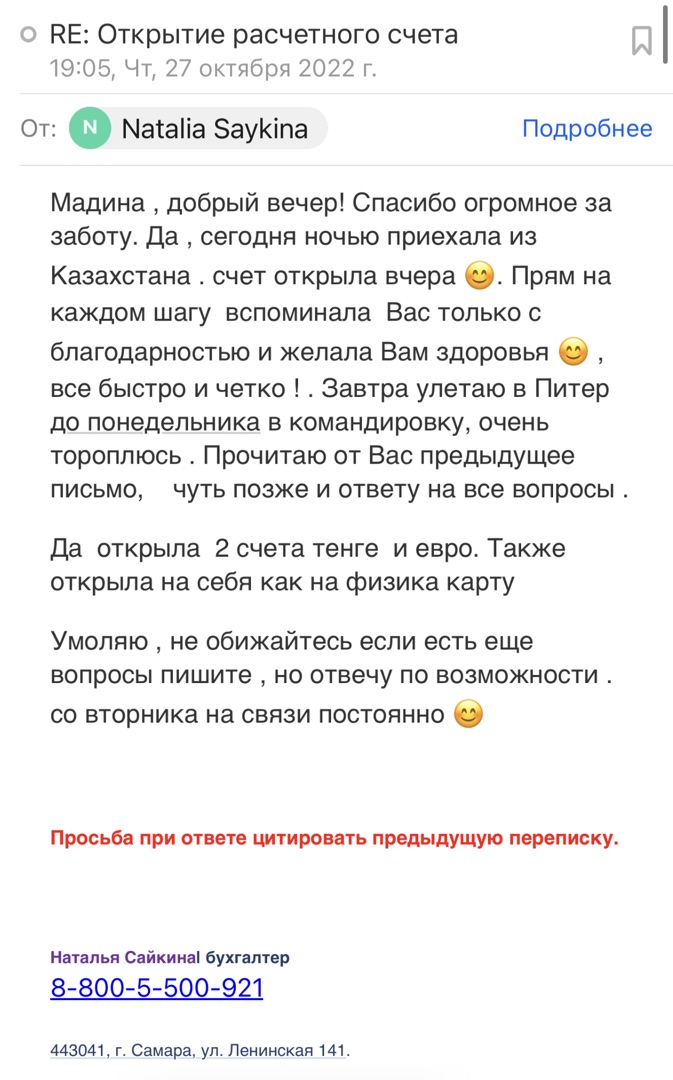
A Satisfied Client's Testimonial

Congratulations from Our Partner Bank

International Women's Day, March 7, 2025

International Women's Day, March 6, 2026

Legal Department Management
Accounting and Legal
Stages of NPO registration
1. Defining goals
The goals of non-profit organizations are defined within the framework stipulated by law
2. Selecting a legal form
Determining the appropriate organizational legal form for an NPO
3. Preparation of documents
Preparation of Decision, Minutes, Charter, and Memorandum of Association. Translation of the Charter into Kazakh
4. Checking the name
Checking the availability of an NPO’s chosen name
5. IIN/BIN, digital signature
Registration and receipt of IIN/BIN, digital signature for directors and founders of legal entities
6. Registration
Preparing and submitting an application for NPO registration. Seal production
7. Bank account
Preparation of documents for opening a bank account
8. Accounting
Setting up 1C, submitting reports. Maintaining separate accounting
9. Legal support
Full legal support for NPO


Answers to frequently asked questions
Non-profit organizations in Kazakhstan: legal status, forms and permissible boundaries of commercial activity
Legal criteria for classification as a non-profit sector
In Kazakhstan, the basic parameters defining a legal entity's status as a non-profit organization are set out in Article 2 of the Law "On Non-Profit Organizations." This provision draws a line of demarcation between entities operating for profit and those whose activities lie elsewhere.
The first criterion is the intended purpose. For nonprofits, generating income is not an end in itself. They are created to address issues of social significance: assisting socially vulnerable groups, promoting education and scientific research, developing culture, philanthropy, protecting civil rights, and performing management or other functions that benefit society or specific categories of citizens.
The second criterion is the use of financial flows. Even if a nonprofit organization generates net income (an excess of revenue over expenses) during its operations, it cannot be divided among its founders or members. All funds and assets at the NPO's disposal must be used solely for the purposes for which it was created.
These two characteristics are inextricably linked and are fundamental both in registration and in subsequent monitoring of the activities of non-profit structures.
Variability of organizational and legal forms
Legislation provides a wide range of options for choosing the form in which an NPO can operate. The most popular options include:
Entrepreneurial activity of non-profit organizations: what is permitted and what is not
There's a common misconception that non-profit organizations are completely exempt from business. In fact, the law allows them to engage in entrepreneurship, but imposes strict conditions.
Thus, a non-profit organization may well conduct business, but it must spend its earnings strictly on the purposes for which it was created. Enriching the founders through entrepreneurial profits is unacceptable for a non-profit organization—this would lead to the loss of its status.
In Kazakhstan, the basic parameters defining a legal entity's status as a non-profit organization are set out in Article 2 of the Law "On Non-Profit Organizations." This provision draws a line of demarcation between entities operating for profit and those whose activities lie elsewhere.
The first criterion is the intended purpose. For nonprofits, generating income is not an end in itself. They are created to address issues of social significance: assisting socially vulnerable groups, promoting education and scientific research, developing culture, philanthropy, protecting civil rights, and performing management or other functions that benefit society or specific categories of citizens.
The second criterion is the use of financial flows. Even if a nonprofit organization generates net income (an excess of revenue over expenses) during its operations, it cannot be divided among its founders or members. All funds and assets at the NPO's disposal must be used solely for the purposes for which it was created.
These two characteristics are inextricably linked and are fundamental both in registration and in subsequent monitoring of the activities of non-profit structures.
Variability of organizational and legal forms
Legislation provides a wide range of options for choosing the form in which an NPO can operate. The most popular options include:
- Institutions (public or private) are formed by the owner to carry out specific non-commercial functions and are usually financed by him in whole or in part.
- Public associations are created on the initiative of citizens on a voluntary basis, united for the joint implementation of common goals.
- Foundations are non-membership organizations formed through voluntary property contributions and operating in social, charitable, cultural, or other socially beneficial areas.
- Consumer cooperatives and religious associations.
- Associations (unions) are unions of legal entities created to coordinate their efforts and protect common interests.
- Non-profit joint-stock companies, as well as other forms, if they are expressly provided for by the legislative acts of the Republic of Kazakhstan.
Entrepreneurial activity of non-profit organizations: what is permitted and what is not
There's a common misconception that non-profit organizations are completely exempt from business. In fact, the law allows them to engage in entrepreneurship, but imposes strict conditions.
- Firstly, the business an NPO engages in must be aligned with its statutory goals and contribute to their achievement. This means that entrepreneurial activity cannot be self-sufficient—it is merely a tool for realizing the organization's mission.
- Secondly, all income received from such activities must be used for statutory purposes. The founders or members of the NPO are not allowed to distribute these funds among themselves—they must remain within the organization and be used for its development and the fulfillment of its stated functions.
Thus, a non-profit organization may well conduct business, but it must spend its earnings strictly on the purposes for which it was created. Enriching the founders through entrepreneurial profits is unacceptable for a non-profit organization—this would lead to the loss of its status.
Tax regime for non-profit organizations in Kazakhstan: features of 2026
Non-profit organizations occupy a special place in the tax system of the Republic of Kazakhstan. Legislation offers them preferential tax treatment, but only under strict compliance with certain conditions.
Who can apply for preferential treatment?
The Tax Code establishes clear criteria that an organization must meet to qualify for special tax treatment. Failure to comply automatically disqualifies the NPO from receiving tax benefits.
Mandatory conditions:
Income not subject to taxation
Subject to the above conditions, the following types of income are excluded from the total annual income of the NPO:
- grants (both international and domestic);
- charitable assistance;
- sponsorship support;
- donations from individuals and legal entities;
- other property received free of charge.
Important: gratuitous receipt must be formalized by appropriate agreements, and the intended use of the funds received must be documented.
Taxation of commercial activities
If an NPO, in addition to its main activities, carries out entrepreneurial activities, such income is subject to corporate income tax in accordance with the generally established procedure.
- income exempt from taxation and expenses incurred within the framework of statutory non-commercial activities.
The lack of separate accounting deprives NPOs of the right to benefits for non-commercial income and may lead to additional tax assessments.
Property taxes: special rates
Non-profit organizations are entitled to reduced rates on property and land taxes.
Risks and controversial situations
In practice, tax authorities may make claims against non-profit organizations on the following grounds:
Recommendations for tax security of non-profit organizations
Conclusion
The tax regime for non-profit organizations in Kazakhstan offers significant benefits, but requires strict adherence to established conditions. Tax exemptions on membership fees, grants, donations, and deposit remuneration, as well as reduced property tax rates, create favorable conditions for activities in the public interest.
However, any deviation from the rules (commercial activity without separate accounting, misuse of funds, actual distribution of income) may result in the loss of benefits and additional tax assessments. Therefore, proper accounting and documentary evidence of all transactions are essential for the safe operation of non-profit organizations within the legal framework of Kazakhstan.
Who can apply for preferential treatment?
The Tax Code establishes clear criteria that an organization must meet to qualify for special tax treatment. Failure to comply automatically disqualifies the NPO from receiving tax benefits.
Mandatory conditions:
- Organizational and legal form - an NPO must be registered in one of the forms provided for by the Law "On Non-Commercial Organizations" (public association, foundation, institution, association, etc.);
- Targeted activity orientation - the organization's work must meet public interests (social sphere, culture, education, science, charity, protection of rights, etc.);
- Absence of commercial purpose - the NPO does not set income generation as the main goal of its activities;
- Profit distribution ban - any income received by the organization cannot be distributed among the founders, participants, or employees.
Income not subject to taxation
Subject to the above conditions, the following types of income are excluded from the total annual income of the NPO:
- Entry and membership fees. Funds paid by members upon joining and during their membership period are not subject to corporate income tax. The main condition is that such fees must be provided for in the charter and used for statutory purposes.
- grants (both international and domestic);
- charitable assistance;
- sponsorship support;
- donations from individuals and legal entities;
- other property received free of charge.
Important: gratuitous receipt must be formalized by appropriate agreements, and the intended use of the funds received must be documented.
- Deposit interest. If a nonprofit places temporarily idle funds in bank deposits, the interest earned is also tax-exempt. This encourages organizations to preserve and grow their assets.
- Income from state social procurement. Funds received from the state for the implementation of socially significant programs and services are also excluded from the tax base.
Taxation of commercial activities
If an NPO, in addition to its main activities, carries out entrepreneurial activities, such income is subject to corporate income tax in accordance with the generally established procedure.
- The tax rate is 20% of taxable income received from commercial activities.
- Separate accounting is a mandatory requirement. An organization is required to maintain separate accounting for:
- income exempt from taxation and expenses incurred within the framework of statutory non-commercial activities.
The lack of separate accounting deprives NPOs of the right to benefits for non-commercial income and may lead to additional tax assessments.
Property taxes: special rates
Non-profit organizations are entitled to reduced rates on property and land taxes.
- Property tax – a rate of 0.1% of the average annual value of taxable assets is applied. This is significantly lower than the standard rates established for commercial organizations.
- Land tax – a reduction factor of 0.1 is applied to the calculated tax amount. In practice, non-profit organizations pay only 10% of the calculated land tax amount.
Risks and controversial situations
In practice, tax authorities may make claims against non-profit organizations on the following grounds:
- Misuse of funds. If received grants or donations are spent for purposes inconsistent with the charter, the tax authority may recognize them as taxable income.
- Lack of separate accounting. If a non-profit organization is engaged in commercial activities and has no separate accounting system, the tax authority has the right to recalculate all of its income as taxable.
- Actual distribution of income. If an audit reveals that the NPO's income was actually distributed among its founders or employees (for example, through inflated salaries or other payments), the organization may be stripped of its NPO status for tax purposes.
- Formal compliance with criteria. If the statutory objectives are not supported by actual activities, the tax authority may recognize the organization as a commercial entity that is using tax benefits without justification.
Recommendations for tax security of non-profit organizations
- Document the intended use of funds. All receipts and expenses must be supported by contracts, certificates, and reports on their intended use.
- Maintain separate accounting as soon as necessary. If an NPO receives any income other than exempt income or uses its property for commercial purposes, separate accounting must be established from day one.
- Monitor compliance with statutory objectives. Periodically verify that all organizational operations are consistent with the stated objectives.
- Reflect changes promptly. When new activities emerge, the income structure changes, or the use of assets changes, make appropriate adjustments to your accounting policies and system.
Conclusion
The tax regime for non-profit organizations in Kazakhstan offers significant benefits, but requires strict adherence to established conditions. Tax exemptions on membership fees, grants, donations, and deposit remuneration, as well as reduced property tax rates, create favorable conditions for activities in the public interest.
However, any deviation from the rules (commercial activity without separate accounting, misuse of funds, actual distribution of income) may result in the loss of benefits and additional tax assessments. Therefore, proper accounting and documentary evidence of all transactions are essential for the safe operation of non-profit organizations within the legal framework of Kazakhstan.
The legal landscape of the non-profit sector in Kazakhstan
Non-profit organizations operate in a unique legal environment. Here, general civil law norms intertwine with industry-specific regulations, creating a complex yet internally coherent system. Understanding this system requires not only familiarity with the texts of laws but also the ability to recognize the connections between them, as well as an understanding of how different levels of regulation interact in real-world practice.
Three-tier architecture of legal regulation
The legal framework for NPOs in Kazakhstan can be represented as a three-tiered structure, where each tier performs its own function and has its own logic.
Law "On Non-Commercial Organizations": the function of the system integrator
Law No. 142-II, adopted on January 16, 2001, serves as a universal regulator in this system. Its key feature is its framework nature. It does not attempt to encompass everything and describe every possible situation, but rather creates a conceptual framework within which various organizational forms can coexist.
What exactly does this law do?
Special legislation: zone of differentiation
Laws on specific types of NPOs address a different issue. While the basic law creates a unified framework, specific acts introduce necessary distinctions.
Let's take, for example, three different types of NPOs:
Associations and unions: a hybrid form
Associations and unions of legal entities occupy a special place. This hybrid form lies at the intersection of commercial and non-commercial law.
On the one hand, they are created by commercial organizations and can defend their economic interests. On the other hand, they are themselves non-profit organizations and do not distribute profits among their members.
This duality creates interesting legal consequences. For example, an association can lobby for business interests while still enjoying tax breaks provided to non-profits. This creates potential risks and requires legislators to fine-tune legal regulation.
Non-obvious mechanisms: what remains outside the law
In addition to explicit legal regulation, there are hidden mechanisms that influence the activities of NPOs.
Legal reality: how it works in practice
For a truly operating NPO, knowledge of the structure of legislation is not an academic exercise, but a practical necessity.
When creating an organization, it's important to understand the legal requirements for the chosen form. Once registered, know how to report to the state and what benefits are available. When starting a new business, check whether any additional regulations will be required.
It's especially important to understand the hierarchy of norms. In the event of a conflict between a general and a specific law, the specific law takes precedence. However, this rule only applies if the specific law actually regulates the issue at hand, and doesn't merely allude to it.
Dynamics of Change: Where Regulation is Heading
The legal framework for NPOs is not static. Several trends in its development can be identified.
Resume
For those actually working in or interacting with the nonprofit sector, it's important to understand a few key points:
Three-tier architecture of legal regulation
The legal framework for NPOs in Kazakhstan can be represented as a three-tiered structure, where each tier performs its own function and has its own logic.
- The first level is constitutional and sectoral. The Constitution sets the direction, while the Civil Code forms the basic matrix of legal personality. Fundamental parameters are defined here: what a legal entity is, what rights it has, how it is created and terminated. This is the level of universal rules applicable to all organizations without exception.
- The second level is the framework and coordinating one. The Law "On Non-Commercial Organizations" acts as a system integrator. It doesn't delve into the details of each form, but it creates a unified conceptual framework and establishes general principles and rules of the game for the entire non-profit sector.
- The third level is sector-specific. This level contains laws regulating specific types of non-profit organizations: public associations, trade unions, religious organizations, foundations, and others. This level ensures the necessary differentiation, taking into account the specifics of various areas of activity.
Law "On Non-Commercial Organizations": the function of the system integrator
Law No. 142-II, adopted on January 16, 2001, serves as a universal regulator in this system. Its key feature is its framework nature. It does not attempt to encompass everything and describe every possible situation, but rather creates a conceptual framework within which various organizational forms can coexist.
What exactly does this law do?
- Establishing exclusive purpose. The law clearly states that nonprofits are created to achieve socially beneficial goals. This is not just a declaration, but a legally significant criterion that allows us to distinguish genuine nonprofit organizations from those that merely masquerade as such.
- Establishing a ban on profit distribution. This is perhaps the most stringent and unambiguous criterion for nonprofit organizations. If an organization receives income but distributes it among its members, it is automatically removed from the nonprofit category, regardless of its stated goals.
- Defining the governance structure. The law sets minimum corporate governance standards mandatory for all non-profit organizations. This is important to ensure the organizations' transparency and accountability to their members and society.
- Formulating rules for interaction with the state. The law establishes how the state can support NPOs and how to monitor their activities. This is an area of potential conflict of interest, and its clear regulation is critical.
Special legislation: zone of differentiation
Laws on specific types of NPOs address a different issue. While the basic law creates a unified framework, specific acts introduce necessary distinctions.
Let's take, for example, three different types of NPOs:
- A public association is built on membership and self-governance. Its logic is horizontal connections, voluntary participation, and collective decision-making. The Law on Public Associations enshrines this logic, emphasizing member rights and democratic procedures.
- A foundation has no membership. Its logic is different—it is a mechanism for accumulating funds to achieve specific goals. Here, the rights of participants are not as important as the intended use of assets and oversight of the managers' activities. The law on foundations reflects this specificity.
- A religious association is based on a shared faith. Here, other values take precedence—freedom of religion, the ability to perform religious rites, and the protection of the feelings of believers. Accordingly, legal regulation is built around these priorities.
Associations and unions: a hybrid form
Associations and unions of legal entities occupy a special place. This hybrid form lies at the intersection of commercial and non-commercial law.
On the one hand, they are created by commercial organizations and can defend their economic interests. On the other hand, they are themselves non-profit organizations and do not distribute profits among their members.
This duality creates interesting legal consequences. For example, an association can lobby for business interests while still enjoying tax breaks provided to non-profits. This creates potential risks and requires legislators to fine-tune legal regulation.
Non-obvious mechanisms: what remains outside the law
In addition to explicit legal regulation, there are hidden mechanisms that influence the activities of NPOs.
- Judicial interpretation. Legislative provisions acquire their true meaning only through their interpretation by the courts. The same legal provision may be applied differently depending on established judicial practice.
- Subordinate legislation. Details of procedures are often regulated not by laws, but by acts of ministries and agencies. This is where subtle requirements that significantly impact organizations' operations can be hidden.
- Law enforcement practices of government agencies. How tax authorities or justice agencies understand and apply the law is often more important than the text of the law itself. Informal standards of conduct are formed that NPOs are forced to adhere to.
- International obligations. Kazakhstan is a party to international treaties that may impose additional obligations or grant additional rights in the area of NPO regulation.
Legal reality: how it works in practice
For a truly operating NPO, knowledge of the structure of legislation is not an academic exercise, but a practical necessity.
When creating an organization, it's important to understand the legal requirements for the chosen form. Once registered, know how to report to the state and what benefits are available. When starting a new business, check whether any additional regulations will be required.
It's especially important to understand the hierarchy of norms. In the event of a conflict between a general and a specific law, the specific law takes precedence. However, this rule only applies if the specific law actually regulates the issue at hand, and doesn't merely allude to it.
Dynamics of Change: Where Regulation is Heading
The legal framework for NPOs is not static. Several trends in its development can be identified.
- Trend one: unification. Legislators strive to create uniform standards for all NPOs in terms of reporting, transparency, and accountability.
- Trend two: differentiation. Alongside unification, there's a process of establishing special regimes for specific types of activity.
- Trend three: digitalization. Registration procedures, reporting, and interactions with government agencies are gradually being converted to electronic format.
- Trend four: Harmonization with international law. Legislation is adapting to international standards, which is important for the integration of NPOs into global processes.
Resume
For those actually working in or interacting with the nonprofit sector, it's important to understand a few key points:
- There is no single law for all NPOs. The legal status of a specific organization depends on its legal form and type of activity.
- General rules apply unless specific ones exist. Before applying the provisions of the basic law, it is necessary to check whether there is a specific rule in the sectoral act.
- The law is just the tip of the iceberg. Actual regulation includes judicial practice, bylaws, and law enforcement traditions.
- The legal landscape is changing. What worked yesterday may no longer work tomorrow. Monitoring these changes is essential for successful operation.
The goals of creating a non-profit organization
According to the legislation of the Republic of Kazakhstan, non-profit organizations are a special category of legal entities focused on achieving socially significant results. Their activities do not pursue profit as their primary objective, and all funds received are used exclusively for achieving their statutory goals.
Social mission and areas of work
Nonprofits operate in areas where commercial interests give way to social necessity. Their key areas of activity include:
Goal setting and legal basis
The constituent documents (charter or bylaws) detail the objectives of a specific organization. Depending on its form and focus, these objectives may include:
Social mission and areas of work
Nonprofits operate in areas where commercial interests give way to social necessity. Their key areas of activity include:
- support for education and scientific research;
- development of culture and implementation of creative projects;
- charity and assistance to socially vulnerable groups;
- protecting public health and promoting a healthy lifestyle;
- promoting physical culture and mass sports.
Goal setting and legal basis
The constituent documents (charter or bylaws) detail the objectives of a specific organization. Depending on its form and focus, these objectives may include:
- legal education and protection of the legitimate interests of citizens;
- provision of free legal aid (legal clinics, consultation centers);
- assistance in pre-trial settlement of disputes and conflicts;
- implementation of public initiatives aimed at improving the quality of life of the local community.
Powers of non-profit organizations under the legislation of Kazakhstan
To implement their mission and achieve the goals set out in their founding documents, non-profit organizations are granted a wide range of rights that ensure their full functioning as entities in legal relations.
Property and organizational bases of activity
Rights in the field of civil circulation and management
Financial and procedural aspects
Limits of Legal Capacity: This list of powers is not exhaustive. An NPO may perform any actions not prohibited by current legislation, provided they serve the achievement of its statutory goals and comply with the general principles of law and order.
Property and organizational bases of activity
- Financial infrastructure: NPOs can open bank accounts in accordance with the regulatory requirements of the National Bank of the Republic of Kazakhstan.
- Legal entity attributes: The organization is permitted to use a seal, stamps, and letterhead indicating its full name in both Kazakh and Russian. An emblem or other officially registered symbol is also permitted.
- Property base: The law secures for non-profit organizations the right to own separate property (by right of ownership or operational management) and to maintain an independent balance sheet or budget.
Rights in the field of civil circulation and management
- Exercise of legal capacity: Non-profit organizations may, in their own name, acquire and exercise both property and personal non-property rights (for example, enter into contracts, receive grants, and act as intellectual property owners).
- Structural development : The creation of other legal entities is permitted (unless restrictions are established by the relevant law), as well as the opening of branches and representative offices.
- Cooperation: NPOs have the right to integrate into associations and unions, participating in their activities and forming partnership networks.
Financial and procedural aspects
- Targeted use of resources: Received funds are used exclusively for the implementation of statutory provisions - this is both the right and the obligation of the organization.
- Judicial protection: The organization is granted the right to act in proceedings as a plaintiff or defendant, defending its legal interests.
Limits of Legal Capacity: This list of powers is not exhaustive. An NPO may perform any actions not prohibited by current legislation, provided they serve the achievement of its statutory goals and comply with the general principles of law and order.
Choosing a Non-Profit Form in Kazakhstan: What Founders Need to Know
When establishing a non-profit organization, a key step is determining its legal form. Kazakhstani law offers several options, each with its own specifics: management procedures, sources of income, permitted activities, and the degree of liability of participants.
Overview of available forms
General principles common to all forms
Despite the differences, all non-profit organizations in Kazakhstan are subject to uniform rules:
Overview of available forms
- An institution . It is created by an owner (a private individual or the state) to fulfill specific objectives—educational, cultural, or administrative. Funding is provided by the founder, and the property is assigned to the institution under a limited property right.
- A public association. Based on the voluntary participation of citizens united by common interests. Characterized by membership, self-governance, and democratic decision-making principles.
- Non-profit joint-stock company (NAO). A rare hybrid: formally a joint-stock company, it doesn't pay dividends to shareholders—all profits go toward development. There are legal restrictions: NAOs are not allowed to issue preferred shares or securities convertible into common shares.
- Consumer cooperative. An association of citizens (less commonly, legal entities) based on equity participation to meet members' needs for goods, services, or housing. Income from the cooperative is distributed among members proportionally to their participation, but this option must be expressly provided for in the charter.
- The Foundation . It has no membership, is created through voluntary property contributions, and operates for socially beneficial purposes: charity, support of science, culture, and education. The Foundation is governed by a board of trustees.
- A religious association. It is created by citizens for the purpose of sharing faith, disseminating doctrine, and performing religious rituals. It operates on the basis of religious canons and legislation.
- An association (union). An association of commercial or non-profit organizations to coordinate their activities and represent and protect their common interests. Members retain complete independence.
General principles common to all forms
Despite the differences, all non-profit organizations in Kazakhstan are subject to uniform rules:
- their activities are not aimed at making a profit as their main goal;
- If income is received, it is not distributed among the participants, but is used for statutory purposes;
- Entrepreneurship is allowed, but only as a means of achieving the main mission.
Requirements for the name of non-profit organizations in Kazakhstan
When establishing a non-profit organization (NPO) in Kazakhstan, the choice of name is subject to strict legal regulations. The name must not only identify the organization but also comply with the requirements established by the Civil Code, the Law "On Non-Profit Organizations," and special laws for certain types of NPOs.
General requirements and restrictions
According to Article 7 of the Law "On Non-Commercial Organizations" and Article 38 of the Civil Code of the Republic of Kazakhstan, the name of an NPO must include an indication of its organizational and legal form and the organization's name. The following mandatory restrictions apply when choosing a name:
Inadmissibility of contradiction with law and morality
The use of names that violate legal requirements or public morality is prohibited. This provision is of an evaluative nature and is applied by the registration authority during verification.
Use of names of individuals
The inclusion of proper names in a title is permitted only in two cases:
The principle of uniqueness (inadmissibility of duplication)
The name of an NPO must not fully or substantially coincide with the name of other legal entities already registered in the Republic of Kazakhstan. This requirement is aimed at preventing confusion between organizations and misleading third parties. Additionally, according to paragraph 3 of Article 1020 of the Civil Code of the Republic of Kazakhstan, it is prohibited to use a company name that is confusingly similar to an existing one if this could lead to confusion between the organizations or mislead consumers.
Prohibition on naming government agencies
Legal entities that are not government bodies are prohibited from using in their names the official names of government bodies of the Republic of Kazakhstan established by legislative acts, acts of the President and the Government of the Republic of Kazakhstan.
Special requirements for public associations
For such a form of NPO as a public association, Article 18 of the Law “On Public Associations” establishes additional restrictions:
The full and abbreviated name of a public association, as well as its symbols, must not completely or in significant part duplicate:
Practical recommendations for choosing a name
Taking into account the stated requirements, when developing the name of an NPO, it is recommended:
General requirements and restrictions
According to Article 7 of the Law "On Non-Commercial Organizations" and Article 38 of the Civil Code of the Republic of Kazakhstan, the name of an NPO must include an indication of its organizational and legal form and the organization's name. The following mandatory restrictions apply when choosing a name:
Inadmissibility of contradiction with law and morality
The use of names that violate legal requirements or public morality is prohibited. This provision is of an evaluative nature and is applied by the registration authority during verification.
Use of names of individuals
The inclusion of proper names in a title is permitted only in two cases:
- if the name coincides with the name of one of the participants (founders) of the organization;
- if written permission has been received from the person himself or his heirs to use the name.
The principle of uniqueness (inadmissibility of duplication)
The name of an NPO must not fully or substantially coincide with the name of other legal entities already registered in the Republic of Kazakhstan. This requirement is aimed at preventing confusion between organizations and misleading third parties. Additionally, according to paragraph 3 of Article 1020 of the Civil Code of the Republic of Kazakhstan, it is prohibited to use a company name that is confusingly similar to an existing one if this could lead to confusion between the organizations or mislead consumers.
Prohibition on naming government agencies
Legal entities that are not government bodies are prohibited from using in their names the official names of government bodies of the Republic of Kazakhstan established by legislative acts, acts of the President and the Government of the Republic of Kazakhstan.
Special requirements for public associations
For such a form of NPO as a public association, Article 18 of the Law “On Public Associations” establishes additional restrictions:
The full and abbreviated name of a public association, as well as its symbols, must not completely or in significant part duplicate:
- name and symbols of the Republic of Kazakhstan;
- names and symbols of other states;
- names of government agencies;
- names of public associations already registered in the Republic of Kazakhstan;
- names of public associations that were liquidated due to violation of the legislation of the Republic of Kazakhstan.
Practical recommendations for choosing a name
Taking into account the stated requirements, when developing the name of an NPO, it is recommended:
- Check the uniqueness of the name through open registries of justice agencies to exclude complete or significant overlap with already registered organizations.
- When using the name of an individual, prepare the appropriate written permission (especially if we are talking about famous people or their heirs).
- Public associations should avoid including words and phrases that may be associated with state symbols or official names of the state and its bodies.
- Including a clear indication of the legal form of the organization in the name (for example, “Public Association,” “Foundation,” “Institution”) is a mandatory requirement.
The Anatomy of Nonprofits: Freedom Within Boundaries
Non-profit organizations in Kazakhstan are a unique ecosystem where social missions meet tax realities, and charitable impulses are framed within strict legal frameworks. Imagine an iceberg: its above-water portion represents public activity and high-profile projects, while its underwater portion represents a complex system of legal norms, financial obligations, and bureaucratic procedures that keep the entire structure afloat.
The Anatomy of Nonprofits: Freedom Within Boundaries
Open Fan Principle
Kazakhstani legislation offers NPOs a surprising perspective: an organization can engage in virtually anything, as long as that "anything" isn't prohibited by law and is specified in its charter. It's like an open-ended spectrum of possibilities—you can expand it as far as your founding documents allow, and eliminate those sectors that aren't currently relevant.
Imagine an NPO's charter as a canvas, and its activities as paints. The law doesn't dictate what colors to use, but it does require that the final painting match the artist's original intention. If an organization was founded to protect homeless animals, it can't suddenly start building shopping malls—that would be a different canvas.
The organizational and legal form is like the DNA of every NPO—its own genetic blueprint. Foundations are created to accumulate and distribute funds, like financial donors to public initiatives. Public associations are the voices of collective will, mouthpieces for groups of citizens united by common interests. Religious organizations exist within the realm of faith and cannot engage in commercial activities as freely as consumer cooperatives.
It's as if the legislator assigned different types of toys to different rooms: foundations received spotlights and megaphones (to highlight issues), public associations received a conference table, and religious organizations received candles and books. Toys can be exchanged, but only if doing so doesn't violate the rules of the room.
Licensing corridor
Some activities resemble closed doors with a sign that says "Professionals Only." Education, medicine, and social services—in these areas, NPOs are required to present a license as a pass to enter a high-security zone. This isn't a whim of the state, but a way to protect those on the other side of the service: patients, students, and beneficiaries.
Entrepreneurship in a Nonprofit Package: The Alchemy of Transforming Profit into Mission
Commerce as Service
A nonprofit organization engaged in business is an oxymoron that has become reality. The law resolves this paradox, but with one condition: profit must not be a reward for the founders, but rather the fuel for the organization's statutory activities.
Think of old watermills: the force of the current (commercial activity) turns the wheel, but the energy is spent not on enjoying the rotation, but on grinding the grain (achieving the statutory goals). If the mill starts grinding air, the structure will collapse.
Two accounting departments in one head
The law requires nonprofits to maintain a split identity in their accounting. Commercial income and targeted donations must be kept in separate apartments, even if both are located in the same building. This isn't schizophrenia, but a way to maintain transparency: the tax office needs to see that grant money isn't commingled with revenue from paid seminars, and that sponsorship funds aren't ending up in the founders' pockets.
Imagine you're keeping a diary, but you use different inks to record events from different lives. Red ink for the target story, blue for the business one. The reader (the tax inspector) should be able to easily distinguish between the two.
The Forbidden Fruit of Dividends
The most important taboo for nonprofits is the distribution of profits among their members. This is the red line that separates the nonprofit sector from the commercial one. Proceeds can be used for rent, salaries, equipment, and charity, but not for the founders' pockets.
Public associations and foundations can donate money to charitable causes—this is the only way for funds to leave the organization without leaving a statutory trace. But even here, there are limits: assistance must be targeted and documented.
2026: A Tax Crossroads for NPOs
Invisible income: what can be hidden from taxes?
The 2026 Tax Code retained the right of non-profit organizations to "invisible income"—receipts that are not taxable if the rules are followed. It's like magic: the money is there, but the tax authorities don't see it.
The invisible category includes:
Commercial reality: 20% without discounts
Anything not classified as invisible is subject to the full corporate income tax rate of 20%. Paid services, the sale of goods, and the rental of property—in these cases, NPO status does not provide any leniency.
However, the legislator left some leeway in choosing the method for accounting for expenses. An organization may:
Social benefits: tax amnesty for missionaries
Organizations operating in the social sector (education, culture, healthcare, and support for socially vulnerable groups) can reduce their corporate income tax by 100%. This is not a tax exemption, but rather the right to zero it out by confirming their status.
Imagine the government saying, "You're doing our job—take the tax and spend it on the same thing."
Special status for disabled people's organizations: a double filter. To receive 100% benefits, disabled people's organizations must pass through two sieves:
Turbulence Zones: Where NPOs are Losing Benefits
Tax incentives aren't forever. They vanish like morning fog if an organization makes mistakes:
A navigation map for NPO accountants in 2026
Seven Steps to Tax Security
Epilogue: NPOs as the Art of the Possible
A non-profit organization in Kazakhstan is a complex mechanism where the social mission must be legally sound and its charitable activities documented. It's an art of balancing the desire to help with the need to report, between creative freedom and the strictness of tax regulations.
A successful NPO is like a conductor directing an orchestra of various instruments: legal, financial, and social. Each instrument must sound at the right time and in the right key so that the music (the organization's mission) reaches its listeners ( beneficiaries ) without any false notes.
2026 has added new scores to this orchestra. The accountant's job is to learn them and perform them flawlessly, so that the music sounds pure and the tax office applauds them standing up instead of calling them on the carpet.
The Anatomy of Nonprofits: Freedom Within Boundaries
Open Fan Principle
Kazakhstani legislation offers NPOs a surprising perspective: an organization can engage in virtually anything, as long as that "anything" isn't prohibited by law and is specified in its charter. It's like an open-ended spectrum of possibilities—you can expand it as far as your founding documents allow, and eliminate those sectors that aren't currently relevant.
Imagine an NPO's charter as a canvas, and its activities as paints. The law doesn't dictate what colors to use, but it does require that the final painting match the artist's original intention. If an organization was founded to protect homeless animals, it can't suddenly start building shopping malls—that would be a different canvas.
The organizational and legal form is like the DNA of every NPO—its own genetic blueprint. Foundations are created to accumulate and distribute funds, like financial donors to public initiatives. Public associations are the voices of collective will, mouthpieces for groups of citizens united by common interests. Religious organizations exist within the realm of faith and cannot engage in commercial activities as freely as consumer cooperatives.
It's as if the legislator assigned different types of toys to different rooms: foundations received spotlights and megaphones (to highlight issues), public associations received a conference table, and religious organizations received candles and books. Toys can be exchanged, but only if doing so doesn't violate the rules of the room.
Licensing corridor
Some activities resemble closed doors with a sign that says "Professionals Only." Education, medicine, and social services—in these areas, NPOs are required to present a license as a pass to enter a high-security zone. This isn't a whim of the state, but a way to protect those on the other side of the service: patients, students, and beneficiaries.
Entrepreneurship in a Nonprofit Package: The Alchemy of Transforming Profit into Mission
Commerce as Service
A nonprofit organization engaged in business is an oxymoron that has become reality. The law resolves this paradox, but with one condition: profit must not be a reward for the founders, but rather the fuel for the organization's statutory activities.
Think of old watermills: the force of the current (commercial activity) turns the wheel, but the energy is spent not on enjoying the rotation, but on grinding the grain (achieving the statutory goals). If the mill starts grinding air, the structure will collapse.
Two accounting departments in one head
The law requires nonprofits to maintain a split identity in their accounting. Commercial income and targeted donations must be kept in separate apartments, even if both are located in the same building. This isn't schizophrenia, but a way to maintain transparency: the tax office needs to see that grant money isn't commingled with revenue from paid seminars, and that sponsorship funds aren't ending up in the founders' pockets.
Imagine you're keeping a diary, but you use different inks to record events from different lives. Red ink for the target story, blue for the business one. The reader (the tax inspector) should be able to easily distinguish between the two.
The Forbidden Fruit of Dividends
The most important taboo for nonprofits is the distribution of profits among their members. This is the red line that separates the nonprofit sector from the commercial one. Proceeds can be used for rent, salaries, equipment, and charity, but not for the founders' pockets.
Public associations and foundations can donate money to charitable causes—this is the only way for funds to leave the organization without leaving a statutory trace. But even here, there are limits: assistance must be targeted and documented.
2026: A Tax Crossroads for NPOs
Invisible income: what can be hidden from taxes?
The 2026 Tax Code retained the right of non-profit organizations to "invisible income"—receipts that are not taxable if the rules are followed. It's like magic: the money is there, but the tax authorities don't see it.
The invisible category includes:
- Grants - foreign and domestic, if they are properly executed and spent for their intended purpose.
- Charitable donations are sponsorship contributions that do not become income but rather pass through the organization as a transit.
- Membership fees are the lifeblood of public associations, circulating within the system.
- Deposit fees are the interest that the bank pays for storing targeted funds.
- Payments from homeowners - for cooperatives and housing associations.
Commercial reality: 20% without discounts
Anything not classified as invisible is subject to the full corporate income tax rate of 20%. Paid services, the sale of goods, and the rental of property—in these cases, NPO status does not provide any leniency.
However, the legislator left some leeway in choosing the method for accounting for expenses. An organization may:
- calculate expenses proportionally (the percentage of total income that commerce accounts for is the percentage of expenses that can be attributed to deductions);
- keep separate records (every penny of commercial expenses separately).
Social benefits: tax amnesty for missionaries
Organizations operating in the social sector (education, culture, healthcare, and support for socially vulnerable groups) can reduce their corporate income tax by 100%. This is not a tax exemption, but rather the right to zero it out by confirming their status.
Imagine the government saying, "You're doing our job—take the tax and spend it on the same thing."
Special status for disabled people's organizations: a double filter. To receive 100% benefits, disabled people's organizations must pass through two sieves:
- at least 51% of employees must have a disability;
- Their salary fund must constitute at least 35% of the total payroll.
Turbulence Zones: Where NPOs are Losing Benefits
Tax incentives aren't forever. They vanish like morning fog if an organization makes mistakes:
- Violation of the intended use—the money went to a different destination than promised. It's like using a donation for dog food for homeless dogs to renovate an office. The tax authorities will notice this and assess additional taxes, with all the consequences.
- Lack of documentation—there's a grant, but no paperwork. For the tax authorities, this means there was no grant, just money on which taxes must be paid.
- Accounting chaos—commercial and targeted flows have merged into one river. It's impossible to separate them retroactively.
- Loss of status - an organization for disabled people no longer meets the criteria (someone was fired, someone retired), but continues to receive benefits.
A navigation map for NPO accountants in 2026
Seven Steps to Tax Security
- Step One: Income Inventory
- Step two: Separate accounting as a way of life
- Step Three: Quarterly Status Audit
- Step Four: Documentary Perfectionism
- Step Five: Monitoring Salary Proportions
- Step Six. Archival File
- Step Seven: Monitoring Changes
Epilogue: NPOs as the Art of the Possible
A non-profit organization in Kazakhstan is a complex mechanism where the social mission must be legally sound and its charitable activities documented. It's an art of balancing the desire to help with the need to report, between creative freedom and the strictness of tax regulations.
A successful NPO is like a conductor directing an orchestra of various instruments: legal, financial, and social. Each instrument must sound at the right time and in the right key so that the music (the organization's mission) reaches its listeners ( beneficiaries ) without any false notes.
2026 has added new scores to this orchestra. The accountant's job is to learn them and perform them flawlessly, so that the music sounds pure and the tax office applauds them standing up instead of calling them on the carpet.
Founders of a non-profit organization in Kazakhstan: who has the right to create an NPO according to the law
The creation of a non-profit organization begins with a key step: determining the circle of individuals who will act as founders. The competent authority's decision on registration directly depends on the correct selection of founders and compliance with regulatory requirements for their status.
General characteristics of the subject composition
According to Article 20 of the Law of the Republic of Kazakhstan "On Non-Commercial Organizations" (hereinafter referred to as the Law), two categories of persons may act as founders: individuals (citizens) and legal entities (organizations). The law also permits the establishment of an NPO by both multiple persons and a single founder.
Basic conditions:
Absolute restrictions:
The ban on establishing non-profit organizations applies to individuals involved in financing terrorist activities or proliferation of weapons of mass destruction. This restriction applies regardless of citizenship and applies equally to individuals and legal entities.
Specific requirements for NPO forms
Depending on the organizational and legal form chosen by future founders, the law imposes different requirements on their status and number.
Private institution
Article 10 of the Law stipulates that the founders of a private institution may be individuals or non-governmental legal entities.
Foundation and public foundation
Both individuals and organizations may act as founders of a foundation (Article 12 of the Law). However, an additional requirement has been introduced for public foundations: individual founders must not be related (they cannot be members of the same family). Legal entities must be public associations.
Public association
The most stringent criteria are established for public associations (Articles 11, 19 of the Law):
Foreign founders: limits of legal capacity
An analysis of the legislation allows us to identify the following legal opportunities for foreign participation in the creation of non-profit organizations in Kazakhstan:
Allowed:
Not allowed:
The procedure for verifying founders (legal examination)
The state registration stage of an NPO includes a mandatory legal review conducted by justice authorities. This procedure assesses the founders' compliance with the criteria established by law.
Subject of inspection:
Legal regulation of the composition of founders of NPOs in Kazakhstan is based on a combination of general norms and special requirements differentiated by organizational and legal forms.
Key findings:
Recommendations for those initiating the creation of non-profit organizations:
General characteristics of the subject composition
According to Article 20 of the Law of the Republic of Kazakhstan "On Non-Commercial Organizations" (hereinafter referred to as the Law), two categories of persons may act as founders: individuals (citizens) and legal entities (organizations). The law also permits the establishment of an NPO by both multiple persons and a single founder.
Basic conditions:
- Individuals must have full civil capacity.
- Legal entities must be registered in accordance with the established procedure and not be in the process of liquidation.
- An exception to the single-founder rule applies to consumer cooperatives and associations (unions) – they require multiple members.
Absolute restrictions:
The ban on establishing non-profit organizations applies to individuals involved in financing terrorist activities or proliferation of weapons of mass destruction. This restriction applies regardless of citizenship and applies equally to individuals and legal entities.
Specific requirements for NPO forms
Depending on the organizational and legal form chosen by future founders, the law imposes different requirements on their status and number.
Private institution
Article 10 of the Law stipulates that the founders of a private institution may be individuals or non-governmental legal entities.
- This form does not contain any restrictions on the citizenship of the founders.
- A private institution is optimal for cases where the founder is a foreigner or a foreign company wishing to conduct non-profit activities in the territory of the Republic of Kazakhstan.
Foundation and public foundation
Both individuals and organizations may act as founders of a foundation (Article 12 of the Law). However, an additional requirement has been introduced for public foundations: individual founders must not be related (they cannot be members of the same family). Legal entities must be public associations.
- This requirement excludes the possibility of creating a public fund by spouses, parents and children, and other close relatives.
Public association
The most stringent criteria are established for public associations (Articles 11, 19 of the Law):
- Only citizens of the Republic of Kazakhstan can be founders.
- The minimum number of founders is at least 10 people.
- The creation procedure involves holding a constituent meeting.
Foreign founders: limits of legal capacity
An analysis of the legislation allows us to identify the following legal opportunities for foreign participation in the creation of non-profit organizations in Kazakhstan:
Allowed:
- establishment of a private institution;
- creation of a fund (subject to general rules).
Not allowed:
- establishment of a public association.
The procedure for verifying founders (legal examination)
The state registration stage of an NPO includes a mandatory legal review conducted by justice authorities. This procedure assesses the founders' compliance with the criteria established by law.
Subject of inspection:
- sufficiency of the number of founders for the chosen form of NPO;
- the presence or absence of prohibitions (involvement in terrorism, extremism);
- legal status of the legal entities-founders (whether they are in the process of liquidation);
- compliance of the statutory objectives of the activity with the requirements of the legislation (assessment of the admissibility of the declared types of activity).
Legal regulation of the composition of founders of NPOs in Kazakhstan is based on a combination of general norms and special requirements differentiated by organizational and legal forms.
Key findings:
- For most forms (private institution, foundation), the composition of founders is determined flexibly and may include foreign persons.
- A strict qualification is established for public associations: only citizens of the Republic of Kazakhstan, only collegial composition (at least 10 persons).
- A mandatory step is a compliance check of the founders to ensure their compliance with anti-terrorism and other regulatory legislation.
Recommendations for those initiating the creation of non-profit organizations:
- At the planning stage, determine the organizational and legal form based on the status of future founders.
- If there is foreign participation, choose the form of a private institution or foundation.
- Before submitting documents, conduct an internal check of the founders for potential restrictions (criminal records, connections to prohibited organizations, family ties - for a public foundation).
Conflict of interest in NPOs
Legal regulation of conflicts of interest in non-profit organizations in Kazakhstan is aimed at protecting the organization's property interests and ensuring the transparency of its activities. Below is an analysis of Articles 36 and 37 of the Law.
Concept and scope of application (Article 36)
Article 36 of the Law defines a conflict of interest as a situation arising when transactions are concluded between a non-profit organization and so-called “interested parties.”
Procedure for resolving conflicts of interest and liability (Article 37)
To prevent abuse, the law establishes a clear procedure for approving such transactions and strict liability for violating it.
If a transaction was completed without the required approval and the NPO suffered losses as a result, legal liability will arise.
Concept and scope of application (Article 36)
Article 36 of the Law defines a conflict of interest as a situation arising when transactions are concluded between a non-profit organization and so-called “interested parties.”
- Who is considered an interested party?
- Members of the governing bodies of a non-profit organization.
- Other persons who may influence the disposal of property and (or) income of an NPO.
- When does a conflict of interest arise?
- Direct interest : When the persons listed above participate in a transaction with an NPO as another party (for example, selling it property, receiving a loan).
- Indirect Interest (Presumption of Conflict): A conflict of interest is presumed (i.e., it is assumed to exist until proven otherwise) if the transaction is concluded with persons closely related to the interested party. Such persons include:
- Relatives: spouses, brothers, sisters, parents, children of the interested person.
- Creditors: persons to whom the interested party owes money.
Procedure for resolving conflicts of interest and liability (Article 37)
To prevent abuse, the law establishes a clear procedure for approving such transactions and strict liability for violating it.
- Duty to inform: An interested party is obliged to inform the authorized governing body of the NPO of its interest in the transaction being concluded.
- Mandatory approval: A transaction involving a conflict of interest may only be completed after prior approval by an authorized body of the non-profit organization (e.g., the board of directors, board of trustees, or general meeting).
- Consequences of violation of order:
If a transaction was completed without the required approval and the NPO suffered losses as a result, legal liability will arise.
- For one interested party : It is obliged to compensate the organization for the damages caused in full.
- Special Liability: In addition to compensating for damages, the interested party must return to the non-profit organization all income it received (or should have received) from such a transaction.
- For multiple parties : If multiple parties had an interest in the transaction and its approval, they bear joint and several liability. This means that the NPO has the right to demand compensation for all losses and the return of all income from all violators jointly or from any of them individually.
Registering an NPO in Kazakhstan: A Procedural Guide
The process of establishing a non-profit organization requires not only document preparation but also an understanding of legal nuances. Below is the author's analysis of the key stages, focusing on practical aspects and recent regulatory changes.
1. Choosing a form of activity: from mission to legal status
The first step is to determine the legal form of the future NPO. Article 6 of the Law of the Republic of Kazakhstan "On Non-Commercial Organizations" offers several options:
Important :The chosen form determines not only the statutory objectives, but also taxation, reporting procedures, and the ability to receive grants.
2. Documentary basis: the charter and protocol as a foundation
The creation of a nonprofit begins with the founders' expression of will. This is recorded in the minutes of the founding meeting. Next, the main document—the charter—is developed.
Requirements for the content of the charter are set out in Article 22 of the relevant law. The document must be drafted in both Kazakh and Russian and include:
3. Registration with the justice authorities: what you need to know
The documents are submitted to the Department of Justice at the location of the NPO. The procedure is regulated by the Law "On State Registration of Legal Entities and the Record Registration of Branches and Representative Offices."
Standard set includes :
4. The final stage: printing, counting, frames
After receiving the certificate, you must:
5. Planning Horizon: Legislative Trends to 2026
When creating an NPO, it is important to consider not only current regulations, but also future changes.
Final algorithm of actions
To avoid missing any details, we offer a step-by-step diagram:
1.Formulate the mission and goals of the NPO.
2.Choose organizational and legal form .
3.Develop the charter (and the memorandum of association, if necessary).
4.Hold a constituent meeting and draw up minutes.
5.Prepare a complete package of documents for the justice authorities.
6.Submit documents and wait for registration.
7.Get certificate and BIN.
8.Make seal .
9.Open bank account .
10. Register the manager and get to work.
By following this route and staying up-to-date with legal updates, you can register without complications and establish a solid legal foundation for your organization's operations.
1. Choosing a form of activity: from mission to legal status
The first step is to determine the legal form of the future NPO. Article 6 of the Law of the Republic of Kazakhstan "On Non-Commercial Organizations" offers several options:
| NPO form | For what kind goals fits | Peculiarities management |
|---|---|---|
| Institution | Education , culture , sports | The owner finances and controls the activities |
| Public unification | Protection rights , initiative groups | Voluntary membership , elective organs |
| Fund | Charity, support projects | The property is formed through contributions, there is no membership |
| Association ( union ) | Coordination business or professional participants | Unites legal entities or Sole Proprietors for common purposes |
| Consumer cooperative | Solving household or economic needs | Members are also users of services |
| Non-profit joint-stock company | Large infrastructure or social projects | Shareholders do not receive dividends; profits go towards statutory purposes |
2. Documentary basis: the charter and protocol as a foundation
The creation of a nonprofit begins with the founders' expression of will. This is recorded in the minutes of the founding meeting. Next, the main document—the charter—is developed.
Requirements for the content of the charter are set out in Article 22 of the relevant law. The document must be drafted in both Kazakh and Russian and include:
- full and abbreviated name (the uniqueness of the name is checked by the justice authorities);
- legal address (location of the governing body);
- the subject and purpose of the activity (it is not possible to indicate “any activity not prohibited by law”);
- structure and competence of governing bodies;
- the procedure for the formation of property and sources of income.
3. Registration with the justice authorities: what you need to know
The documents are submitted to the Department of Justice at the location of the NPO. The procedure is regulated by the Law "On State Registration of Legal Entities and the Record Registration of Branches and Representative Offices."
Standard set includes :
- statement established sample ;
- charter in two copies (Kazakh + Russian);
- protocol constituent meetings ;
- constituent contract ( if required );
- receipt of payment of the registration fee;
- Notarized copies of identity cards of the founders and director.
4. The final stage: printing, counting, frames
After receiving the certificate, you must:
- make a seal (it is permitted, but not required, to have forms and stamps with the name in two languages - Article 5 of the Law);
- open a bank account (check the list of documents with your specific bank);
- register the manager in accordance with the Labor Code (conclude an employment contract, issue an order).
5. Planning Horizon: Legislative Trends to 2026
When creating an NPO, it is important to consider not only current regulations, but also future changes.
- New reporting requirements. Amendments strengthening controls over the transparency of NPO income and expenditure are expected to be adopted in the second half of 2026. This could affect both existing organizations and newly created ones.
- State social procurement reform . Starting in 2026, uniform quality standards for services provided by NPOs under state procurement will be introduced. For organizations planning to participate in tenders, this means the need for more stringent performance monitoring.
- Special laws. Depending on the type of activity (charity, public associations), additional regulations will need to be reviewed.
Final algorithm of actions
To avoid missing any details, we offer a step-by-step diagram:
1.Formulate the mission and goals of the NPO.
2.Choose organizational and legal form .
3.Develop the charter (and the memorandum of association, if necessary).
4.Hold a constituent meeting and draw up minutes.
5.Prepare a complete package of documents for the justice authorities.
6.Submit documents and wait for registration.
7.Get certificate and BIN.
8.Make seal .
9.Open bank account .
10. Register the manager and get to work.
By following this route and staying up-to-date with legal updates, you can register without complications and establish a solid legal foundation for your organization's operations.
A step-by-step process for establishing an NPO in Kazakhstan with the participation of a founder from the EAEU
The procedure for incorporating a non-profit organization in Kazakhstan requires strict adherence to the algorithm established by the Civil Code and the relevant Law "On Non-Commercial Organizations." If one of the founders is a foreign citizen (especially from the EAEU countries), the process has important procedural peculiarities.
Stage 0:
Obtaining an initial temporary residence permit for a business immigrant (3 months)
- Documents: Passport, IIN (obtained from the Public Service Center), eQonaq notification , certificate of no criminal record (with an apostille from the country of origin), fingerprinting (at the Public Service Center or migration police ).
- Important detail: EAEU citizens are exempt from providing medical insurance for a temporary residence permit.
Stage 1. Determination of the legal structure (LPF)
The first step is choosing the legal form. Kazakhstani law offers several options: foundation, private institution, public association, association (union), etc. The choice affects the management structure and the required documentation. For example, an association must have a memorandum of association if it has multiple founders.
Stage 2. Formation of constituent documents
Depending on the number of founders, the package of documents varies:
Stage 3. Specifics of document legalization for EAEU citizens
For a foreign founder—an individual from an EAEU country (Russia, Belarus, Armenia, Kyrgyzstan)—the document requirements have their own nuances:
Step 4. Registration procedure
From 2024-2025, the functions of registering non-profit organizations have been transferred to the Registration Service Committee of the Ministry of Justice of the Republic of Kazakhstan (previously, this was handled by territorial justice bodies).
Stage 5. Post-registration steps
After receiving documents from the Ministry of Justice, you must:
A checklist of documents for an individual founder from the EAEU. To be included in the package of documents for registering a non-profit organization, a citizen of the EAEU will need:
Stage 0:
Obtaining an initial temporary residence permit for a business immigrant (3 months)
- Your steps: You must submit documents for an initial business immigrant temporary residence permit (TRP) valid for 3 months within 30 days. This is key.
- Documents: Passport, IIN (obtained from the Public Service Center), eQonaq notification , certificate of no criminal record (with an apostille from the country of origin), fingerprinting (at the Public Service Center or migration police ).
- Important detail: EAEU citizens are exempt from providing medical insurance for a temporary residence permit.
- Objective : Obtain legal status that allows stay in the country for longer than 90 days and grants the legal right to establish a legal entity. Without a temporary residence permit, registering an NPO in the name of a foreign national planning to stay is impossible.
Stage 1. Determination of the legal structure (LPF)
The first step is choosing the legal form. Kazakhstani law offers several options: foundation, private institution, public association, association (union), etc. The choice affects the management structure and the required documentation. For example, an association must have a memorandum of association if it has multiple founders.
Stage 2. Formation of constituent documents
Depending on the number of founders, the package of documents varies:
- Collegial institution (2 or more persons): In addition to the Charter, a Memorandum of Association is concluded. This agreement sets forth the procedure for the transfer of property, joint actions for the establishment, and rules for withdrawal . Internal disputes between the founders are resolved according to the rules of this agreement, and with third parties, according to the rules of the Charter.
- Sole-Person Institution : If there is only one founder (for example, a foreign citizen establishing a foundation), a Memorandum of Association is not required. It is replaced by a Resolution of the Sole Founder.
Stage 3. Specifics of document legalization for EAEU citizens
For a foreign founder—an individual from an EAEU country (Russia, Belarus, Armenia, Kyrgyzstan)—the document requirements have their own nuances:
- Identity document : A copy of your passport is required . Since documents in Kazakhstan are accepted in the state language and Russian, a passport issued in a EAEU country (where official writing is often in Cyrillic) generally does not require translation if the text is legible and is duplicated in Russian. However, a notary or justice authority may request an official translation if in doubt.
- Identification Number (IIN) : A critical element. Without an IIN, a foreign citizen cannot be a founder. You can obtain an IIN:
- In person at the Public Service Center in the Republic of Kazakhstan.
- Through the embassy or consulate of the Republic of Kazakhstan abroad (the pilot project has been extended until 2026).
- Proof of registration in the country of origin : Unlike a legal entity founder, an individual does not need to legalize an extract from the commercial register or apostille their passport. A notarized translation of the passport (if required) and a valid Individual Identification Number (IIN) are sufficient.
- Confirmation of status : EAEU citizens do not require a visa to enter Kazakhstan, but legal residence and activity in Kazakhstan may require registration at the place of residence or other migration records. Registering an NPO does not require a residence permit, but the founder must be legally present in the country.
Step 4. Registration procedure
From 2024-2025, the functions of registering non-profit organizations have been transferred to the Registration Service Committee of the Ministry of Justice of the Republic of Kazakhstan (previously, this was handled by territorial justice bodies).
- Submission: Documents are submitted through the eGov.kz portal or through the information systems of second-tier banks.
- Timeframe: The standard registration period is up to 14 working days.
- Result: Assignment of a BIN (business identification number) and issuance of a certificate of state registration.
Stage 5. Post-registration steps
After receiving documents from the Ministry of Justice, you must:
- Make a seal: An NPO has the right to have a seal with its name in Kazakh and Russian .
- Open a bank account : A current account is required for payments. Banks will request the director's passport (which may also be a citizen of the Eurasian Economic Union) and NPO registration documents .
- Formalizing employment relationships: The manager (director) is hired in accordance with the procedure established by the Labor Code. If the manager is a foreigner, this obligates the employer to notify the immigration service.
A checklist of documents for an individual founder from the EAEU. To be included in the package of documents for registering a non-profit organization, a citizen of the EAEU will need:
- Copy of passport : Notarized copy of the page with the photo and the registration page (if a translation is required, it will be performed by a notary).
- Certificate of assignment of IIN: Issued by the authorities of the Republic of Kazakhstan (Public Service Center or Embassy).
- Document confirming payment of the fee: Receipt for payment of state registration (the amount of the fee depends on the legal form of organization).
- Decision of the founder: If there is only one, or the minutes of the meeting and the founding agreement (if there are several founders ).
The procedure for establishing NPO in Kazakhstan with the participation of a founder from a foreign country requiring a visa
The procedure for establishing a non-profit organization in the Republic of Kazakhstan is regulated by the Civil Code and the Law "On Non-Commercial Organizations." However, for a foreign founder, their migration status is critical. Citizens of visa-required countries (non-EAEU members) undergo a fundamentally different procedure than citizens of the EAEU: they are required to obtain a category C5 business visa.
A foreign citizen without a C5 visa or a temporary residence permit (TRP) as a business immigrant cannot establish a legal entity in Kazakhstan. Registration without the appropriate status will result in the company being declared invalid and administrative sanctions.
Step 0: Obtaining a C5 Business Visa is a mandatory prerequisite
What is a C5 visa?
This is a special visa category for foreigners arriving in Kazakhstan for the purpose of entrepreneurial activity – registering a company or participating in the authorized capital of an existing legal entity.
Two-step process for obtaining a C5 visa
Step 1. Initial single-entry visa (up to 90 days)
- Pass fingerprint registration;
- Register a non-profit organization.
Step 2. Extend your visa for up to 2 years ( multiple-entry status )
Step 1: Determining the legal form (OLF)
The first step after moving in is choosing the legal structure of the future NPO. Kazakhstani law allows for several forms: foundation, private institution, public association, association (union), and others. The management structure and constituent documents depend on this choice.
Key features for a foreign founder:
Stage 2: Legalization of documents for a citizen of a visa country
Document requirements for citizens of countries outside the EAEU differ significantly from the rules for citizens of the EAEU.
A complete list of documents, taking into account specifics:
1. International passport
2. Individual Identification Number (IIN)
- Through the eResidency program , which allows you to obtain a digital ID card with an IIN remotely.
3. Certificate of no criminal record and no ban on business activities
4. Medical insurance (VHI)
5. Medical certificate form 028/u
6. Fingerprint registration
7. Arrival Notification ( eQonaq )
8. Photo 35×45 mm
An important procedural difference
The application for a temporary residence permit is submitted not by the foreigner themselves, but by the host party—the property owner, employer, or authorized representative.
Step 3: Registration of NPOs with justice authorities
Who registers?
From 2024-2025, the functions of registering non-profit organizations have been transferred to the Registration Service Committee of the Ministry of Justice of the Republic of Kazakhstan (previously, this was handled by territorial justice bodies).
Methods of submitting documents
Timing and results
Stage 4: Post-registration procedures
After receiving the documents from the Ministry of Justice, you must:
Step 5: Extension of Status (Visa Conversion)
After successfully registering an NPO and receiving a BIN, the foreign founder submits documents to extend the temporary residence permit for up to 1 year or convert the visa into a multiple-entry visa for up to 2 years.
A foreign citizen without a C5 visa or a temporary residence permit (TRP) as a business immigrant cannot establish a legal entity in Kazakhstan. Registration without the appropriate status will result in the company being declared invalid and administrative sanctions.
Step 0: Obtaining a C5 Business Visa is a mandatory prerequisite
What is a C5 visa?
This is a special visa category for foreigners arriving in Kazakhstan for the purpose of entrepreneurial activity – registering a company or participating in the authorized capital of an existing legal entity.
Two-step process for obtaining a C5 visa
Step 1. Initial single-entry visa (up to 90 days)
- Where to apply: At the consular office of the Republic of Kazakhstan in the applicant’s country of citizenship.
- Required condition: Invitation issued through the Ministry of Internal Affairs of the Republic of Kazakhstan (portal vmp.gov.kz ).
- What can be done : During these 90 days, the foreigner is obliged to:
- Pass fingerprint registration;
- Register a non-profit organization.
- The most important restriction: A single-entry visa is not extended if the legal entity was not registered within the specified period.
Step 2. Extend your visa for up to 2 years ( multiple-entry status )
- When possible : Only after successful registration of the NPO.
- Procedure: A foreigner submits an application to the local executive body (akimat), which evaluates the business plan and the prospects of the organization’s activities.
- Result : If the decision is positive, the single-entry visa is converted into a multiple-entry visa valid for up to 2 years without the need to leave Kazakhstan.
- However, if a foreigner does not plan to live and conduct business in the Republic of Kazakhstan, then a visa extension is not required.
Step 1: Determining the legal form (OLF)
The first step after moving in is choosing the legal structure of the future NPO. Kazakhstani law allows for several forms: foundation, private institution, public association, association (union), and others. The management structure and constituent documents depend on this choice.
Key features for a foreign founder:
- If there is only one founder (for example, a foreign citizen establishing a foundation), a memorandum of association is not required. It is replaced by a Resolution of the Sole Founder.
- If there are two or more founders (including foreigners), in addition to the Charter, a Memorandum of Association is concluded, which sets out the procedure for joint activities, transfer of property, and withdrawal from membership.
Stage 2: Legalization of documents for a citizen of a visa country
Document requirements for citizens of countries outside the EAEU differ significantly from the rules for citizens of the EAEU.
A complete list of documents, taking into account specifics:
1. International passport
- The validity period must cover the period of the requested permit.
- A notarized translation into Kazakh and Russian is required.
2. Individual Identification Number (IIN)
- A critical element: without an IIN, a foreign citizen cannot be a founder.
- Change 2026: From January 1, 2026, the issuance of IIN through foreign institutions of the Republic of Kazakhstan has been discontinued.
- Current methods of obtaining:
- Through the eResidency program , which allows you to obtain a digital ID card with an IIN remotely.
3. Certificate of no criminal record and no ban on business activities
- Issued by the competent authorities of the country of citizenship.
- Validity: 180 days from the date of issue.
- Mandatory requirement: The document must be legalized (apostille or consular legalization). Electronic versions are not accepted.
4. Medical insurance (VHI)
- Difference from citizens of the EAEU: For citizens of visa countries, having a voluntary health insurance policy from a Kazakhstani insurance company is mandatory.
- Recommended product: "Voluntary imputed health insurance for labor migrants", covering primary and emergency care, for a period of 1 year.
5. Medical certificate form 028/u
- Confirms the absence of diseases that prevent temporary stay.
- Issued exclusively by Kazakhstani licensed medical institutions after passing an examination.
6. Fingerprint registration
- A mandatory procedure for all foreigners applying for a temporary residence permit starting in 2024.
- It takes place at the district migration police department or at the Public Service Center .
7. Arrival Notification ( eQonaq )
- Submitted by the receiving party through the egov.kz portal within 3 working days from the moment of crossing the border.
- Failure to notify is grounds for denial of a temporary residence permit and an administrative fine.
8. Photo 35×45 mm
- This is done directly at the Public Service Center when submitting documents.
An important procedural difference
The application for a temporary residence permit is submitted not by the foreigner themselves, but by the host party—the property owner, employer, or authorized representative.
Step 3: Registration of NPOs with justice authorities
Who registers?
From 2024-2025, the functions of registering non-profit organizations have been transferred to the Registration Service Committee of the Ministry of Justice of the Republic of Kazakhstan (previously, this was handled by territorial justice bodies).
Methods of submitting documents
- Through the eGov.kz portal;
- Through the information systems of second- tier banks.
Timing and results
- Standard registration period: up to 14 working days.
- Result: assignment of a BIN (business identification number) and issuance of a certificate of state registration.
Stage 4: Post-registration procedures
After receiving the documents from the Ministry of Justice, you must:
- Production of a seal: An NPO has the right to have a seal with its name in Kazakh and Russian .
- Opening a bank account: Regulated by the regulations of the National Bank of the Republic of Kazakhstan. Banks will request the director's passport and NPO registration documents.
- Employment Relationship Formalization: The manager (director) is hired in accordance with the Labor Code. If the manager is a foreigner, this imposes an obligation on the employer to notify the immigration service.
Step 5: Extension of Status (Visa Conversion)
After successfully registering an NPO and receiving a BIN, the foreign founder submits documents to extend the temporary residence permit for up to 1 year or convert the visa into a multiple-entry visa for up to 2 years.
- Required documents for renewal:
- Passport with notarized translation;
- IIN;
- Medical certificate 028/u;
- Voluntary medical insurance policy (for citizens of visa countries);
- Fingerprint card ;
- A certificate of legal residence with the signature of the property owner, certified by a notary;
- Documents from the migration service.
The founder of an NPO is a foreign company: list of documents and legalization requirements
If a foreign legal entity is the founder of a non-profit organization in Kazakhstan, the registration process has its own specifics. In addition to the standard package of documents, confirmation of the foreign company's legal capacity and legalization of documents in accordance with international agreements will be required.
Basic package of documents from a foreign founder
To register a non-profit organization with the participation of a foreign company, the following documents must be submitted to the justice authority:
1. A document confirming the status of a legal entity
This document is an extract from the commercial register of the country of incorporation or its equivalent. This document may be called by different names in different countries: a certificate of registration, a certificate of entry in the register, a founding document, etc. The main requirement is that the document must be officially issued by the authorized body of the company's country of origin and contain up-to-date information about its registration and status.
2. Notarized translation
All documents written in a foreign language must be translated into Kazakh and Russian. The translation must be notarized. This means the notary certifies the authenticity of the translator's signature and the translation's compliance with the original.
3. Power of attorney for a representative
Since a foreign company cannot be physically present when submitting documents, an authorized representative acts on its behalf. For this purpose, a power of attorney is issued, which must be:
It is advisable to indicate in the power of attorney not only the right to submit documents, but also the authority to obtain a registration certificate, make changes, and perform other actions related to the creation of an NPO.
4. Copy of the manager’s passport
A copy of the identity document of the person who will be designated as the first manager (director) of the NPO being created is provided. This person may be either a citizen of Kazakhstan or a foreign citizen, subject to the rules for attracting foreign labor.
Legalization of documents: apostille or consular legalization
A key point that must not be overlooked is confirming the legal validity of foreign documents in Kazakhstan. The procedure depends on the presence of international treaties:
Option A. Apostille
If the country of incorporation of a foreign company and Kazakhstan are parties to the 1961 Hague Convention Abolishing the Requirement of Legalization for Foreign Public Documents, then an apostille is sufficient. An apostille is issued by the competent authority of the document's country of origin and confirms the authenticity of the signature and seal. Apostilled documents are recognized in Kazakhstan without additional certification at a consulate.
Option B. Consular legalization
Documents from countries that are not party to the Hague Convention require consular legalization. This involves certification of the document by the Ministry of Foreign Affairs of the country of origin and subsequent certification at a Kazakhstani consular office abroad. This is a lengthier and more complex procedure.
Important: You can find out whether an apostille or legalization is required on the website of the Ministry of Foreign Affairs of Kazakhstan or at the consulate of the founder's country. Choosing the wrong procedure may result in registration being denied.
Additional recommendations
Final checklist
To successfully register a non-profit organization with a foreign founder, please prepare:
Basic package of documents from a foreign founder
To register a non-profit organization with the participation of a foreign company, the following documents must be submitted to the justice authority:
1. A document confirming the status of a legal entity
This document is an extract from the commercial register of the country of incorporation or its equivalent. This document may be called by different names in different countries: a certificate of registration, a certificate of entry in the register, a founding document, etc. The main requirement is that the document must be officially issued by the authorized body of the company's country of origin and contain up-to-date information about its registration and status.
2. Notarized translation
All documents written in a foreign language must be translated into Kazakh and Russian. The translation must be notarized. This means the notary certifies the authenticity of the translator's signature and the translation's compliance with the original.
3. Power of attorney for a representative
Since a foreign company cannot be physically present when submitting documents, an authorized representative acts on its behalf. For this purpose, a power of attorney is issued, which must be:
- certified in accordance with the legislation of the country of establishment;
- translated into Kazakh and Russian languages;
It is advisable to indicate in the power of attorney not only the right to submit documents, but also the authority to obtain a registration certificate, make changes, and perform other actions related to the creation of an NPO.
4. Copy of the manager’s passport
A copy of the identity document of the person who will be designated as the first manager (director) of the NPO being created is provided. This person may be either a citizen of Kazakhstan or a foreign citizen, subject to the rules for attracting foreign labor.
Legalization of documents: apostille or consular legalization
A key point that must not be overlooked is confirming the legal validity of foreign documents in Kazakhstan. The procedure depends on the presence of international treaties:
Option A. Apostille
If the country of incorporation of a foreign company and Kazakhstan are parties to the 1961 Hague Convention Abolishing the Requirement of Legalization for Foreign Public Documents, then an apostille is sufficient. An apostille is issued by the competent authority of the document's country of origin and confirms the authenticity of the signature and seal. Apostilled documents are recognized in Kazakhstan without additional certification at a consulate.
Option B. Consular legalization
Documents from countries that are not party to the Hague Convention require consular legalization. This involves certification of the document by the Ministry of Foreign Affairs of the country of origin and subsequent certification at a Kazakhstani consular office abroad. This is a lengthier and more complex procedure.
Important: You can find out whether an apostille or legalization is required on the website of the Ministry of Foreign Affairs of Kazakhstan or at the consulate of the founder's country. Choosing the wrong procedure may result in registration being denied.
Additional recommendations
- Extract validity. An extract from the commercial register must be current—usually no more than 3–6 months old when the documents are submitted. Please check with your local justice authority for exact requirements.
- Notarized translation. In Kazakhstan, a translation can be performed by a professional translator, after which their signature is certified by a notary. Alternatively, a notary proficient in the relevant language can perform both the translation and certification in one person.
- Authority of the signatory to the power of attorney. When verifying the power of attorney, the Kazakhstani notary and justice authority will note on whose behalf it is issued. The power of attorney must be signed by the director of the foreign company or another person authorized to do so according to the constituent documents. It is advisable to attach a copy of the decision appointing such director (also legalized).
Final checklist
To successfully register a non-profit organization with a foreign founder, please prepare:
- An extract from the commercial register of the country of incorporation (with an apostille or legalized)
- Notarized translation of the extract into Kazakh and Russian
- Power of attorney for a representative in Kazakhstan (with apostille/legalization and translation)
- A notarized copy of the passport of the director of the NPO
- Other documents required for registration of a non-profit organization (charter, minutes, application, etc.)
A Foreign Citizen Heading an NPO in Kazakhstan: Legal Aspects and Exceptions
The question of whether a foreign citizen can serve as director of a non-profit organization in Kazakhstan is clearly regulated by law. The answer is yes, but with important caveats regarding the procedures for hiring foreign labor.
General procedure: permission and quotas
As a general rule, employers planning to hire a foreign citizen are required to obtain a permit to employ foreign labor. This provision is enshrined in paragraph 1 of Article 37 of the Law of the Republic of Kazakhstan "On Employment." Permits are issued by local executive bodies within the quota approved annually by the Government of the Republic of Kazakhstan.
However, the legislation provides for a number of exceptions when obtaining such permission is not required.
Who can hold the position of director of an NPO without permission?
1. Citizens of the EAEU member states
The most significant category is citizens of countries within the Eurasian Economic Union. According to the Treaty on the EAEU of May 29, 2014, workers from member states are exempt from obtaining work permits . The union includes:
2. The first heads of organizations with foreign participation
If a non-profit organization's founder is a foreign entity (company or citizen) and the authorized capital is formed entirely through foreign investment, the organization's chief executive is exempt from obtaining a permit. This exempts foreigners from visa countries from quotas, and non-profit organizations from obtaining a permit to engage foreign labor. However, this does not exempt them from obtaining a C3 visa.
This rule also applies to his deputies.
3. Managers under investment contracts
The top executives of organizations that have signed investment contracts with the Government of the Republic of Kazakhstan worth over $50 million may also operate without additional permits. This applies to activities in priority sectors identified by the authorized investment body.
4. Business trips
If a foreigner arrives in Kazakhstan on a business trip and the total duration of their stay does not exceed 120 calendar days within one year, a work permit is not required. It is important to adhere to the total number of days to avoid becoming a labor migrant, requiring formal registration.
5. AIFC participants and staff
The Astana International Financial Centre (AIFC) operates under a separate legal regime. AIFC participants and bodies have the right to employ foreign workers without obtaining permits from local executive authorities.
6. Managers in the structure of national holdings
Certain categories of managers (not lower than the heads of structural divisions) of national management holdings may also be hired without permits if they have confirmed higher education.
What an employer needs to check
Even if your situation falls under an exception and permits are not required, this does not exempt you from other obligations to the state. The employer is obligated to:
Resume
A foreign citizen can become the director of an NPO in Kazakhstan. If they are a citizen of an EAEU member state, the procedure is simplified as much as possible. If they are a citizen of another state, it is necessary to check whether they fall under one of the legislative exceptions for quotas and the requirement to obtain a permit to engage foreign labor. If no such exceptions exist, a permit within the approved quota will be required. A C3 visa is required for all categories of citizens from visa-required countries.
It is important to remember that the employer is responsible for violating immigration and labor laws, so it is best to first analyze any non-standard situation taking into account the specific circumstances.
General procedure: permission and quotas
As a general rule, employers planning to hire a foreign citizen are required to obtain a permit to employ foreign labor. This provision is enshrined in paragraph 1 of Article 37 of the Law of the Republic of Kazakhstan "On Employment." Permits are issued by local executive bodies within the quota approved annually by the Government of the Republic of Kazakhstan.
However, the legislation provides for a number of exceptions when obtaining such permission is not required.
Who can hold the position of director of an NPO without permission?
1. Citizens of the EAEU member states
The most significant category is citizens of countries within the Eurasian Economic Union. According to the Treaty on the EAEU of May 29, 2014, workers from member states are exempt from obtaining work permits . The union includes:
- Russian Federation
- Republic of Belarus
- Republic of Armenia
- Kyrgyz Republic
2. The first heads of organizations with foreign participation
If a non-profit organization's founder is a foreign entity (company or citizen) and the authorized capital is formed entirely through foreign investment, the organization's chief executive is exempt from obtaining a permit. This exempts foreigners from visa countries from quotas, and non-profit organizations from obtaining a permit to engage foreign labor. However, this does not exempt them from obtaining a C3 visa.
This rule also applies to his deputies.
3. Managers under investment contracts
The top executives of organizations that have signed investment contracts with the Government of the Republic of Kazakhstan worth over $50 million may also operate without additional permits. This applies to activities in priority sectors identified by the authorized investment body.
4. Business trips
If a foreigner arrives in Kazakhstan on a business trip and the total duration of their stay does not exceed 120 calendar days within one year, a work permit is not required. It is important to adhere to the total number of days to avoid becoming a labor migrant, requiring formal registration.
5. AIFC participants and staff
The Astana International Financial Centre (AIFC) operates under a separate legal regime. AIFC participants and bodies have the right to employ foreign workers without obtaining permits from local executive authorities.
6. Managers in the structure of national holdings
Certain categories of managers (not lower than the heads of structural divisions) of national management holdings may also be hired without permits if they have confirmed higher education.
What an employer needs to check
Even if your situation falls under an exception and permits are not required, this does not exempt you from other obligations to the state. The employer is obligated to:
- conclude an employment contract in accordance with the Labor Code of the Republic of Kazakhstan;
- register the agreement with the authorized bodies (ESUTD);
- notify the migration service of the arrival of a foreign worker;
- monitor the duration of stay and, if necessary, extend registration.
Resume
A foreign citizen can become the director of an NPO in Kazakhstan. If they are a citizen of an EAEU member state, the procedure is simplified as much as possible. If they are a citizen of another state, it is necessary to check whether they fall under one of the legislative exceptions for quotas and the requirement to obtain a permit to engage foreign labor. If no such exceptions exist, a permit within the approved quota will be required. A C3 visa is required for all categories of citizens from visa-required countries.
It is important to remember that the employer is responsible for violating immigration and labor laws, so it is best to first analyze any non-standard situation taking into account the specific circumstances.
Charter of a non-profit organization in the Republic of Kazakhstan: regulatory structure and mandatory details
For any legal entity operating in the non-profit sector of Kazakhstan, the charter serves as the fundamental governing document. It establishes the organization's legal status, its internal governance mechanisms, and the limits of its legal capacity. The key provisions applicable to this constituent document are set out in the Civil Code and the relevant Law "On Non-Profit Organizations."
Charter structure: mandatory sections
When preparing a draft charter, it is necessary to detail the following information blocks:
- Accepted abbreviation (if used).
- The exact legal address (the actual location of the permanent governing body).
- Determining the purpose of creation (socially beneficial focus: charity, education, science, protection of rights, etc.).
- An exhaustive list of activities that the organization plans to carry out to achieve its statutory goals.
- The procedure for the formation of governing bodies and the duration of their powers.
- Regulations for making management decisions.
- The scope of rights and obligations of participants (for organizations operating on the principles of membership).
- Rules for the ownership and disposal of the organization's assets.
- The scope of property rights of founders (participants).
- Regulations on reorganization procedures.
- Procedure and conditions for voluntary liquidation.
- Principles of distribution of remaining property after completion of liquidation.
3. Additional requirements for various forms of NPOs
The legal specifics of certain types of non-profit organizations dictate the need to include additional provisions in the charter:
The procedure for making changes to the constituent document
Initiating amendments to the charter falls within the exclusive competence of the highest governing body:
5. Technical design parameters
The charter text must be presented in two languages—Kazakh and Russian. The document must be submitted bound and numbered, certified by the signature of the director (or other authorized person). Two copies of the charter must be submitted for registration.
6. Normative basis
When developing the charter, one should be guided by:
Conclusion
A well-developed charter serves as the foundation for an organization's stable operation. It is designed not only to comply with legal requirements but also to comprehensively regulate internal processes, thereby minimizing the risk of corporate disputes and claims from government agencies during future operations.
Charter structure: mandatory sections
When preparing a draft charter, it is necessary to detail the following information blocks:
- Details of the legal entity:
- Accepted abbreviation (if used).
- The exact legal address (the actual location of the permanent governing body).
- Objectives and areas of activity:
- Determining the purpose of creation (socially beneficial focus: charity, education, science, protection of rights, etc.).
- An exhaustive list of activities that the organization plans to carry out to achieve its statutory goals.
- Control system:
- The procedure for the formation of governing bodies and the duration of their powers.
- Regulations for making management decisions.
- The scope of rights and obligations of participants (for organizations operating on the principles of membership).
- Property relations:
- Rules for the ownership and disposal of the organization's assets.
- The scope of property rights of founders (participants).
- Procedural issues:
- Regulations on reorganization procedures.
- Procedure and conditions for voluntary liquidation.
- Principles of distribution of remaining property after completion of liquidation.
3. Additional requirements for various forms of NPOs
The legal specifics of certain types of non-profit organizations dictate the need to include additional provisions in the charter:
| Organizational and legal form | Specific statutory requirements |
|---|---|
| Fund | The establishment of a Board of Trustees—an oversight body—is mandatory. The law imposes restrictions: relatives and staff members of the foundation cannot constitute a majority on this board |
| Non-profit joint-stock company | A direct reference to the non-profit status in the charter. A detailed description of the voting procedure and a provision on non-payment of dividends to shareholders |
| Public unification | A prescribed mechanism for admission to the ranks of the association and exit (exclusion) from it. Fixation legal status member organizations |
| Institution | The charter is approved directly by the owner (founder) |
| Association ( union ) | Regulation of activities may be supplemented by a memorandum of association, which is signed by all participants |
| Consumer cooperative | Reflection of the mechanism for the formation of a mutual fund and the procedure for making share contributions |
The procedure for making changes to the constituent document
Initiating amendments to the charter falls within the exclusive competence of the highest governing body:
- For member organizations, the decision is made at a general meeting, congress or conference.
- For institutions - by decision of the founder.
- For funds - by the governing body, if such right is delegated to it by the charter.
5. Technical design parameters
The charter text must be presented in two languages—Kazakh and Russian. The document must be submitted bound and numbered, certified by the signature of the director (or other authorized person). Two copies of the charter must be submitted for registration.
6. Normative basis
When developing the charter, one should be guided by:
- Civil Code of the Republic of Kazakhstan.
- The Law of the Republic of Kazakhstan “On Non-Commercial Organizations” (in particular, Articles 21-22).
- Specialized laws (for example, “On Public Associations”), if they regulate the activities of the chosen form of NPO.
Conclusion
A well-developed charter serves as the foundation for an organization's stable operation. It is designed not only to comply with legal requirements but also to comprehensively regulate internal processes, thereby minimizing the risk of corporate disputes and claims from government agencies during future operations.
A non-profit organization's Memorandum of Association in Kazakhstan: when it's needed and what it looks like
In Kazakhstan, the process of establishing a non-profit organization (NPO) is regulated by the Law "On Non-Profit Organizations." One of the key documents that may be required during registration is a memorandum of association. However, its availability depends solely on the number of people involved in the establishment.
The essence of the document
A memorandum of association is a civil-law agreement that formalizes the agreements between the founders of a nonprofit organization. It specifies who assumes responsibility for the organization's assets and under what conditions, how rights to participate in management are distributed, and what happens if a member leaves.
Main criterion: one or more
The legislation of the Republic of Kazakhstan draws a clear line:
l If there are two or more founders, a memorandum of association is a mandatory requirement. Without one, the registration documents will be considered incomplete.
Who is released from the contract under a special law?
In addition to cases with a single founder, there is an exception for certain entities. A memorandum of association is not required for:
What must be included in the text of the contract?
For a document to be legally valid and registered, it must disclose the following aspects:
Connection with the Charter: What is more important?
A nonprofit organization established by several individuals will have two constituent documents: a charter and an agreement. Competing standards often arise between these two. Legal practice proceeds from the following:
Nuances for certain forms of NPOs
The essence of the document
A memorandum of association is a civil-law agreement that formalizes the agreements between the founders of a nonprofit organization. It specifies who assumes responsibility for the organization's assets and under what conditions, how rights to participate in management are distributed, and what happens if a member leaves.
Main criterion: one or more
The legislation of the Republic of Kazakhstan draws a clear line:
l If there are two or more founders, a memorandum of association is a mandatory requirement. Without one, the registration documents will be considered incomplete.
- If there is only one founder, no agreement is drawn up. Instead, the sole founder draws up a Resolution of Establishment, which unilaterally formalizes all similar agreements. This rule applies to all forms of non-profit organizations, including foundations, institutions, and associations of legal entities.
Who is released from the contract under a special law?
In addition to cases with a single founder, there is an exception for certain entities. A memorandum of association is not required for:
- National Chamber of Entrepreneurs of the Republic of Kazakhstan " Atameken "
- Regional chambers of entrepreneurs (regional, cities of republican significance).
What must be included in the text of the contract?
For a document to be legally valid and registered, it must disclose the following aspects:
- Obligation to establish : How exactly the founders undertake to act together (hold a meeting, approve the charter, elect governing bodies).
- Property issues: The amount, composition, and procedure for transferring contributions (money, property) to the authorized capital or balance sheet of the NPO. The legal status of the transferred property is also specified here.
- Management structure : How members influence the activities of the organization, how directors or board members are appointed.
- Rules for the movement of participants: Conditions for leaving the founders or exclusion from them, the procedure for settlements in such cases.
- Liability: The extent of the founders' liability for the obligations of the established NPO (usually they are not liable for the organization's debts, but it is important to clarify this).
Connection with the Charter: What is more important?
A nonprofit organization established by several individuals will have two constituent documents: a charter and an agreement. Competing standards often arise between these two. Legal practice proceeds from the following:
- In internal disputes between the founders, the terms of the memorandum of association take precedence, as this is their personal agreement.
- For the outside world (counterparties, tax authorities, and courts), the charter is the primary document. Anything that contradicts the charter but is specified in the agreement cannot be challenged by third parties.
Nuances for certain forms of NPOs
- Private institutions and foundations : Here, the rule "one founder = decision, two or more = agreement" applies fully. However, if the founder is a state or a public legal entity, there may be special considerations for formalizing the will.
- Associations of legal entities (unions) : For them, the founding agreement plays a special role, since it often specifies the amount of membership fees and the frequency of their payment during the organization's formation stage.
What documents are required to assign a BIN to a foreign organization that is the founder of an NPO?
To assign a BIN to a foreign company, copies of the following documents must be notarized:
1) constituent (charter);
2) confirming state registration in the country of incorporation of a non-resident, indicating the state registration number (or its equivalent);
3) confirming tax registration in the country of incorporation of a non-resident, indicating the tax registration number (or its equivalent) if such a document is available;
4) an extract from the trade register (or an equivalent document in the country of incorporation) with a notarized translation into Kazakh and Russian, 2 copies;
5) passports of all founders and the director of the foreign legal entity to which the BIN is assigned (just in case, also with a translation into Kazakh);
6) IIN of the director of a legal entity;
7) Power of attorney for assigning a BIN and registering a limited liability partnership, certified by a legal entity by a notary.
*Documents listed in points 1-5 must be notarized, apostilled , or legalized in accordance with the laws of the country of incorporation. If the documents are not in Russian, they will also need to be translated into Russian and certified.
1) constituent (charter);
2) confirming state registration in the country of incorporation of a non-resident, indicating the state registration number (or its equivalent);
3) confirming tax registration in the country of incorporation of a non-resident, indicating the tax registration number (or its equivalent) if such a document is available;
4) an extract from the trade register (or an equivalent document in the country of incorporation) with a notarized translation into Kazakh and Russian, 2 copies;
5) passports of all founders and the director of the foreign legal entity to which the BIN is assigned (just in case, also with a translation into Kazakh);
6) IIN of the director of a legal entity;
7) Power of attorney for assigning a BIN and registering a limited liability partnership, certified by a legal entity by a notary.
*Documents listed in points 1-5 must be notarized, apostilled , or legalized in accordance with the laws of the country of incorporation. If the documents are not in Russian, they will also need to be translated into Russian and certified.
NPO Management
The functioning of any non-profit organization is impossible without a clearly defined administrative model. Kazakhstani legislation sets forth framework requirements for the development of a governance system for non-profit organizations, which, however, can be adapted to the specific legal structure of the organization.
Basic elements of management architecture
In the classic version, the system is built on three independent levels, ensuring the separation of strategic, operational and supervisory functions:
Exclusive prerogative of the highest governing body
Legislation establishes a list of issues that cannot be referred to lower authorities for consideration. Only the highest authority is authorized to make decisions on the following matters:
Principles of material incentives for management
The specific nature of the non-profit sector impacts financial relationships with members of governing bodies. The activities of individuals serving on the highest governing body are unpaid. The only exceptions are compensation payments covering documented expenses incurred in performing managerial functions (travel, accommodation). There is no compensation for simply serving on the highest governing body.
Legal status of hired personnel
Relationships with employees supporting the organization's day-to-day operations (administrative, accounting, and technical staff) are governed by the Labor Code. This means that matters of hiring, firing, wages, work schedules, and vacations are resolved within the framework of labor law, not corporate law, although the staffing schedule and overall headcount may be approved by the NPO's authorized bodies.
Management specifics depending on the form of NPO
The general three-link model can be modified under the influence of special laws:
Basic elements of management architecture
In the classic version, the system is built on three independent levels, ensuring the separation of strategic, operational and supervisory functions:
- The strategic management level. Represented by the highest collegial body (members' meeting, congress, conference). This body has the greatest scope of authority and convenes to address the most significant issues affecting the NPO's operations.
- Operational and administrative level. These are the executive structures (director, board, presidium) tasked with day-to-day management. They ensure the implementation of strategic decisions and manage current resources.
- Supervisory and Audit Unit. The supervisory body (auditor, audit commission) is tasked with auditing financial and economic activities, verifying the legality of the executive body's actions, and the accuracy of reporting documents.
Exclusive prerogative of the highest governing body
Legislation establishes a list of issues that cannot be referred to lower authorities for consideration. Only the highest authority is authorized to make decisions on the following matters:
- Approval of changes to the constituent documents or adoption of a new version of the charter.
- Initiation of reorganization procedures (change of form, merger with other structures) or complete termination of activities (liquidation).
- Formation of the personnel of executive and supervisory bodies, as well as early termination of their powers.
- Making decisions on joining other legal entities or creating subsidiaries.
Principles of material incentives for management
The specific nature of the non-profit sector impacts financial relationships with members of governing bodies. The activities of individuals serving on the highest governing body are unpaid. The only exceptions are compensation payments covering documented expenses incurred in performing managerial functions (travel, accommodation). There is no compensation for simply serving on the highest governing body.
Legal status of hired personnel
Relationships with employees supporting the organization's day-to-day operations (administrative, accounting, and technical staff) are governed by the Labor Code. This means that matters of hiring, firing, wages, work schedules, and vacations are resolved within the framework of labor law, not corporate law, although the staffing schedule and overall headcount may be approved by the NPO's authorized bodies.
Management specifics depending on the form of NPO
The general three-link model can be modified under the influence of special laws:
- A mandatory requirement for foundations is the creation of a Board of Trustees—a special body that performs oversight functions and has significant influence on the organization's strategy.
- Public associations often base their governance on a territorial principle, creating branches and representative offices with their own hierarchy.
- The National Chamber of Entrepreneurs " Atameken " operates on the basis of a separate legislative act that details a complex multi-level governance system: from regional councils to the republican congress and board.
- In autonomous educational organizations, the management model may include specific bodies provided for by the relevant education law (for example, academic councils).
Property of non-profit organizations in Kazakhstan: legal regime, boundaries of liability and industry specifics
Issues of ownership, use, and disposal of property are central to the activities of any non-profit organization. Kazakhstani legislation establishes a differentiated approach to the legal regulation of property relations depending on the NPO's organizational structure. Let's examine the key aspects.
Basic principles of property capacity of non-profit organizations
A non-profit organization is granted the right to own property assets that serve as the material basis for achieving its statutory objectives. Such assets may include:
Three models of property rights depending on the form of NPO
An analysis of the Law "On Non-Commercial Organizations" allows us to identify three fundamentally different approaches to regulating property relations.
Model 1. Ownership (funds, associations, cooperatives)
Most non-profit organizations (public associations, foundations, consumer cooperatives, non-profit joint-stock companies, associations) own property by right of ownership. This means the most comprehensive range of powers:
Model 2. Right of operational management (of an institution)
Institutions—both public and private—have a fundamentally different status. Property is assigned to them under the right of operational management. This entails the following consequences:
As the table shows, an institution is the most "connected" form in terms of property independence. The founder retains control over the assets and bears additional liability.
Model 3. Special regime for religious organizations
Religious associations occupy a special status. They may acquire property with their own funds or receive it as donations from individuals and legal entities. In this case:
Responsibility for obligations: two opposing approaches
The question of the extent of an NPO's liability to creditors is of fundamental importance and is decided depending on whether the organization is the owner of the property or acts on the basis of operational management.
Sources of formation of the property base
The legislation provides for an open list of sources of income for NPOs:
Practical conclusions
Basic principles of property capacity of non-profit organizations
A non-profit organization is granted the right to own property assets that serve as the material basis for achieving its statutory objectives. Such assets may include:
- real estate objects (buildings, premises, land plots);
- movable property (transport, equipment, inventory);
- financial resources (cash, securities, deposits);
- intangible assets and exclusive rights.
Three models of property rights depending on the form of NPO
An analysis of the Law "On Non-Commercial Organizations" allows us to identify three fundamentally different approaches to regulating property relations.
Model 1. Ownership (funds, associations, cooperatives)
Most non-profit organizations (public associations, foundations, consumer cooperatives, non-profit joint-stock companies, associations) own property by right of ownership. This means the most comprehensive range of powers:
- independent ownership and use of assets;
- disposal of property (sale, lease, transfer as collateral) within the limits that do not contradict the statutory purposes;
- the right to income from the use of property.
Model 2. Right of operational management (of an institution)
Institutions—both public and private—have a fundamentally different status. Property is assigned to them under the right of operational management. This entails the following consequences:
| Parameter | Institution | Other NPO ( owner ) |
|---|---|---|
| Right orders real estate | Only with consent founder | On one's own |
| The fate of income from the use of property | They are placed at the disposal of the institution, but are accounted for separately | Completely at the disposal of the NPO |
| Liability for debts | Cash only | With all property |
| Subsidiary liability of the founder | Yes (if funds are insufficient) | Absent |
Model 3. Special regime for religious organizations
Religious associations occupy a special status. They may acquire property with their own funds or receive it as donations from individuals and legal entities. In this case:
- religious buildings and structures may belong to religious associations on the basis of ownership;
- property for religious purposes cannot be seized in response to claims by creditors;
- Religious organizations have the right to use the property received solely for the implementation of the purposes stipulated by their charters.
Responsibility for obligations: two opposing approaches
The question of the extent of an NPO's liability to creditors is of fundamental importance and is decided depending on whether the organization is the owner of the property or acts on the basis of operational management.
- For owner-organizations (foundations, associations, cooperatives, and unions), a general rule has been established: they are liable for their debts with all their property. A creditor has the right to seize any of the debtor's assets, with the exception of those that cannot be seized by law (for example, property necessary for the implementation of the main statutory activities, if this is specifically stipulated).
- to institutions . A private institution is liable for its obligations only with the funds at its disposal . If funds are insufficient, the owner (founder) bears subsidiary liability for the institution's debts .
Sources of formation of the property base
The legislation provides for an open list of sources of income for NPOs:
- contributions of founders and participants;
- membership fees (for organizations with membership);
- voluntary donations and charitable assistance;
- income from permitted entrepreneurial activities;
- proceeds from the use of property;
- dividends and interest on securities.
Practical conclusions
- When establishing a nonprofit organization, it's important to clearly understand the specific property management model that will apply. If maximum independence is essential, choose a foundation or association. If you plan to operate under the control of a founder and with limited liability, an institution is appropriate.
- When concluding transactions on behalf of an institution, always check whether the founder's consent is required to dispose of the property. A transaction concluded without such consent may be contested.
- When assessing the risks for a founder, keep in mind that by creating an institution, you assume subsidiary liability for its debts. Foundations and associations do not have this risk.
- It is important for religious organizations to document the origin of property (especially that received as donations) to avoid claims from regulatory authorities.
Tax regime and reporting requirements for non-profit organizations in Kazakhstan
Why non-profit organizations do not use special tax regimes
In Kazakhstan, small businesses benefit from simplified taxation regimes that replace corporate income tax (CIT) and value-added tax (VAT) with a single payment or reduced rates. However, the legislature has made an exception for non-profit organizations (NPOs). The provisions of the Tax Code (subparagraph 6, paragraph 4, Article 681) explicitly prohibit NPOs from applying such regimes, even if they meet formal criteria (number of employees, turnover) for small businesses.
The practical consequences of this ban are:
Government support measures and tax exemptions
Although the simplified tax system is not available to non-profit organizations, the legislation provides for other preferences:
Accounting and Mandatory Transparency
All non-profit organizations are required to maintain accounting records in accordance with the Law on Accounting and Financial Reporting and national accounting standards (NAS). This includes:
Responsibility for violations
If an NPO violates requirements (such as late reporting, misuse of funds, or engaging in commercial activities not provided for in the charter), justice authorities or the prosecutor's office have the right to appeal to the court. The court may suspend the organization's activities for up to three months. If the violations are not corrected within this time, liquidation by court order follows.
Practical advice for a foreign founder
VAT declaration (for VAT payers) – quarterly.
Annual financial statements – to statistical authorities by April 30.
Report to justice authorities - annually (the form is approved by order of the Minister of Justice).
4. Plan for property taxes. Even without commercial activity, you may still have property taxes (if you own fixed assets), land taxes, and transport taxes.
5. Learn about double taxation treaties with many countries. Receiving grants or donations from abroad may qualify for preferential treatment if properly documented.
Brief review key moments
Therefore, for a foreign founder, operating in Kazakhstani jurisdiction will require comprehensive tax accounting and strict reporting. This imposes certain administrative costs, but simultaneously allows for legal access to the provided benefits and ensures operational transparency.
In Kazakhstan, small businesses benefit from simplified taxation regimes that replace corporate income tax (CIT) and value-added tax (VAT) with a single payment or reduced rates. However, the legislature has made an exception for non-profit organizations (NPOs). The provisions of the Tax Code (subparagraph 6, paragraph 4, Article 681) explicitly prohibit NPOs from applying such regimes, even if they meet formal criteria (number of employees, turnover) for small businesses.
The practical consequences of this ban are:
- CIT: NPOs are required to pay tax at the standard rate of 20% (as of 2026) on any taxable income.
- VAT : If the annual turnover exceeds 20,000 MCI (the 2026 threshold), the organization is required to register as a VAT payer and apply a rate of 12%.
- Social payments : How NPO employers pay social taxes, mandatory pension contributions, and compulsory health insurance contributions for their employees.
Government support measures and tax exemptions
Although the simplified tax system is not available to non-profit organizations, the legislation provides for other preferences:
- Corporate Tax Exemption : Income from entrance and membership fees, charitable donations, grants (including international grants), and gratuitously received property used for statutory activities is exempt from corporate tax. Important: This exemption only applies when such income is accounted for separately.
- VAT exemption: Imports of goods for charitable purposes may be exempt from VAT if certain procedures are followed.
- Property Tax: Property used exclusively for non-commercial activities may be exempt from tax.
Accounting and Mandatory Transparency
All non-profit organizations are required to maintain accounting records in accordance with the Law on Accounting and Financial Reporting and national accounting standards (NAS). This includes:
- documentation of all operations;
- formation of accounting registers;
- preparation of financial statements.
Responsibility for violations
If an NPO violates requirements (such as late reporting, misuse of funds, or engaging in commercial activities not provided for in the charter), justice authorities or the prosecutor's office have the right to appeal to the court. The court may suspend the organization's activities for up to three months. If the violations are not corrected within this time, liquidation by court order follows.
Practical advice for a foreign founder
- Engage a tax specialist for non-profits. An accountant familiar with the specifics of the non-profit sector will help avoid errors in calculating corporate income tax, VAT, and social security contributions.
- Keep separate records of your income. If an organization receives both tax-exempt funds (grants, membership fees) and taxable funds (for example, rent), it's essential to clearly separate these streams. Otherwise, the tax authorities may recalculate taxes, including all receipts in the base.
- Monitor reporting deadlines:
VAT declaration (for VAT payers) – quarterly.
Annual financial statements – to statistical authorities by April 30.
Report to justice authorities - annually (the form is approved by order of the Minister of Justice).
4. Plan for property taxes. Even without commercial activity, you may still have property taxes (if you own fixed assets), land taxes, and transport taxes.
5. Learn about double taxation treaties with many countries. Receiving grants or donations from abroad may qualify for preferential treatment if properly documented.
Brief review key moments
| Aspect | The essence |
|---|---|
| Tax regime | General tax only (CIT 20%, VAT 16%). Simplified tax regimes are prohibited |
| Benefits according to the corporate tax system | Targeted receipts (membership fees, grants, charitable assistance) are exempt from tax when accounted for separately |
| Accounting accounting | Mandatory, reporting is public, commercial secrets are not allowed |
| Sanctions | Suspension of activities for up to 3 months by court order, then liquidation |
| Foreign grants | A check for benefits under international treaties is required |
Therefore, for a foreign founder, operating in Kazakhstani jurisdiction will require comprehensive tax accounting and strict reporting. This imposes certain administrative costs, but simultaneously allows for legal access to the provided benefits and ensures operational transparency.
Mechanism for Applying the VAT Threshold for Non-Profit Organizations
For organizations applying the general taxation regime, a uniform rule applies: exceeding the amount of income from entrepreneurial activity during a calendar year above 10,000 MCI (Monthly Calculation Index) necessitates registration as a VAT payer. In 2026, this amount is equivalent to 43,250,000 tenge.
Important: the deadline for filing an application begins from the moment the said threshold is actually exceeded. Five working days are allotted for preparing and submitting the documents.
Which Receipts Are Excluded from the Calculation
When determining the amount of taxable turnover, only receipts from commercial activities are taken into account. The following types of receipts are not included in the calculation base and, accordingly, do not affect the emergence of the obligation to register:
Clarifications
The official position on the qualification of membership fees was voiced by the Deputy Head of the authorized body for tax policy. Using the example of consumer cooperatives (which belong to the category of non-profit organizations), it was clarified: membership fees are not payment for goods sold, work performed, or services rendered.
Legal consequences of this qualification:
Peculiarities of Taxation of Non-Profit Organizations: Consequences of the Lack of the Right to a Special Tax Regime
The fact that non-profit organizations are unable to apply special tax regimes, as well as their absence from the list of grounds for exemption from VAT registration, creates the following peculiarities of their tax status: automatic exemption from VAT does not apply.
Unlike business entities using the simplified regime, non-profit organizations do not have such a privilege.
Obligation to Pay VAT Upon Exceeding the Threshold
If the amount of income from entrepreneurial activity exceeds the established limit of 10,000 MCI, the organization is obliged to:
Requirement for Separate Accounting
For the correct calculation of tax liabilities, non-profit organizations are obliged to organize an accounting system that allows separate recording of:
Key Conclusions
Summarizing, the following provisions defining the status of non-profit organizations within the VAT system of the Republic of Kazakhstan can be formulated:
Important: the deadline for filing an application begins from the moment the said threshold is actually exceeded. Five working days are allotted for preparing and submitting the documents.
Which Receipts Are Excluded from the Calculation
When determining the amount of taxable turnover, only receipts from commercial activities are taken into account. The following types of receipts are not included in the calculation base and, accordingly, do not affect the emergence of the obligation to register:
- regular and one-time membership fees of participants;
- funds received under grant financing;
- property and monetary assets transferred for charitable purposes;
- sponsorship support;
- assets received free of charge;
- financing that has a designated purpose.
Clarifications
The official position on the qualification of membership fees was voiced by the Deputy Head of the authorized body for tax policy. Using the example of consumer cooperatives (which belong to the category of non-profit organizations), it was clarified: membership fees are not payment for goods sold, work performed, or services rendered.
Legal consequences of this qualification:
- fees are not recognized as an object of VAT taxation;
- invoices for such receipts are not issued;
- the mandatory VAT registration threshold is not calculated based on the amounts of membership fees, regardless of their size.
Peculiarities of Taxation of Non-Profit Organizations: Consequences of the Lack of the Right to a Special Tax Regime
The fact that non-profit organizations are unable to apply special tax regimes, as well as their absence from the list of grounds for exemption from VAT registration, creates the following peculiarities of their tax status: automatic exemption from VAT does not apply.
Unlike business entities using the simplified regime, non-profit organizations do not have such a privilege.
Obligation to Pay VAT Upon Exceeding the Threshold
If the amount of income from entrepreneurial activity exceeds the established limit of 10,000 MCI, the organization is obliged to:
- undergo registration procedures;
- calculate VAT at a rate of 16%;
- remit the tax to the budget in a timely manner.
Requirement for Separate Accounting
For the correct calculation of tax liabilities, non-profit organizations are obliged to organize an accounting system that allows separate recording of:
- income subject to VAT;
- receipts exempt from taxation;
- expenses related to each of the said types of activities.
Key Conclusions
Summarizing, the following provisions defining the status of non-profit organizations within the VAT system of the Republic of Kazakhstan can be formulated:
- Non-profit organizations do not have the right to choose a special tax regime and operate exclusively within the framework of the generally established taxation procedure.
- The obligation to register as a VAT payer arises when the annual income from commercial activities exceeds the amount of 10,000 MCI.
- Targeted receipts, including membership fees, grants, and charitable aid, are not included in the calculation of the threshold value and are not subject to VAT.
- When the established threshold is exceeded, the standard VAT rate of 16% applies, with the mandatory maintenance of separate accounting for taxable and non-taxable transactions.
Fees for registering a non-profit organization
The amount of fees for state registration of non-profit organizations is currently determined by the provisions of Article 553 of the new Tax Code of the Republic of Kazakhstan.
Below are the current rates calculated in MCI. As a reminder, the MCI in 2026 is set at 4,325 tenge.
Fee amounts according to Article 553 of the Tax Code of the Republic of Kazakhstan
What to look out for
Thus, for the vast majority of ordinary non-profit organizations (foundations, associations, unions), the registration fee currently amounts to 6.5 MCI (converted to tenge as of 2026, this is approximately 28,112 tenge). This figure differs from the values you previously provided based on outdated data.
Preferential rates of 1 (one) or 2 (two) MCIs are retained exclusively for organizations working in the social sphere (associations of children, youth, and citizens with disabilities), as well as for structures financed from the state budget and housing associations of owners.
Below are the current rates calculated in MCI. As a reminder, the MCI in 2026 is set at 4,325 tenge.
Fee amounts according to Article 553 of the Tax Code of the Republic of Kazakhstan
- If a children's or youth public association (including its branches and representative offices) is registered, the state registration fee will be equivalent to two (2) minimum monthly calculation indices (MCI). In cases of subsequent re-registration or official termination of activities, the fee will be one (1) MCI.
- A similar procedure applies to public associations established by individuals with disabilities, as well as their structural divisions. Initial registration costs two (2) MCIs, while re-registration or liquidation costs one (1) MCI.
- Different rates are established for budgetary institutions, state-owned enterprises, and property owners' associations (formerly known as KSKs, now OSIs), along with their branches and representative offices. A fee equal to one (1) MCI is charged upon initial registration or liquidation. If re-registration is required, the fee is reduced to 0.5 (one half) of the MCI.
- All other types of non-profit organizations that do not fall into the above categories (for example, various foundations, associations, or unions), including their regional branches, pay a higher registration fee. Any procedure—whether initial registration, re-registration, or liquidation—will require a fee of 6.5 MCI.
- Political parties and their separate divisions are subject to the highest fee. Regardless of the type of registration (creation, amendment, or termination), the fee will be 14 MCIs.
What to look out for
Thus, for the vast majority of ordinary non-profit organizations (foundations, associations, unions), the registration fee currently amounts to 6.5 MCI (converted to tenge as of 2026, this is approximately 28,112 tenge). This figure differs from the values you previously provided based on outdated data.
Preferential rates of 1 (one) or 2 (two) MCIs are retained exclusively for organizations working in the social sphere (associations of children, youth, and citizens with disabilities), as well as for structures financed from the state budget and housing associations of owners.
Taxation of non-profit organizations in the Republic of Kazakhstan
Non-profit organizations (NPOs) in Kazakhstan have a special tax regime that takes into account their specific activities and goals. Key provisions include:
- Income exemption from the SRS: Certain NPO income is exempt from corporate income tax (CIT), including entrance and membership fees, property received free of charge, grants, sponsorship and charitable assistance.
- Taxation of other income: Income from commercial activities is subject to corporate income tax at a rate of 20%. Non-profit organizations are required to maintain separate records of tax-exempt income and taxable income.
- Special tax rates: NPOs apply a coefficient of 0.1 to land tax rates and property tax at a rate of 0.1% of the tax base.
- VAT registration: Non-profit organizations are required to register for VAT upon reaching the established threshold.
- Restrictions: Non-profit organizations cannot apply the special tax regime for small businesses.
Income of non-profit organizations not subject to corporate income tax
According to Article 134 of the Tax Code of the Republic of Kazakhstan, the following types of income of a non-profit organization are not subject to corporate income tax (CIT), provided that the criteria for recognizing the organization as non-profit are met:
- Income from a contract for the implementation of a government order.
- Income in the form of remuneration on deposits.
- Income in the form of a grant.
- Income from entrance and membership fees.
- Income from contributions from condominium participants.
- Charitable and sponsorship assistance.
- Income from property received free of charge.
- Income from deductions and donations on a gratuitous basis.
If an organization does not meet the criteria for recognition as a non-profit, for example, by distributing income received among its participants, such income is subject to taxation in accordance with the generally established procedure.
- Income from a contract for the implementation of a government order.
- Income in the form of remuneration on deposits.
- Income in the form of a grant.
- Income from entrance and membership fees.
- Income from contributions from condominium participants.
- Charitable and sponsorship assistance.
- Income from property received free of charge.
- Income from deductions and donations on a gratuitous basis.
If an organization does not meet the criteria for recognition as a non-profit, for example, by distributing income received among its participants, such income is subject to taxation in accordance with the generally established procedure.
Methods of allocating expenses to taxable income
A non-profit organization has the right to engage in entrepreneurial activity, but income from such activities is subject to corporate income tax (CIT) in accordance with the generally established procedure. The key to proper taxation is maintaining separate records of income and expenses related to different types of activities.
Obligation to maintain separate records
According to the provisions of the new Tax Code of the Republic of Kazakhstan, all taxpayers, including non-profit organizations, are required to maintain separate tax records if they carry out activities subject to different tax rates, or if part of their income is exempt from taxation.
For NPOs, this means a strict distinction:
Methods of deducting expenses
To accurately calculate a non-profit organization's taxable income, it is necessary to determine which expenses can be deducted. Since some expenses may be related to both statutory non-taxable activities and commercial ones, the Tax Code provides two methods:
1. Direct method
This method is applied to expenses that can be directly and unambiguously attributed to a specific activity. For example, the salary of an employee solely engaged in commercial projects or the cost of materials used to produce goods for sale. Such expenses are fully deductible when calculating corporate income tax from commercial activities.
2. Proportional method
This method is used to allocate so-called "general" or "indirect" costs that are simultaneously associated with both activities. These include, for example, administrative staff salaries, office rent, or utilities.
Such expenses are distributed proportionally to the share of taxable income in the total annual income. The formula is as follows:
Deductible expense amount = Total indirect expense amount × (Income from taxable activities / Total annual income)
Fixing the method in the accounting policy
Choosing a cost allocation method is not an ad hoc decision, but rather an element of an organization's tax accounting policy. Since 2026, tax accounting policy requirements have become more stringent. They must include the following:
Obligation to maintain separate records
According to the provisions of the new Tax Code of the Republic of Kazakhstan, all taxpayers, including non-profit organizations, are required to maintain separate tax records if they carry out activities subject to different tax rates, or if part of their income is exempt from taxation.
For NPOs, this means a strict distinction:
- Non-taxable income: grants, charitable and sponsorship assistance, membership fees, and property received free of charge. These incomes are excluded from the total annual income (TAI) provided they are used for their intended purpose and are documented.
- Taxable income: proceeds from the sale of goods, works, or services (commercial activities). This income is included in the SRS and is subject to tax.
Methods of deducting expenses
To accurately calculate a non-profit organization's taxable income, it is necessary to determine which expenses can be deducted. Since some expenses may be related to both statutory non-taxable activities and commercial ones, the Tax Code provides two methods:
1. Direct method
This method is applied to expenses that can be directly and unambiguously attributed to a specific activity. For example, the salary of an employee solely engaged in commercial projects or the cost of materials used to produce goods for sale. Such expenses are fully deductible when calculating corporate income tax from commercial activities.
2. Proportional method
This method is used to allocate so-called "general" or "indirect" costs that are simultaneously associated with both activities. These include, for example, administrative staff salaries, office rent, or utilities.
Such expenses are distributed proportionally to the share of taxable income in the total annual income. The formula is as follows:
Deductible expense amount = Total indirect expense amount × (Income from taxable activities / Total annual income)
Fixing the method in the accounting policy
Choosing a cost allocation method is not an ad hoc decision, but rather an element of an organization's tax accounting policy. Since 2026, tax accounting policy requirements have become more stringent. They must include the following:
- Procedure for maintaining separate tax records.
- Methods of deducting expenses for the purposes of calculating corporate income tax (i.e. direct and/or proportional).
- Forms of tax registers developed by the taxpayer.
Taxes and payments on income of NPO employees in 2026
A non-profit organization, acting as a tax agent, is obligated to calculate, withhold, and transfer to the budget the following taxes and payments from payments to employees:
Personal income tax withheld at source
From January 1, 2026, a progressive scale of personal income tax rates was introduced:
Tax deductions are applied when calculating the personal income tax. The previous standard deduction of 14 monthly calculation indices has been replaced by a basic tax deduction of 30 monthly calculation indices (129,750 tenge for 2026). A deduction for social payments has also been introduced, including mandatory social insurance contributions, compulsory health insurance contributions, and social contributions under civil-law contracts.
Social tax
The social tax rate has been reduced to 6%. An important change: the calculated social tax amount is no longer reduced by the amount of social contributions. This simplifies the process of determining the amount payable.
Mandatory pension contributions
OPVs are paid by agents for employees and individuals receiving income under civil law contracts (CLCs ). The list of income from which contributions are withheld has been clarified and brought into line with the new Tax Code.
Mandatory employer pension contributions
Employers pay the OPVR for employees engaged in hazardous and dangerous industries in accordance with the rules updated to the standards of the new Tax Code.
Contributions to compulsory social health insurance
From 2026, deductions and contributions to the compulsory medical insurance fund will not be withheld from payments and income that are not considered as an individual's income for tax purposes.
Social contributions
Paid to the State Social Insurance Fund.
Reporting to tax authorities
All taxes and payments from employee income are reflected in a single declaration. Non-profit organizations, including those using special tax regimes, are required to submit Form 200.00 "Declaration of Individual Income Tax and Social Tax." This declaration is submitted quarterly.
Important Features for NPOs in 2026
Separate accounting
Nonprofits receiving tax-exempt income (grants, membership fees, etc.) are required to maintain separate records of such income and taxable income from commercial activities. This is necessary for the accurate calculation of payroll taxes and the allocation of expenses.
Benefits for organizations of disabled people
Specialized organizations created by individuals with disabilities are entitled to special tax treatment, provided they meet criteria for the number of employees with disabilities (at least 51%) and the proportion of their salaries in the total fund (at least 35% ). Such organizations may reduce the amount of corporate income tax calculated.
Resume
Thus, in 2026, non-profit organizations will pay personal income tax (on a progressive scale of 10/15%), social tax (6%), compulsory social insurance (CSI), and social contributions for their employees, and are also required to submit quarterly reports using Form 200.00. They must also strictly adhere to the requirements for separate accounting of income and expenses to maintain eligibility for exempt income benefits.
Personal income tax withheld at source
From January 1, 2026, a progressive scale of personal income tax rates was introduced:
- 10% – from income up to 8,500 MCI (36,762,500 tenge for 2026)
Tax deductions are applied when calculating the personal income tax. The previous standard deduction of 14 monthly calculation indices has been replaced by a basic tax deduction of 30 monthly calculation indices (129,750 tenge for 2026). A deduction for social payments has also been introduced, including mandatory social insurance contributions, compulsory health insurance contributions, and social contributions under civil-law contracts.
Social tax
The social tax rate has been reduced to 6%. An important change: the calculated social tax amount is no longer reduced by the amount of social contributions. This simplifies the process of determining the amount payable.
Mandatory pension contributions
OPVs are paid by agents for employees and individuals receiving income under civil law contracts (CLCs ). The list of income from which contributions are withheld has been clarified and brought into line with the new Tax Code.
Mandatory employer pension contributions
Employers pay the OPVR for employees engaged in hazardous and dangerous industries in accordance with the rules updated to the standards of the new Tax Code.
Contributions to compulsory social health insurance
From 2026, deductions and contributions to the compulsory medical insurance fund will not be withheld from payments and income that are not considered as an individual's income for tax purposes.
Social contributions
Paid to the State Social Insurance Fund.
Reporting to tax authorities
All taxes and payments from employee income are reflected in a single declaration. Non-profit organizations, including those using special tax regimes, are required to submit Form 200.00 "Declaration of Individual Income Tax and Social Tax." This declaration is submitted quarterly.
Important Features for NPOs in 2026
Separate accounting
Nonprofits receiving tax-exempt income (grants, membership fees, etc.) are required to maintain separate records of such income and taxable income from commercial activities. This is necessary for the accurate calculation of payroll taxes and the allocation of expenses.
Benefits for organizations of disabled people
Specialized organizations created by individuals with disabilities are entitled to special tax treatment, provided they meet criteria for the number of employees with disabilities (at least 51%) and the proportion of their salaries in the total fund (at least 35% ). Such organizations may reduce the amount of corporate income tax calculated.
Resume
Thus, in 2026, non-profit organizations will pay personal income tax (on a progressive scale of 10/15%), social tax (6%), compulsory social insurance (CSI), and social contributions for their employees, and are also required to submit quarterly reports using Form 200.00. They must also strictly adhere to the requirements for separate accounting of income and expenses to maintain eligibility for exempt income benefits.
The period for registering an NPO with the registration authority
Registering a non-profit organization is a process involving two agencies: the Russian Ministry of Justice and the Federal Tax Service. The timeframe depends on the stage and method of submitting the documents.
1. The stage of decision-making by the Ministry of Justice
2. Stage of entering an entry into the Unified State Register of Legal Entities (Federal Tax Service)
3. Issuance of documents to the applicant
Current registration deadlines (subject to changes from 01.03.2026)
Federal Law No. 304-FZ of July 31, 2025, establishes the following maximum timeframes for the Ministry of Justice to make a decision from March 1, 2026:
1. The stage of decision-making by the Ministry of Justice
- Duration : From 14 to 30+ business days (depending on the type of NPO and the method of submission).
- Authority: Ministry of Justice of the Russian Federation or its territorial body.
- Action: Checking constituent documents for compliance with Russian legislation.
2. Stage of entering an entry into the Unified State Register of Legal Entities (Federal Tax Service)
- Deadline: No more than 5 working days.
- Authority: Federal Tax Service.
- Action: Entering a record of the organization’s creation into the Unified State Register of Legal Entities (USRLE).
3. Issuance of documents to the applicant
- Deadline : No more than 3 working days.
- Authority: Ministry of Justice of the Russian Federation.
- Action: Issuance to the applicant of a registration certificate and charter with a note.
Current registration deadlines (subject to changes from 01.03.2026)
Federal Law No. 304-FZ of July 31, 2025, establishes the following maximum timeframes for the Ministry of Justice to make a decision from March 1, 2026:
| Type organizations | Deadline for submission through State Services ( electronically ) | Total time limit (if submitted on paper) |
|---|---|---|
| Non-profit organizations (general order) | 11 working days | Up to 17 working days |
| Religious organizations | 16 working days | Up to 30 working days or more |
| Public associations | 17 working days | 33 working days |
| Political parties | 21 working days | 30 working days |
Important: Please add 5 business days for the registration in the Unified State Register of Legal Entities (USRLE) of the Federal Tax Service and 3 business days for the issuance of documents by the Ministry of Justice to the specified timeframes. Therefore, the total registration period can range from 19 to 40 business days or more.
Disclaimer
All service pricing and information provided on vitaliberta.kz are for informational purposes only and do not constitute a public offer under Article 395 of the Civil Code of the Republic of Kazakhstan.
While the website has been prepared with due regard to current legislation and relevant case law, LLP “Vita Liberta” does not guarantee the absolute accuracy, completeness, or timeliness of the content. For definitive guidance, please consult with our team directly.
All service pricing and information provided on vitaliberta.kz are for informational purposes only and do not constitute a public offer under Article 395 of the Civil Code of the Republic of Kazakhstan.
While the website has been prepared with due regard to current legislation and relevant case law, LLP “Vita Liberta” does not guarantee the absolute accuracy, completeness, or timeliness of the content. For definitive guidance, please consult with our team directly.