

1. Our LLP specializes in IT development. Can we switch to the simplified declaration regime starting in 2026, and what are the main obstacles?
Simplified Declaration in Kazakhstan: How the Special Tax Regime for Small Businesses Works
25 June, 2026
Since January 2026, a consolidation of special tax regimes has taken place in Kazakhstan, as a result of which the regime based on the simplified declaration has taken on the role of a system-forming element in supporting entrepreneurship. It has transformed from one of many options into a key, unified mechanism for the legalization and growth of a significant part of the business.
Fundamental changes in the tax status for entities switching to this regime are enshrined in regulations. According to them, taxpayers:
Thus, the regime based on the simplified declaration is not a complete exemption from all tax obligations but represents a targeted optimization, focusing on replacing key taxes with a single calculation while simultaneously removing the administrative burden of VAT and social tax for most domestic transactions.
The main value of the updated system is achieving a balance between the fiscal interests of the state and the operational freedom of business. The regime offers a fundamental trade-off: the entrepreneur receives maximum reduction in bureaucratic routine in exchange for complying with transparent and predictable rules of the game. This is a transition from the logic of constant tax control to a model based on trust and incentivizing legal turnover.
Fundamental changes in the tax status for entities switching to this regime are enshrined in regulations. According to them, taxpayers:
- Receive an exemption from the obligation to pay social tax. This leads to a direct reduction in the overall tax burden on the payroll fund.
- Are exempted from value added tax. A critical clarification is that there are legally established exceptions to this exemption. The obligation to calculate and pay VAT remains in two cases:
- When importing goods into the customs territory of the Republic of Kazakhstan.
- When purchasing works and services from non-resident suppliers, if the place of supply of these services is recognized as Kazakhstan.
Thus, the regime based on the simplified declaration is not a complete exemption from all tax obligations but represents a targeted optimization, focusing on replacing key taxes with a single calculation while simultaneously removing the administrative burden of VAT and social tax for most domestic transactions.
The main value of the updated system is achieving a balance between the fiscal interests of the state and the operational freedom of business. The regime offers a fundamental trade-off: the entrepreneur receives maximum reduction in bureaucratic routine in exchange for complying with transparent and predictable rules of the game. This is a transition from the logic of constant tax control to a model based on trust and incentivizing legal turnover.

Contents
Who Can Apply the Simplified Declaration in 2026?
Individual entrepreneurs and legal entities – residents of the Republic of Kazakhstan
Additional criteria for applying the "Simplified Declaration" special tax regime.
Only for independent businesses with a simple ownership structure, without overlap with other preferential regimes.
Who CANNOT apply the simplified declaration (2026)
1. Holding structures: Share of other legal entities in the authorized capital > 25%
2. Affiliated structures: Founder already applies the simplified regime – as an individual entrepreneur or in another company
3. Business fragmentation: Individual entrepreneur or individual – founder of a "simplified" company
4. Non-profit organizations: Do not carry out entrepreneurial activities
5. Residents of special economic zones and "Astana Hub": Already benefit from territorial tax preferences
6. Participants in simple partnerships: Joint activities = special taxation procedure
Single tax rate: from 2% to 4%
→ Regions compete for entrepreneurs through tax incentives
Advantages of the regime since 2026:
⚠️ Important to remember: Social contributions and pension contributions for employees are paid in full – the regime does not cancel labor obligations.
What is cancelled upon switching to the simplified regime:
1. VAT on domestic transactions:
Remain:
Reporting – 2 times a year. Semi-annual period instead of quarterly:
Tax benefits and simplifications
Main limitation of the simplified regime: VAT barrier in B2B
Simplified regime taxpayers do not pay VAT → do not issue VAT invoices → counterparties lose tax deductions.
What your clients on the general regime lose
Who is the regime suitable for
Not suitable for:
Conclusion: This regime is truly inappropriate for companies operating primarily in the B2B (business-to-business) segment, where their clients or primary suppliers are large enterprises or government procurement (all of which are VAT payers). This makes the regime ideal for the B2C (business-to-consumer) sector—retail, consumer services, and startups not integrated into VAT chains.
- Revenue ≤ 2.595 billion tenge per year (600,000 MCI)
- The activity is not on the official prohibited list (e.g., finance, mining, gambling, etc. from the prohibited list)
Additional criteria for applying the "Simplified Declaration" special tax regime.
Only for independent businesses with a simple ownership structure, without overlap with other preferential regimes.
Who CANNOT apply the simplified declaration (2026)
1. Holding structures: Share of other legal entities in the authorized capital > 25%
2. Affiliated structures: Founder already applies the simplified regime – as an individual entrepreneur or in another company
3. Business fragmentation: Individual entrepreneur or individual – founder of a "simplified" company
4. Non-profit organizations: Do not carry out entrepreneurial activities
5. Residents of special economic zones and "Astana Hub": Already benefit from territorial tax preferences
6. Participants in simple partnerships: Joint activities = special taxation procedure
Single tax rate: from 2% to 4%
- Base: 4% of income – nationwide level
- Flexibility: Maslikhats can reduce it to 2% in their territory
→ Regions compete for entrepreneurs through tax incentives
Advantages of the regime since 2026:
- Tax holidays: Moratorium on scheduled on-site inspections for new SMEs – business starts without administrative pressure
- Cash method: Income is recognized when money is received into the account, not upon shipment – easier to manage cash flow
⚠️ Important to remember: Social contributions and pension contributions for employees are paid in full – the regime does not cancel labor obligations.
What is cancelled upon switching to the simplified regime:
1. VAT on domestic transactions:
- You do not pay, do not issue invoices
- Simplified document flow, no cash flow gaps
- import of goods
- purchase of services from non-residents (place of provision - Republic of Kazakhstan)
- Full exemption for individual entrepreneurs and companies
- Reduction of costs on the payroll fund
Remain:
- Mandatory pension contributions
- Social contributions for employees
Reporting – 2 times a year. Semi-annual period instead of quarterly:
- Declaration is submitted only for 6 and 12 months
- 2 times fewer calculations and payments
Tax benefits and simplifications
- Deduction of payroll expenses when income > 24,000 MCI: This is a real benefit. When taxable income calculated on a cumulative basis from the beginning of the year exceeds 24,000 MCI, the taxpayer gets the right to reduce their tax base by the amount of actually accrued employee wages. This is a powerful incentive for legalizing "grey" salaries.
- Exemption from accounting when income < 135,000 MCI: This is a crucial simplification for individual entrepreneurs. According to official explanations, individual entrepreneurs whose income does not exceed 135,000 MCI are exempt from the obligation to maintain accounting records. They only need to maintain an Income Register.
Main limitation of the simplified regime: VAT barrier in B2B
Simplified regime taxpayers do not pay VAT → do not issue VAT invoices → counterparties lose tax deductions.
What your clients on the general regime lose
- No input VAT – they cannot reduce their tax burden
- Expenses are not credited when calculating corporate income tax – higher profit tax
Who is the regime suitable for
- Retail and catering
- Services to the population
- Startups without VAT chains
Not suitable for:
- Supplies to VAT-paying companies
- Government procurement
- Businesses embedded in industrial chains
Conclusion: This regime is truly inappropriate for companies operating primarily in the B2B (business-to-business) segment, where their clients or primary suppliers are large enterprises or government procurement (all of which are VAT payers). This makes the regime ideal for the B2C (business-to-consumer) sector—retail, consumer services, and startups not integrated into VAT chains.
If at least one condition is violated, the taxpayer loses the right to the simplified regime. Such an entity is obliged to switch to standard taxation starting from the date following the quarter of the violation.
Activity Type Prohibitions in 2026
The regime cannot be applied if the taxpayer:
- Is a legal entity with a share of participation of other legal entities exceeding 25%;
- Has a founder or participant who is simultaneously a participant in another legal entity under the special tax regime;
- Is themselves a founder/participant of a company under the special tax regime;
- Belongs to non-profit organizations;
- Participates in special economic or industrial zones, including Astana Hub;
- Carries out activities under joint activity agreements;
- Engages in types of activities included in the prohibitory list approved by the Government of the Republic of Kazakhstan.
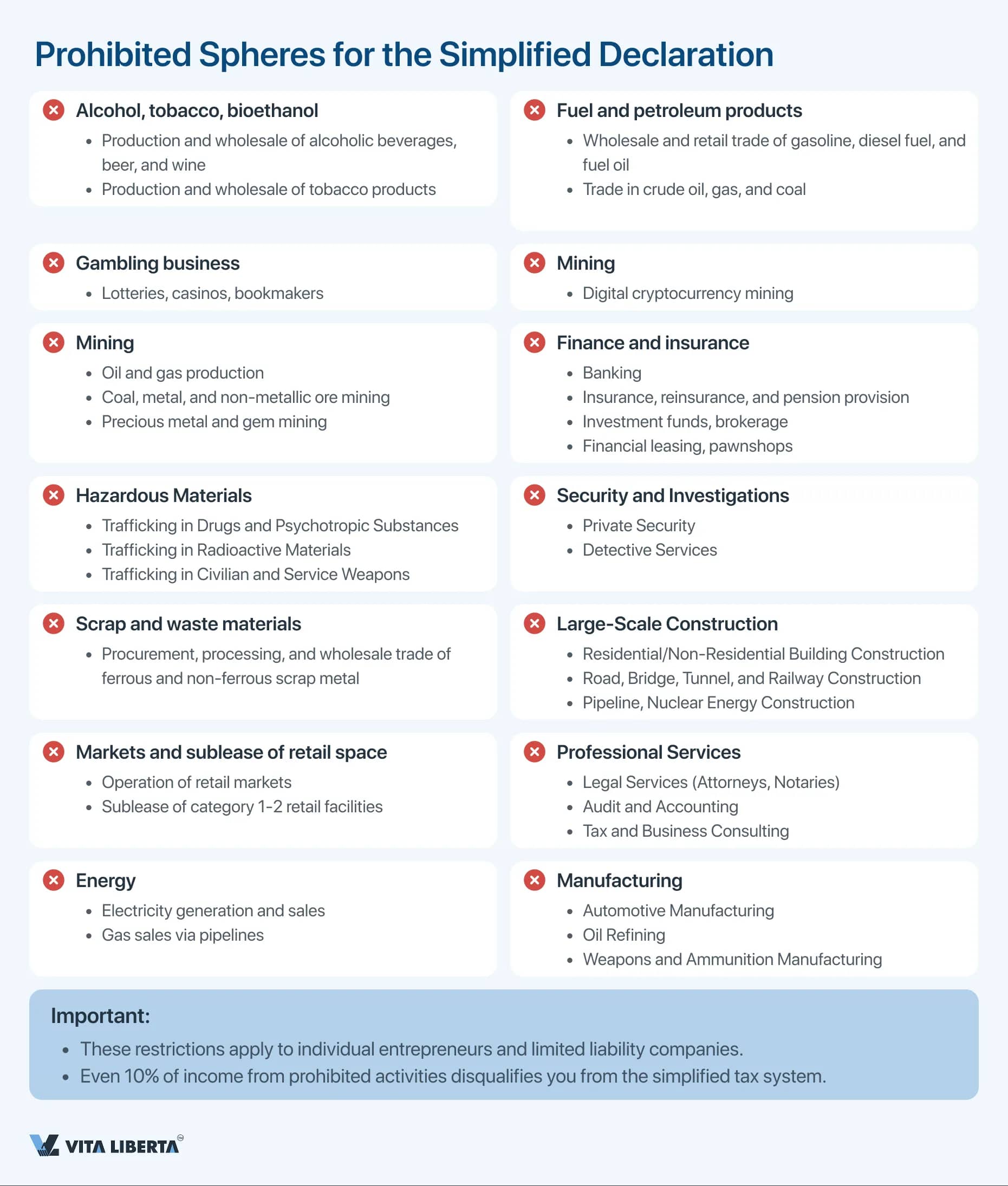
Procedure for Adopting and Terminating the Application of the Special Tax Regime Based on the Simplified Declaration
1. How to Start Applying the Simplified Regime
Important: If you do not submit the notification on time, the general established regime will be applied automatically.
2. Effective Date of the Regime
3. Restriction on Re-transition
After leaving the simplified regime, you can return only after 1 year, provided that:
Transition to the Simplified Regime in 2026: Two Scenarios
Scenario A: Former users of abolished special regimes
⚠️ Missed the March 1 deadline? Transition is impossible in 2026.
Scenario B: Former payers of the general established regime
Critical Reminder: The B2B Barrier
Simplified regime taxpayers do not issue VAT invoices → clients on the general established regime cannot deduct expenses → cooperation with large businesses and government customers is financially disadvantageous.
→ The regime is suitable for B2C but not for supplying VAT-paying companies.
- New Individual Entrepreneurs: Indicate the regime when submitting the notification of the start of activity.
- New Companies: Submit a notification to the tax authority within 5 working days after state registration.
- Existing Businesses: Submit a notification to change the regime at any time, provided the conditions are met.
Important: If you do not submit the notification on time, the general established regime will be applied automatically.
2. Effective Date of the Regime
- New Individual Entrepreneurs: From the date of tax registration.
- New Companies: From the date of state registration.
- Existing Businesses: From the date of submission of the notification.
3. Restriction on Re-transition
After leaving the simplified regime, you can return only after 1 year, provided that:
- A full calendar year has passed under the general established regime.
- The annual income for that year did not exceed 2.595 billion tenge.
Transition to the Simplified Regime in 2026: Two Scenarios
Scenario A: Former users of abolished special regimes
- Notification submission deadline: Until March 1, 2026.
- Tax from January 1, 2026 – already according to the new rules.
- For VAT payers:
- Submit a final declaration for the 4th quarter of 2025.
- Pay VAT at 12% on remaining inventory as of December 31, 2025.
⚠️ Missed the March 1 deadline? Transition is impossible in 2026.
Scenario B: Former payers of the general established regime
- Transition upon application in any form.
- New rules come into effect from the date of registration of the application by the tax authority.
- For VAT payers:
- Submit a final VAT declaration.
- Pay VAT at 12% on remaining inventory as of the day before the transition.
Critical Reminder: The B2B Barrier
Simplified regime taxpayers do not issue VAT invoices → clients on the general established regime cannot deduct expenses → cooperation with large businesses and government customers is financially disadvantageous.
→ The regime is suitable for B2C but not for supplying VAT-paying companies.
Expiration Date of the Special Tax Regime "Simplified Declaration"
The termination of the use of this preferential fiscal mechanism occurs at strictly defined moments by law, which vary depending on the grounds for its termination.
- In the case of a voluntary change of tax status. When a taxpayer decides to switch to another taxation system – whether another special regime or the general procedure – the validity of the current regime ends on the calendar day immediately preceding the date of sending the official notification of the change of the chosen tax status to the inspectorate.
- Due to the loss of legally established criteria. If changes occur in the economic activity of a taxpayer that deprive it of the right to further use simplified declaration, the regime loses its force starting from the day preceding the date of the actual occurrence of these circumstances. The taxpayer is obliged to inform the fiscal authority by submitting a corresponding notification within five working days following the occurrence of such conditions.
- On the initiative of the controlling authority. In a situation where, during a desk tax audit, the inspectorate discovers a fact of the taxpayer's non-compliance with the legally established requirements for applying the special regime, the date of termination of its validity is recognized as the day preceding the date of the occurrence of the identified non-compliance.
Tax Base: Simple and Transparent
Tax Base = All gross income for the half-year
Without deducting expenses for purchases, rent, utilities
Cash method
Income is recognized when money is received into the account — not earlier
💰 The only deduction: salary
For incomes over 103.8 million tenge (24,000 MCI since the beginning of the year):
✅ The tax base can be reduced by the accrued salary amount
→ Strong incentive to legalize employees
What is included in income
• Revenue from sales, work, and services
• Fines and penalties from contractors
• Government subsidies and compensation
• Property received free of charge (not charity)
• Repair costs reimbursed by the tenant
⚠️ Important nuances
Agency contracts
What is NOT included in taxable income
Income adjustment: when you can reduce the tax base
Possible with documentary confirmation
Grounds for adjustment:
⚠️ Important nuances
Write-off of bad debt: 2 grounds:
3 conditions for correct adjustment:
Without deducting expenses for purchases, rent, utilities
Cash method
Income is recognized when money is received into the account — not earlier
💰 The only deduction: salary
For incomes over 103.8 million tenge (24,000 MCI since the beginning of the year):
✅ The tax base can be reduced by the accrued salary amount
→ Strong incentive to legalize employees
What is included in income
• Revenue from sales, work, and services
• Fines and penalties from contractors
• Government subsidies and compensation
• Property received free of charge (not charity)
• Repair costs reimbursed by the tenant
⚠️ Important nuances
Agency contracts
- The full transaction price is included in the tax base, not just your commission.
- Simple partnership. The simplified tax system does not apply—income is divided and taxed under the general regime.
- Sale of property. Profit from the sale of fixed assets is not included in the tax base—it is taxed separately (CIT/PIT).
What is NOT included in taxable income
- Free transfer
- The value of the property you give away for free is not your income (income accrues to the recipient)
- Advertising samples for individual entrepreneurs
- Free goods/samples up to 21,625 tenge per unit (5 MCI) are not income
- Utilities for housing
- Tenant's expenses for utilities and repairs not included in the rent are not your income
- Written-off fines
- Penalties and fines on taxes written off by law are not income
Income adjustment: when you can reduce the tax base
Possible with documentary confirmation
Grounds for adjustment:
- Return of goods by the buyer (full or partial)
- Discounts and price changes under the contract
- Currency fluctuations - recalculation of the amount in tenge
- Debt write-off:
- upon liquidation of the counterparty
- based on a court decision that has entered into force
⚠️ Important nuances
- Adjustment is only within the limits of the initially recognized income
- Reflected in the period of the event or carried over to the period of initial recognition
Write-off of bad debt: 2 grounds:
- Liquidation of the counterparty: The debt can be written off on the date of approval of the debtor's liquidation balance sheet
- Court decision: Write off the debt after the judicial act enters into force
3 conditions for correct adjustment:
- Not more than initial income: You can reduce the base only within the amount previously recognized as income
- Documents are required: Liquidation balance sheet, court decision, return certificate — adjustment is impossible without supporting documents
- Correct period: The adjustment is reflected in the period of the event. If income in this period is insufficient — it is carried over to the period of initial recognition
List of Regions of Kazakhstan with Reduced Tax Rates by Decision of Maslikhats in 2026
Maslikhats are empowered to adjust the basic tax rate – both downwards and upwards – but with a limitation: the maximum deviation amplitude cannot exceed 50%. In other words, the actual tax rate for a taxpayer today can range from 2% to 6%, depending on where they operate and what they do.
Article 726 of the Tax Code of the Republic of Kazakhstan indeed provides maslikhats with the right to both reduce and increase the rate within 50%. However, for 2026, only the right to reduce has been implemented. No maslikhat decision adopted by the deadline of December 1, 2025, contains a rate increase.
Of the 172 maslikhats that adopted decisions on rate adjustments for 2026:
What is important to understand about the limits of maslikhat competence:
Why has this mechanism become particularly noticeable in 2026?
The norm itself has existed in the code for a long time. But previously, maslikhats used their power sparingly and reluctantly. In 2026, the situation has changed. Amidst overall fiscal consolidation and the reduction in the number of special regimes, regions have received, in effect, the only lever for targeted small business support that does not require direct budget expenditures. The result is an unprecedented number of decisions to reduce the rate to 2% in industrial, manufacturing, and socially significant sectors.
It is also worth noting that the reduction or increase of the rate directly and unconditionally depends on the type of activity. The law states directly: maslikhats adjust the rate "depending on the type of activity and the location of the object." These are two equivalent bases. A region cannot establish a simple "rate for everyone" – the decision is always tied to specific activity codes.
What this means in practice
When a maslikhat adopts a decision on a 2% rate, it never writes: "We reduce the tax for all taxpayers in our region to 2%." This would be prohibited by law. Instead, the decision looks like this:
“Set a 3% rate for taxpayers carrying out activities in the sphere of manufacturing, tourism, social services, agriculture, education…” – followed by a list of specific activity codes.
Everything else that is not included in this list is taxed at the basic rate of 4% (or at another rate established for other groups of activities).
Summary
The 4% rate on the simplified declaration in 2026 is not a fixed given, but a starting point. The actual tax amount today is determined at the intersection of national norms and regional rule-making. For businesses, this necessitates:
Important Caveat: The Maslikhat Rate is a Temporary Advantage, Not a Strategic Foundation
When choosing a business registration location, focusing solely on the reduced rate set by the maslikhat is a risky tactic. Here's why.
The rate is approved for only one year
The maslikhat's decision on rate reduction is adopted no later than December 1 and is valid only for the following calendar year. The business has no guarantee that the preferential rate will be maintained in a year.
Today the maslikhat reduced the rate to 2%. Tomorrow:
The "rate migration" effect
Imagine an entrepreneur who in 2026 specifically registered a business in Region A, where a 2% rate is set for their activity code. In 2027, the maslikhat of Region A revises its decision and leaves only 4%. Meanwhile, neighboring Region B introduces 2%.
What to do? Relocate? Changing legal address, re-registration, potential loss of counterparties, new tax support – the costs will offset any annual tax savings.
Regional competition is instability
In 2026, the widespread rate reduction is a conscious policy to compensate businesses after the abolition of old special regimes. But policy has a tendency to change. When regions fulfill their social obligations or face budget deficits, rates will begin to equalize.
What really matters when choosing a region
The right attitude towards the maslikhat rate
A reduced rate is a weather vane, not a foundation. It is here today, gone tomorrow. A business built on a tax benefit as its sole competitive advantage is extremely vulnerable.
The strategically sound approach is to choose a region based on the economics of the business, and consider the preferential rate as a temporary support. If it continues – great. If not – the business should remain sustainable even at the base rate of 4%.
Article 726 of the Tax Code of the Republic of Kazakhstan indeed provides maslikhats with the right to both reduce and increase the rate within 50%. However, for 2026, only the right to reduce has been implemented. No maslikhat decision adopted by the deadline of December 1, 2025, contains a rate increase.
Of the 172 maslikhats that adopted decisions on rate adjustments for 2026:
- 114 regions set a rate of 2%
- The remaining set a rate of 3%
- A rate of 6% is not applied by any maslikhat in 2026
What is important to understand about the limits of maslikhat competence:
- Firstly, the decision is impersonal and regulatory in nature. No regional authority has the right to set an individual rate for a specific individual entrepreneur or legal entity – this is directly prohibited by law. Adjustments are only possible based on two objective criteria: the type of activity and the location of the object.
- Secondly, the decision is adopted strictly by December 1 of the year preceding its introduction and comes into force on January 1 of the following year. All adopted rates are subject to mandatory official publication. This means the taxpayer has the opportunity and the obligation to know their rate before the start of the new tax period.
- Thirdly, if a taxpayer's activities fall under different rates, an obligation arises to maintain separate tax accounting of income. Ignoring this requirement is one of the most frequent causes of additional assessments during desk audits.
Why has this mechanism become particularly noticeable in 2026?
The norm itself has existed in the code for a long time. But previously, maslikhats used their power sparingly and reluctantly. In 2026, the situation has changed. Amidst overall fiscal consolidation and the reduction in the number of special regimes, regions have received, in effect, the only lever for targeted small business support that does not require direct budget expenditures. The result is an unprecedented number of decisions to reduce the rate to 2% in industrial, manufacturing, and socially significant sectors.
It is also worth noting that the reduction or increase of the rate directly and unconditionally depends on the type of activity. The law states directly: maslikhats adjust the rate "depending on the type of activity and the location of the object." These are two equivalent bases. A region cannot establish a simple "rate for everyone" – the decision is always tied to specific activity codes.
What this means in practice
When a maslikhat adopts a decision on a 2% rate, it never writes: "We reduce the tax for all taxpayers in our region to 2%." This would be prohibited by law. Instead, the decision looks like this:
“Set a 3% rate for taxpayers carrying out activities in the sphere of manufacturing, tourism, social services, agriculture, education…” – followed by a list of specific activity codes.
Everything else that is not included in this list is taxed at the basic rate of 4% (or at another rate established for other groups of activities).
Summary
The 4% rate on the simplified declaration in 2026 is not a fixed given, but a starting point. The actual tax amount today is determined at the intersection of national norms and regional rule-making. For businesses, this necessitates:
- annually checking the current maslikhat decision for their activity code;
- monitoring official publications before the start of the new reporting period;
- when combining different rates within the same business, ensuring separate accounting of income.
Important Caveat: The Maslikhat Rate is a Temporary Advantage, Not a Strategic Foundation
When choosing a business registration location, focusing solely on the reduced rate set by the maslikhat is a risky tactic. Here's why.
The rate is approved for only one year
The maslikhat's decision on rate reduction is adopted no later than December 1 and is valid only for the following calendar year. The business has no guarantee that the preferential rate will be maintained in a year.
Today the maslikhat reduced the rate to 2%. Tomorrow:
- the budget situation in the region may change;
- the composition of deputies or priorities may shift;
- the benefit could be cancelled, reduced, or – attention – increased.
The "rate migration" effect
Imagine an entrepreneur who in 2026 specifically registered a business in Region A, where a 2% rate is set for their activity code. In 2027, the maslikhat of Region A revises its decision and leaves only 4%. Meanwhile, neighboring Region B introduces 2%.
What to do? Relocate? Changing legal address, re-registration, potential loss of counterparties, new tax support – the costs will offset any annual tax savings.
Regional competition is instability
In 2026, the widespread rate reduction is a conscious policy to compensate businesses after the abolition of old special regimes. But policy has a tendency to change. When regions fulfill their social obligations or face budget deficits, rates will begin to equalize.
What really matters when choosing a region
- Sales market and logistics. Where are your customers? Where are your suppliers? Where is your warehouse? A 2% tax rate won't save you if you have to transport goods a thousand kilometers or are far from your target audience.
- Human resources. Are there the necessary specialists in the region? Are they willing to work for adequate pay?
- Infrastructure. Are there access roads, communication links, utilities, offices, production facilities?
- Administrative environment. How comfortable is it to work with Public Service Centers, tax offices, permitting bodies? Is there excessive regulation?
- Tax rate as a bonus, not a base. It should close the list, not open it.
The right attitude towards the maslikhat rate
A reduced rate is a weather vane, not a foundation. It is here today, gone tomorrow. A business built on a tax benefit as its sole competitive advantage is extremely vulnerable.
The strategically sound approach is to choose a region based on the economics of the business, and consider the preferential rate as a temporary support. If it continues – great. If not – the business should remain sustainable even at the base rate of 4%.
Overview of Maslikhat Decisions on Reducing the Simplified Declaration Rate for 2026
Ahead of 2026, local representative bodies (maslikhats) in several regions have exercised their right to reduce the individual income tax rate for taxpayers operating under the simplified declaration regime. Depending on the region, the rate has been set at 3% or 2%. Below is a detailed list of the administrative-territorial units where maslikhats have approved these changes.
Cities of Republican Significance
East Kazakhstan Region
Cities of regional subordination:
Districts:
A 2% rate was approved in the Altay, Glubokovsky, Zaysan, Katon-Karagay, Kurchum, Marqaköl, Samar, Tarbagatay, Ulan, Ulken Naryn, and Shemonaikha districts. Decision dates range from November 25 to 28, 2025.
Abai Region
Cities:
A reduced 2% rate is established in the Abai, Ayagoz, Beskaragay, Borodulikha, Zharma, Kokpekti, and Urdzhar districts, as well as the Aksuat, Zhanasemey, and Maqanshy districts.
Akmola Region
Cities:
The vast majority of districts set the rate at 2%, including: Akkol, Arshaly, Astrakhan, Atbasar, Bulandy, Burabay, Birzhan Sal, Egindykol, Ereymentau, Esil, Zharkain, Zerenda, Korgalzhyn, Sandyktaun, Tselinograd, and Shortandy.
Aktobe Region
Almaty Region
Atyrau Region
A 2% rate was approved in all administrative units that reached a decision: Atyrau city, and the Zhylyoi, Inder, Isatay, Kurmangazy, Kyzylkoga, Makat, and Mahambet districts.
Zhambyl Region
All reporting maslikhats unanimously set the rate at 2%. Decisions cover Taraz city, and the Bayzak, Zhambyl, Zhualy, Korday, Merke, Moyynkum, Sarysu, Talas, and Shu districts, as well as the Turar Ryskulov district.
Jetisu Region
West Kazakhstan Region
Karaganda Region
A 2% rate applies to most cities and districts, including Karaganda, Balkhash, Priozersk, Saran (including Aktas village), Temirtau, Shakhtinsk, as well as the Abai, Aktogay, Bukhar-Zhyrau, Karkaraly, Nura, Osakarovka, and Shet districts.
Kostanay Region
In all listed cities and districts, maslikhats approved a 3% rate. Decisions were made in Kostanay, Lisakovsk, Rudny, and the Auliekol, Zhitikara, Kostanay, and Sarykol districts.
Kyzylorda Region
A uniform 2% rate was introduced in Kyzylorda and the Aral, Zhalagash, Zhanakorgan, Kazaly, Karmakshy, Syrdariya, and Shieli districts.
Mangystau Region
Pavlodar Region
All maslikhats that issued decisions set the rate at 3%. This includes Pavlodar, Aksu, Ekibastuz, and the Aqquly, Aktogay, Bayanaul, Zhelezinka, Irtysh, May, Pavlodar, Terenkol, Uspenka, and Shcherbakty districts.
North Kazakhstan Region
A 3% rate was approved in all administrative divisions: Petropavl, and the Ayirtau, Akzhar, Akkayin, Esil, Zhambyl, Kyzylzhar, Mamlyutka, Taiynsha, Timiryazevo, and Oualikhanov districts, as well as the G. Musrepov and M. Zhumabaev districts.
Turkistan Region
The region shows unity in its decisions: in Turkistan, Arys, Kentau, and all districts listed below, the rate was reduced to 2%:
Baidebek, Zhetysay, Kazygurt, Keles, Maktaaral, Ordabasy, Otrar, Sayram, Saryagash, Sauran, Sozak, Tole Bi, Tyulkubas, and Shardara districts.
Ulytau Region
Cities of Republican Significance
- Astana: By Maslikhat Decision No. 349/46-VIII dated November 28, 2025, the rate is set at 3%.
- Almaty: According to Maslikhat Decision No. 256 dated November 28, 2025, a 3% rate applies.
- Shymkent: The Maslikhat set a 2% rate by Decision No. 30/271-VIII dated November 28, 2025.
East Kazakhstan Region
Cities of regional subordination:
- Oskemen (Ust-Kamenogorsk): Decision dated 24.10.2025 No. 38/3-VIII, 2% rate.
- Ridder: Decision dated 28.11.2025 No. 32/3-VIII, 2% rate.
Districts:
A 2% rate was approved in the Altay, Glubokovsky, Zaysan, Katon-Karagay, Kurchum, Marqaköl, Samar, Tarbagatay, Ulan, Ulken Naryn, and Shemonaikha districts. Decision dates range from November 25 to 28, 2025.
Abai Region
Cities:
- Semey: Decision dated 26.11.2025 No. 51/272-VIII, 2% rate.
- Kurchatov: Decision dated 25.11.2025 No. 33/213-VIII, 2% rate.
A reduced 2% rate is established in the Abai, Ayagoz, Beskaragay, Borodulikha, Zharma, Kokpekti, and Urdzhar districts, as well as the Aksuat, Zhanasemey, and Maqanshy districts.
Akmola Region
Cities:
- Kokshetau: 3% rate (Decision dated 28.11.2025 No. С-26/2).
- Kosshy: 2% rate (Decision dated 12.11.2025 No. 206/51-8).
- Stepnogorsk: 2% rate (Decision dated 25.11.2025 No. 8С-26/5).
The vast majority of districts set the rate at 2%, including: Akkol, Arshaly, Astrakhan, Atbasar, Bulandy, Burabay, Birzhan Sal, Egindykol, Ereymentau, Esil, Zharkain, Zerenda, Korgalzhyn, Sandyktaun, Tselinograd, and Shortandy.
Aktobe Region
- Aktobe: Maslikhat decision dated 18.11.2025 No. 356, 3% rate.
- Kobda and Martuk districts: 3% rate.
- Remaining territories: (Ayteke Bi, Alga, Bayganin, Irgiz, Kargaly, Mugalzhar, Temir, Ouil, Khromtau, and Shalkar districts) approved a 2% rate.
Almaty Region
- Qonaev: 2% rate (Decision dated 27.11.2025 No. 54-177).
- Alatau: 3% rate (Decision dated 27.11.2025 No. 24-65).
- Enbekshikazakh, Talgar, and Uygur districts: 3% rate.
- Zhambyl, Ili, and Karasay districts: Switched to a 2% rate.
Atyrau Region
A 2% rate was approved in all administrative units that reached a decision: Atyrau city, and the Zhylyoi, Inder, Isatay, Kurmangazy, Kyzylkoga, Makat, and Mahambet districts.
Zhambyl Region
All reporting maslikhats unanimously set the rate at 2%. Decisions cover Taraz city, and the Bayzak, Zhambyl, Zhualy, Korday, Merke, Moyynkum, Sarysu, Talas, and Shu districts, as well as the Turar Ryskulov district.
Jetisu Region
- Taldykorgan and Tekeli: 2% rate.
- Aksu, Alakol, Eskeldi, Karatal, Koksu, Panfilov, and Sarkan districts: 3% rate.
- Kerbulak district: Retained a 2% rate.
West Kazakhstan Region
- Uralsk: Maslikhat decision dated 28.11.2025 No. 24-9, 3% rate.
Karaganda Region
A 2% rate applies to most cities and districts, including Karaganda, Balkhash, Priozersk, Saran (including Aktas village), Temirtau, Shakhtinsk, as well as the Abai, Aktogay, Bukhar-Zhyrau, Karkaraly, Nura, Osakarovka, and Shet districts.
Kostanay Region
In all listed cities and districts, maslikhats approved a 3% rate. Decisions were made in Kostanay, Lisakovsk, Rudny, and the Auliekol, Zhitikara, Kostanay, and Sarykol districts.
Kyzylorda Region
A uniform 2% rate was introduced in Kyzylorda and the Aral, Zhalagash, Zhanakorgan, Kazaly, Karmakshy, Syrdariya, and Shieli districts.
Mangystau Region
- Aktau, Zhanaozen, and the Beyneu, Karakiya, and Munaily districts: 3% rate.
- Mangystau and Tupkaragan districts: 2% rate (Decisions dated 18.12.2025 and 28.11.2025, respectively).
Pavlodar Region
All maslikhats that issued decisions set the rate at 3%. This includes Pavlodar, Aksu, Ekibastuz, and the Aqquly, Aktogay, Bayanaul, Zhelezinka, Irtysh, May, Pavlodar, Terenkol, Uspenka, and Shcherbakty districts.
North Kazakhstan Region
A 3% rate was approved in all administrative divisions: Petropavl, and the Ayirtau, Akzhar, Akkayin, Esil, Zhambyl, Kyzylzhar, Mamlyutka, Taiynsha, Timiryazevo, and Oualikhanov districts, as well as the G. Musrepov and M. Zhumabaev districts.
Turkistan Region
The region shows unity in its decisions: in Turkistan, Arys, Kentau, and all districts listed below, the rate was reduced to 2%:
Baidebek, Zhetysay, Kazygurt, Keles, Maktaaral, Ordabasy, Otrar, Sayram, Saryagash, Sauran, Sozak, Tole Bi, Tyulkubas, and Shardara districts.
Ulytau Region
- Zhezkazgan, Karazhal, Satpayev, and the Ulytau district: 3% rate (Decisions adopted November 25–27, 2025).
Simplified Tax Rate: Not 4% for Everyone
Base Rate: 4%nationwide
Reality: 2% to 3% — determined by your local district maslikhat
2% — The New Standard
Not a single maslikhat increased the rate for 2026.
⚠️ Three Rules of the Tax Rate
Reality: 2% to 3% — determined by your local district maslikhat
2% — The New Standard
- 114 districts and cities (66% of all those that issued decisions).
- East Kazakhstan, Abai, Zhambyl, and Turkistan regions — almost entirely at 2%.
- The majority of districts in other regions.
- Astana, Almaty, Aktobe, Kostanay, Pavlodar.
- Select districts with moderate tax relief.
Not a single maslikhat increased the rate for 2026.
⚠️ Three Rules of the Tax Rate
- Tied to Activity Codes: The rate depends on the type of business activity—it’s not "2% for everyone," but only for specific codes.
- Annual Decision: Decisions are made by December 1 and take effect on January 1 of the following year.
- Separate Accounting: If you combine activities with different rates, you must maintain separate records of income for each Activity Code.
Map of Simplified Tax Rates for 2026
Base Rate (per Code): 4%
Actual Regional Rates: only 2% or 3%
Where it’s 2% — The Benefit Zone
Where it’s 3% — Moderate Relief
Where it’s 4% — Standard Base Rate
In areas where the maslikhat did not adopt a decision by December 1, 2025.
(The 6% rate is not being applied in any region.)
Actual Regional Rates: only 2% or 3%
Where it’s 2% — The Benefit Zone
- Fully at 2%: Turkistan, Zhambyl, Abai, Atyrau, and Kyzylorda regions.
- Key Cities at 2%: Shymkent, Oskemen (Ust-Kamenogorsk), Semey, Taraz, Taldykorgan, and Qonaev.
- The majority of districts in all other regions have also opted for 2%.
Where it’s 3% — Moderate Relief
- Major Hubs: Astana, Almaty, Aktobe, Kokshetau, Pavlodar, Petropavl, and Uralsk.
- Entire Regions at 3%: Kostanay, North Kazakhstan, and Pavlodar regions.
- Specific Districts in the Akmola, Almaty, and Jetisu regions.
Where it’s 4% — Standard Base Rate
In areas where the maslikhat did not adopt a decision by December 1, 2025.
(The 6% rate is not being applied in any region.)
Reporting and Deadlines: How to Submit Form 910.00
The tax regime in effect since 2026 establishes a specific fiscal responsibility schedule for business entities, based on semi-annual intervals.
Cycle and Key Dates
The financial year is divided into two independent reporting periods, each with identical structural requirements but different calendar deadlines:
Cycle and Key Dates
The financial year is divided into two independent reporting periods, each with identical structural requirements but different calendar deadlines:
- First Half (January–June): The taxpayer must submit a declaration no later than August 15 of the current year. Payment of the calculated unified tax must be made by August 25 of the same year.
- Second Half (July–December): The deadline for filing tax reports is set for February 15 of the following calendar year. The tax amount must be transferred to the budget by February 25.
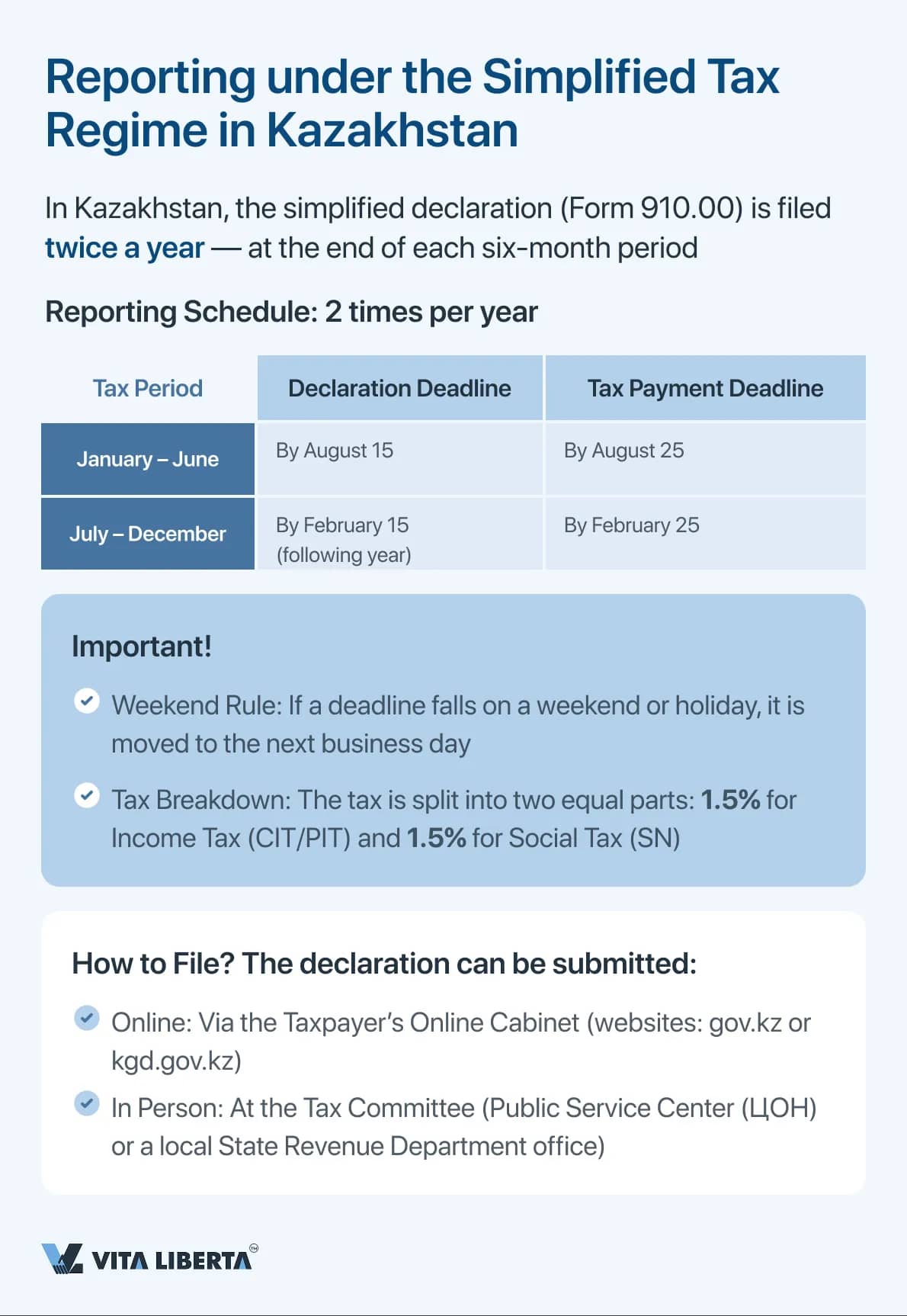
How to Submit Declaration 910.00. Three Methods of Submission
- Via the "eSalyq" portal — online
- Via accounting software (1C:Accounting, etc.)
- In person at a State Revenue Service office
Filing Rules
Modular Form
Complete only the sections that correspond to your specific business activities.
→ No employees? Skip the payroll/salary section
Mandatory Appendices:
- Appendix 910.01 — if you have employees who are residents of the Republic of Kazakhstan.
- Appendix 910.02 — for payments made to foreigners and stateless persons.
For TIS Users
You must complete the "Inventory Information" section—including balances at the start/end of the period plus any acquired inventory.
Important Details
- Currency: All amounts must be in tenge, rounded to the nearest whole number (no tiyns).
- Location: The declaration is submitted at your place of tax registration.
- Deadlines: August 15 and February 15 (based on the half-year periods).
Frequently Asked Questions (FAQ)
2. We are a small shop. Is it true that from 2026 we won't have to pay Social Tax and VAT, and how is this handled technically?
3. Is there a way to lower the 4% tax rate under this regime? If so, where and how is this verified?
4. How does the payroll affect the unified tax amount, and can we simply not register employees officially to make things easier?
5. What happens if revenue unexpectedly exceeds the 2.5 billion tenge limit mid-year? Do we need to rush to the tax office?
Simplified declaration in Kazakhstan: how the special tax regime for small business works
Disclaimer
All service pricing and information provided on vitaliberta.kz are for informational purposes only and do not constitute a public offer under Article 395 of the Civil Code of the Republic of Kazakhstan.
While the website has been prepared with due regard to current legislation and relevant case law, LLP “Vita Liberta” does not guarantee the absolute accuracy, completeness, or timeliness of the content. For definitive guidance, please consult with our team directly.
All service pricing and information provided on vitaliberta.kz are for informational purposes only and do not constitute a public offer under Article 395 of the Civil Code of the Republic of Kazakhstan.
While the website has been prepared with due regard to current legislation and relevant case law, LLP “Vita Liberta” does not guarantee the absolute accuracy, completeness, or timeliness of the content. For definitive guidance, please consult with our team directly.