

Registering an LLP in Kazakhstan (2026): Steps, Deadlines and What It Really Costs
19 октября, 2026
eGov produces the certificate for a newly formed partnership in about sixty minutes. Opening a bank account, fixing the tax regime and keeping the founder legally in the country are three separate tracks, and you can’t take them in any order you like.
eGov can put an LLP (the local abbreviation is TOO) on the register in under sixty minutes, quicker than most lunch breaks. Filed at a PSC (Public Service Center), the paperwork is processed by close of the following working day. Foreigners lose weeks elsewhere: on a visa or residence permit, an IIN, notary-certified translations, telling the tax authority which regime they chose and convincing a bank’s compliance officers. The system is rarely the slow part. What costs money is a step done too early or too late.
Where it goes wrong:
“Filing in Astana, we had our certificate by morning. The joy lasted about a day: there’s no backdating the simplified regime, the bank refuses an account until it has checked who ultimately owns us, and three weeks from now my C5 runs out. So where exactly did we go wrong?”
Roughly half of our foreign clients arrive with a version of that story.

Can a foreigner set up an LLP in Kazakhstan? Individual vs corporate founders
Kazakh law lets a non-resident own an LLP outright, up to 100%. A person and a company, though, take different paths to becoming a participant.
Individual founders: sort out migration status first
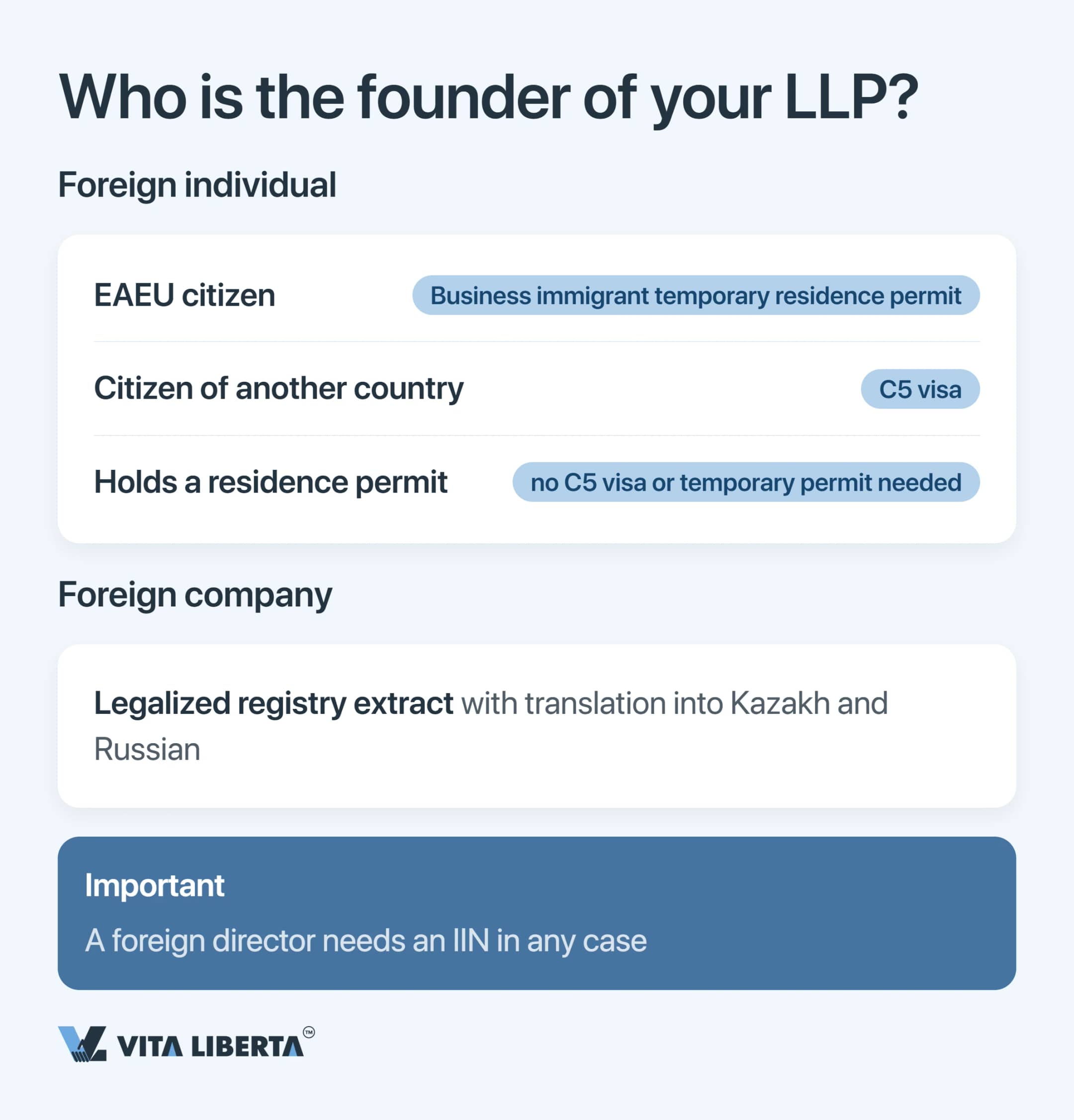
Paragraph 2 of Article 40 of Migration Law No. 477-IV (22 July 2011) is the gatekeeper. A foreigner may join an LLP’s participants only after obtaining a C5 visa or a business-immigrant temporary residence permit (TRP). If you already hold a Kazakh residence permit, you need neither.
Your mode of entry, not your passport, decides which of the two applies. Crossed the border visa-free, as Russians and other EAEU nationals (Belarus, Armenia, Kyrgyzstan) do? Then it’s the TRP. Needed a visa to get in? Then you apply for the C5 at a Kazakh embassy or consulate.
A common misconception among non-residents is that once the LLP exists, their right to stay is settled too. It isn’t. Companies are put on the register by the “Government for Citizens” State Corporation, whether you file through eGov or at a PSC. Your right to stay as a founder is decided by the Interior Ministry’s migration service. Neither body treats the other’s papers as covering its own area.
Corporate founders: a document trail instead of a visa
Since Article 40 governs individuals, a foreign company doesn’t need a visa. What it needs is paperwork. Under Law No. 2198 of 17 April 1995, which sets the rules for registering legal entities, the founder must prove it really exists as a company back home. That proof is a legalized excerpt from its national business register, or any other legalized document showing its status. A Kazakh and a Russian version must accompany it, with a notary certifying the translations.
Skipping the visa doesn’t mean skipping scrutiny. Bank compliance will follow the shareholding upwards, layer by layer, until it reaches the person who ultimately owns the business. A director who is a foreign national will need an IIN whatever the structure.
Skipping the visa doesn’t mean skipping scrutiny. Bank compliance will follow the shareholding upwards, layer by layer, until it reaches the person who ultimately owns the business. A director who is a foreign national will need an IIN whatever the structure.
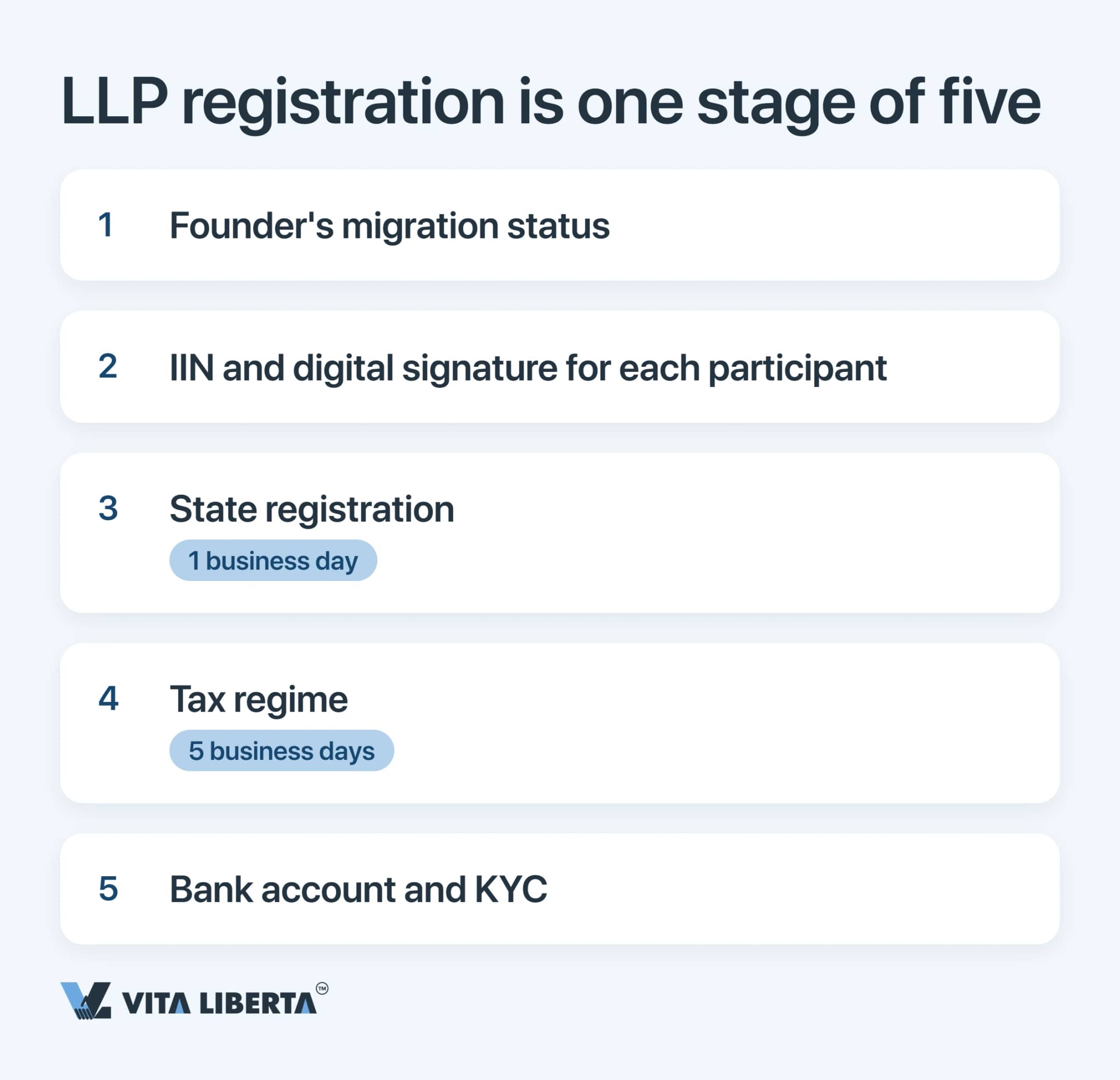
Step by step: from IIN to BIN in five moves
We’ve ranked these steps by what a mistake at each one costs you, not by the order of screens on eGov.
| Step | When | Where to do it and what to watch |
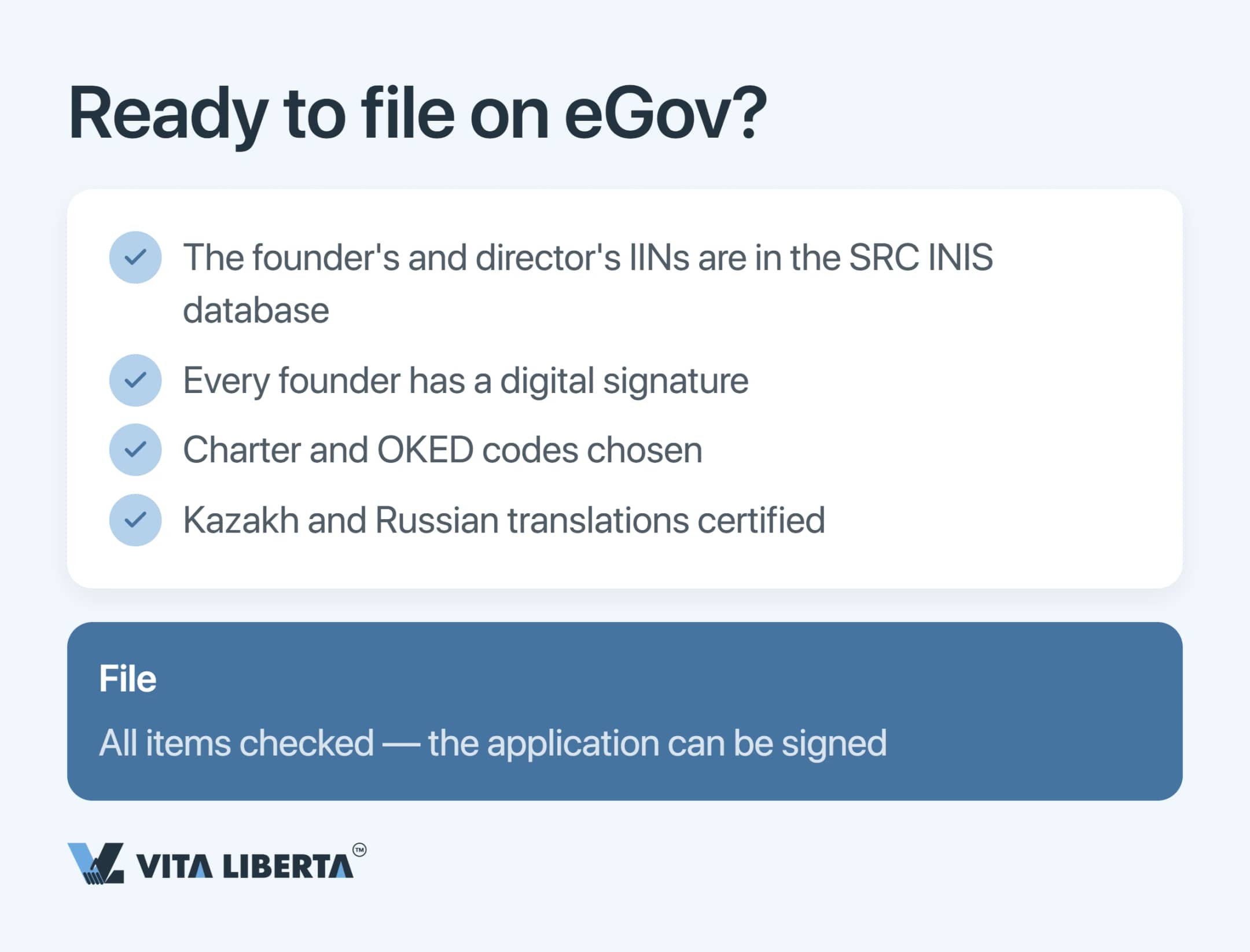
| IIN for the founder and the director | before filing | In person at a PSC. eGov rejects an application with no IIN, so a non-resident who doesn’t have one files at a PSC |
| An EDS key for each participant | before filing | Every founder signs. One missing key and the whole application stops |
| Charter and activity code (OKED) | before filing | The standard-form charter (Justice Ministry Order No. 106, 24 February 2015) is checked faster, yet it says nothing about how a participant leaves |
| Registration itself | eGov: under an hour; PSC: by the next working day at the latest | eGov suits private businesses; non-residents lacking an IIN go through a PSC |
| Choosing the tax regime | 5 working days | Through the Taxpayer’s Cabinet, E-Salyq Business or your bank’s app. Too late, and the company is placed on the general regime (OUR) by default |
Get your LLP running with no document resubmissions
- Check of the founder’s status
- Charter plus notary-certified translations
- Filing and regime notice to the tax authority

Real-world timeline for LLP registration in Kazakhstan
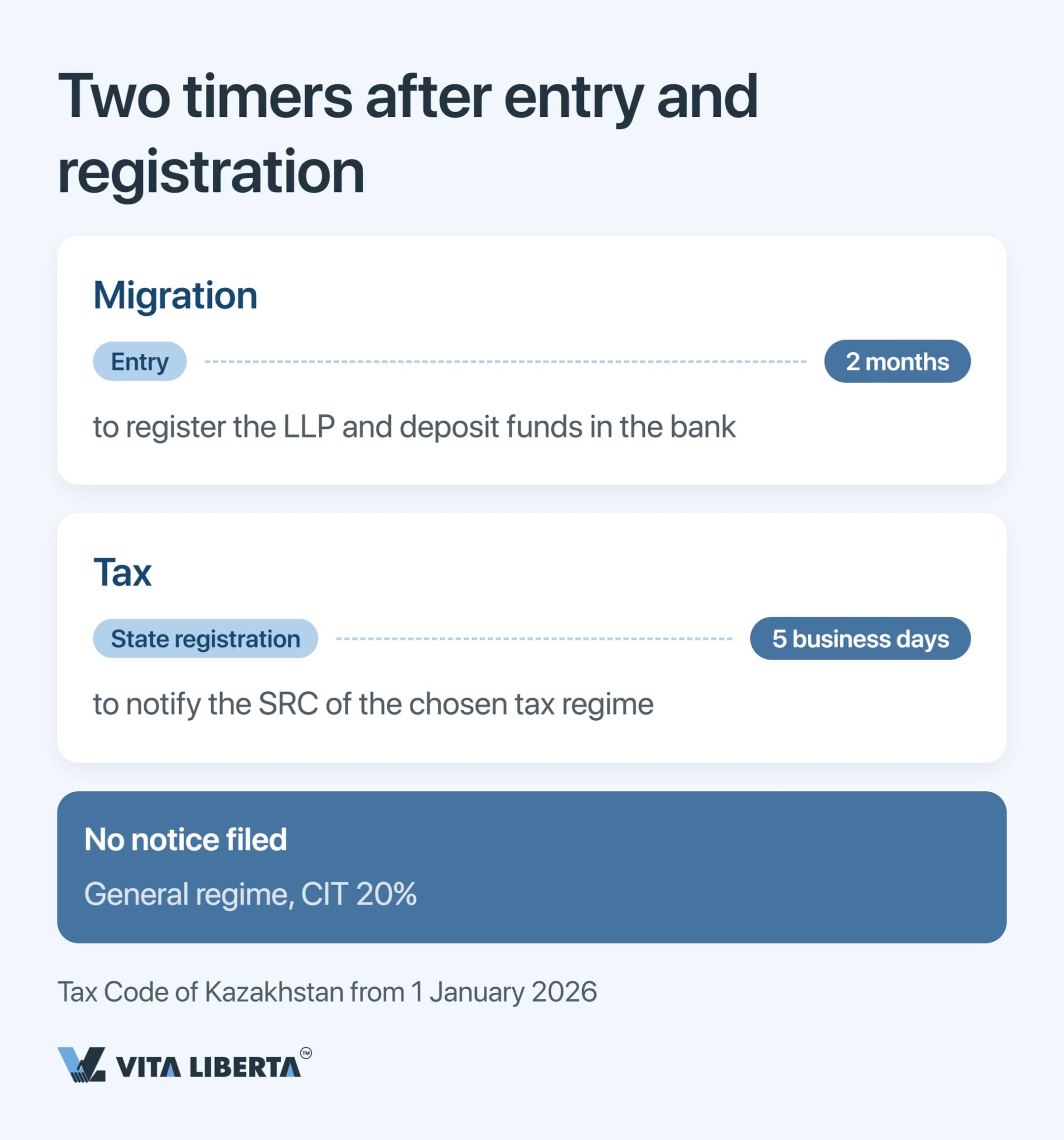
The sixty minutes on eGov are a tiny slice of the schedule. Two deadlines frame everything else.
Countdown: two months after you cross the border
Under Article 40, time runs from the border stamp, not from the day you apply. A business immigrant gets those two months to do two things. One: found a commercial organization or buy into an existing one as a participant. Two: deposit no less than the statutory minimum capital with a Kazakh second-tier (commercial) bank.
A tip from practice: have your passport and company papers translated and notarized in your home country, before departure. The visa or TRP isn’t box-ticking before the schedule. The moment it’s issued, the schedule begins.
A tip from practice: have your passport and company papers translated and notarized in your home country, before departure. The visa or TRP isn’t box-ticking before the schedule. The moment it’s issued, the schedule begins.
Five working days to pick a tax regime
From 1 January 2026, Kazakhstan taxes businesses under Tax Code No. 214-VIII of 18 July 2025, and the 2017 code (No. 120-VI) has been repealed. Just three special regimes survive: one for the self-employed, one for peasant and farm households, and the simplified declaration regime. A partnership can use only the simplified declaration, and only when it satisfies Article 723.
Once registered, an LLP has five working days to tell the SRC (State Revenue Committee, the tax authority) which regime it wants. Stay silent and the decision is made for you: general regime, 20% corporate income tax (CIT). Moving to the simplified regime later is possible, but it kicks in on the date of the notification, not the date the company was registered. A practical safeguard: set a reminder for day three after the BIN is issued.
Note: a company on the general regime has to register for value-added tax (VAT) when its yearly taxable turnover goes above 10,000 MCI, which is KZT 43,250,000 for 2026. You have five working days to apply, and VAT is charged at 16%. VAT payers issue electronic invoices (ESF), so one wrong character in the registration data will repeat across every invoice.
What does it cost to open an LLP in Kazakhstan in 2026?
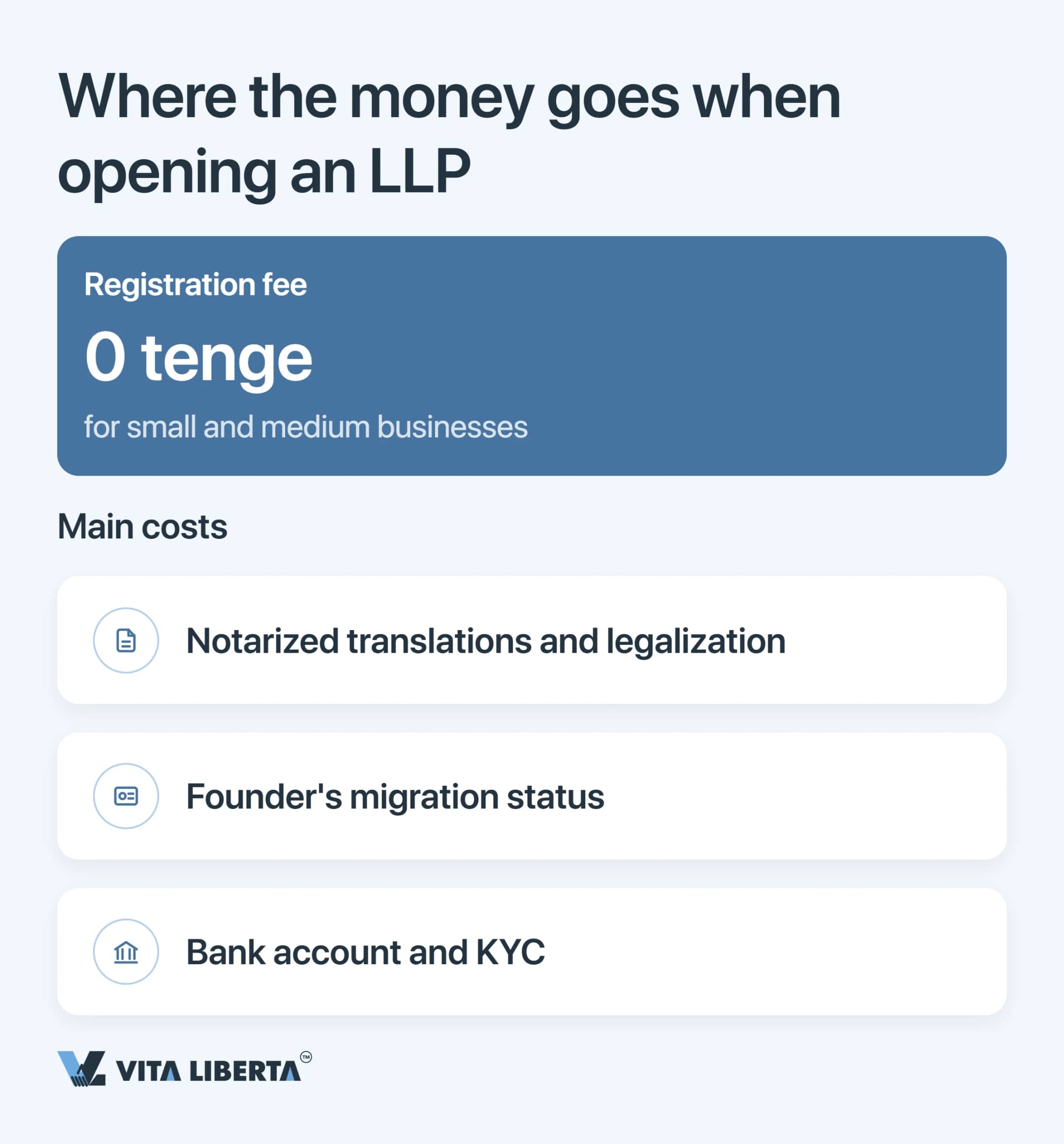
For a small business, the state’s bill is close to zero. The money goes on everything around the procedure.
| Expense | Legal position | In practice |
| Registration fee | free for SMEs | Only large companies pay the State Corporation; size follows Article 24 of the Entrepreneurial Code of 29 October 2015 |
| Translations and legalization | notary, Kazakh plus Russian | The least predictable line: it hinges on where the founder comes from and how many documents there are |
| Founder’s migration status | C5 visa or business-immigrant TRP | Every step has to happen while the visa or TRP is still valid |
| Corporate account | per the bank’s price list | Vetting a non-resident (KYC) normally outlasts registration |
How much capital a Kazakh LLP needs: by law and by the bank’s standards
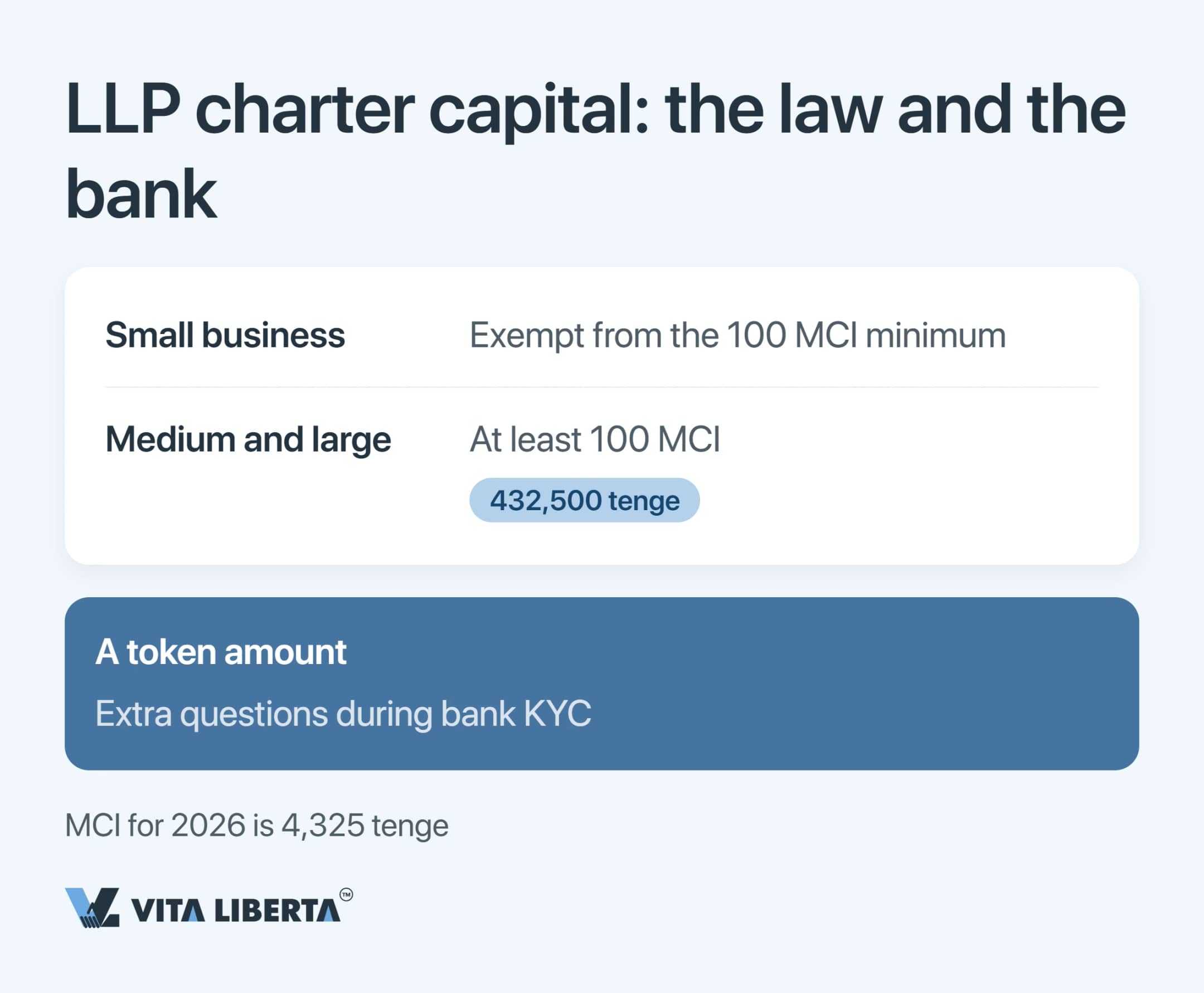
Article 23(2) of Law No. 220-I of 22 April 1998, which governs LLPs and additional liability partnerships, sets a floor of 100 MCI for medium and large companies, using the MCI in force on the day documents are filed. For 2026 that means KZT 432,500, or around $953 at the National Bank’s rate on 12 October 2026 (KZT 453.93 to the dollar).
MCI stands for Monthly Calculation Index. The 2026–2028 budget law (No. 239-VIII, 8 December 2025) fixes it at KZT 4,325. Small businesses are exempt from the floor. Article 24 of the Entrepreneurial Code classes a business as small if it averages no more than 100 staff a year and earns up to 300,000 MCI.
Advisers in Almaty report that banks, when running KYC, compare declared capital with the deal flow the company expects, and a symbolic figure next to a foreign participant’s name invites questions. So the legal minimum satisfies the law but not always the bank. We go deeper into this in our separate piece on LLP capital.
Your LLP registered, your bank account opened
- Paperwork matched to your status
- Hands-on help with the eGov filing
- Getting ready for the bank’s KYC review
Key lessons before you register an LLP in Kazakhstan
Because registration is so quick, it’s tempting to make it step one. Make it a later step and begin with your migration grounds and your tax numbers.
- Order beats pace. First comes business-immigrant status, with an IIN and EDS for each participant. Afterwards you have five working days, no more, to pick a regime.
- Fees are the smallest part of the budget. Translation, legalization and bank vetting together outweigh anything paid to the state.
- How you own the company is a long-term choice. Holding through a company spares you the visa but makes KYC longer.
- A BIN opens a file rather than closing one. The bank, the SRC and the migration service will keep coming back to it for years.
Five questions foreign founders ask about Kazakh LLPs
What’s the official processing time, and why is my registration dragging on?
If I don’t pick a tax regime, what will my LLP default to?
What capital figure should I put in the charter so the bank doesn’t hold things up?
Can I hold a Kazakh LLP through my foreign company instead of personally, and what will that mean for the business?
Вся представленная на сайте информация, касающаяся стоимости оказываемых услуг носит информационный характер и ни при каких условиях не является публичной офертой, определяемой положениями ст. 395 ГК РК. Интернет-сайт vitaliberta.kz составлен с вниманием к деталям в отношении законодательных требований, в том числе путем анализа судебной практики. Несмотря на это, компания ТОО "Вита Либерта" не может гарантировать безошибочность и точность содержащейся на сайте информации.