

Kazakhstan Payroll Taxes 2026: What Employers Withhold, What They Pay and Where Costs Hide
22 октября, 2026
Only two of Kazakhstan’s seven salary charges came through 2026 untouched. This guide takes an employer through PIT, OPV, OPVR, VOSMS, OOSMS, SO and social tax under the new Tax Code, with a 350,000-tenge example and the rules for foreign hires.
The New Year of 2026 broke the payroll routine Kazakh accountants knew by heart. Seven compulsory charges sit on every salary. Five of them now carry a different rate, base or ceiling, and only two look the way they did in 2025.
It all starts with the new Tax Code (TC): Code No. 214-VIII ZRK “On Taxes and Other Obligatory Payments to the Budget”, signed on 18 July 2025 and applied since 1 January 2026. Two more acts were amended alongside it: the Social Code (No. 224-VII ZRK, adopted on 20 April 2023) and Law No. 405-V of 16 November 2015 on compulsory social medical insurance (OSMS). For whoever runs the numbers, four turns stand out:
Firms with foreign shareholders take the hardest hit. Copy last year’s settings straight into the accounting software, and the first quarterly close will already expose mismatches: in social tax, in executive-level caps and in how foreign staff are classified.
The New Year of 2026 broke the payroll routine Kazakh accountants knew by heart. Seven compulsory charges sit on every salary. Five of them now carry a different rate, base or ceiling, and only two look the way they did in 2025.
It all starts with the new Tax Code (TC): Code No. 214-VIII ZRK “On Taxes and Other Obligatory Payments to the Budget”, signed on 18 July 2025 and applied since 1 January 2026. Two more acts were amended alongside it: the Social Code (No. 224-VII ZRK, adopted on 20 April 2023) and Law No. 405-V of 16 November 2015 on compulsory social medical insurance (OSMS). For whoever runs the numbers, four turns stand out:
- income tax now climbs in two steps instead of one flat rate;
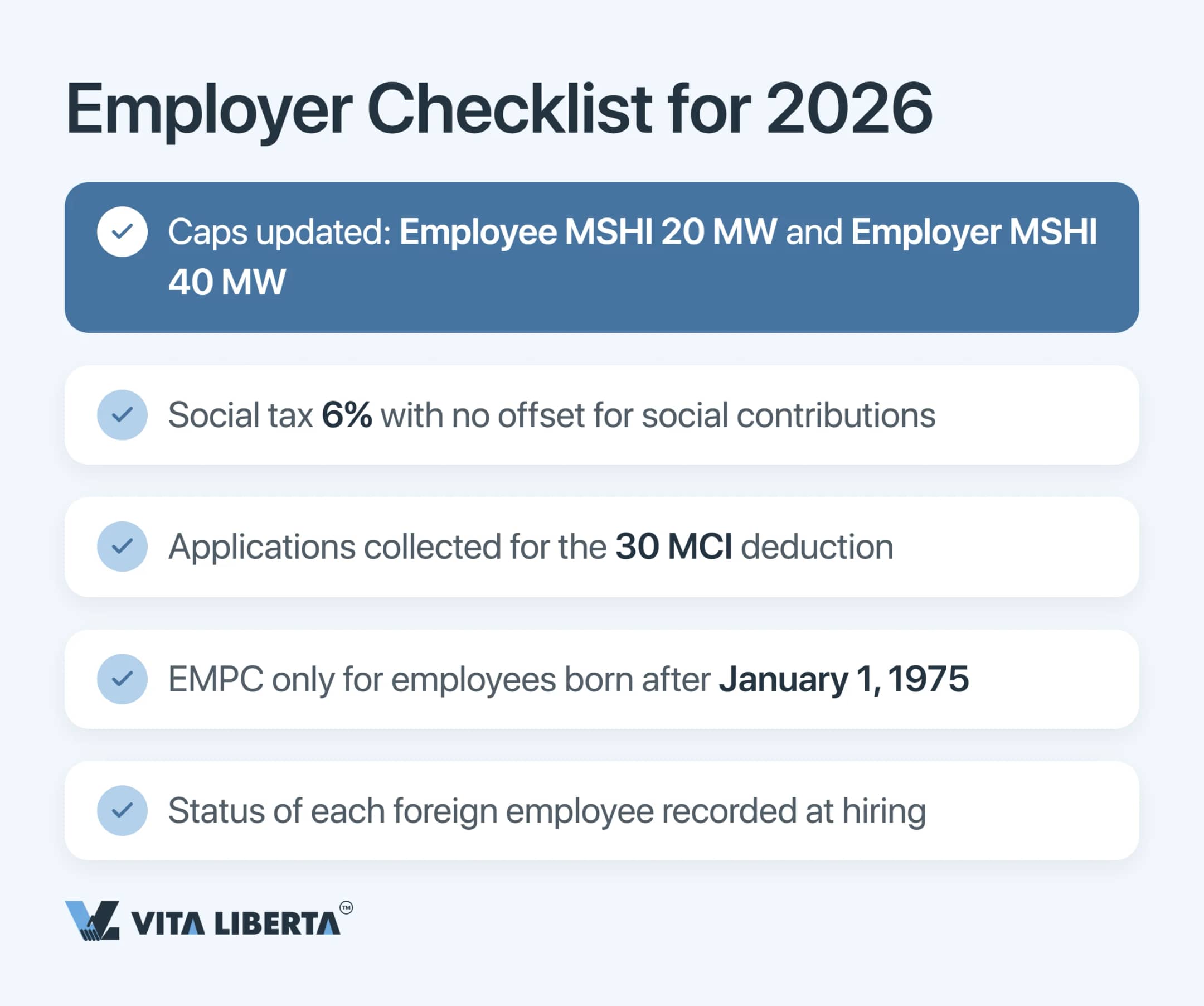
- the basic deduction jumped from 14 MCI to 30 MCI;
- social tax fell from 11% to 6%, yet SO can no longer be credited against it;
- health insurance charges now hit a ceiling: 20 MMW on the employee’s side, 40 MMW on the company’s.
Firms with foreign shareholders take the hardest hit. Copy last year’s settings straight into the accounting software, and the first quarterly close will already expose mismatches: in social tax, in executive-level caps and in how foreign staff are classified.

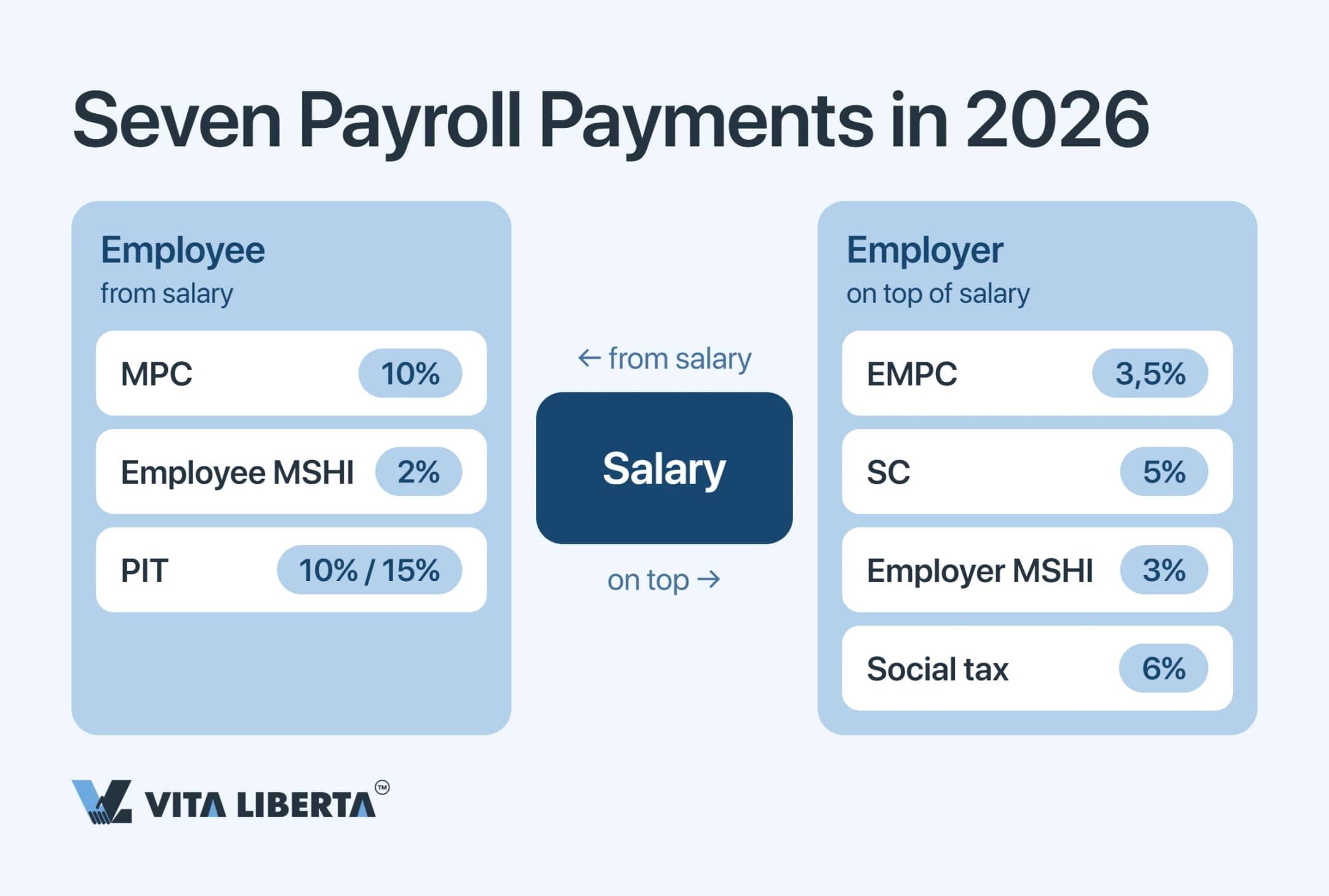
Seven salary charges: who bears each one
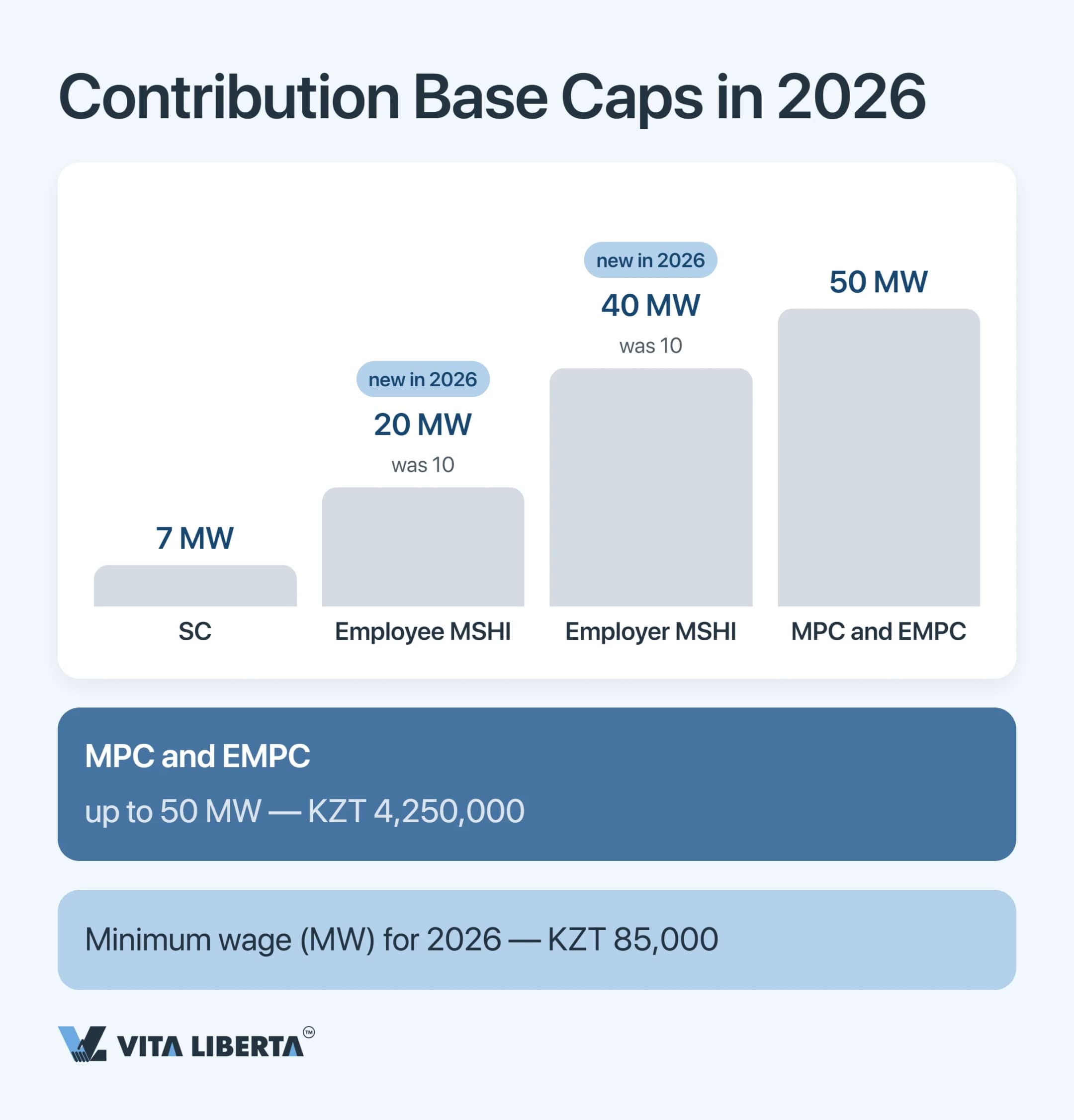
The anchor numbers sit in Article 7 of the three-year budget law for 2026–2028 (Law No. 239-VIII ZRK, signed on 8 December 2025). The statutory minimum wage (MMW, known locally as MZP) remains 85,000 tenge, and every contribution floor and ceiling is a multiple of it. The monthly calculation index (MCI, locally MRP) now equals 4,325 tenge. It is the yardstick for the PIT threshold, the basic deduction and the social tax minimum.
PIT in 2026: a lower step of 10% and an upper step of 15%
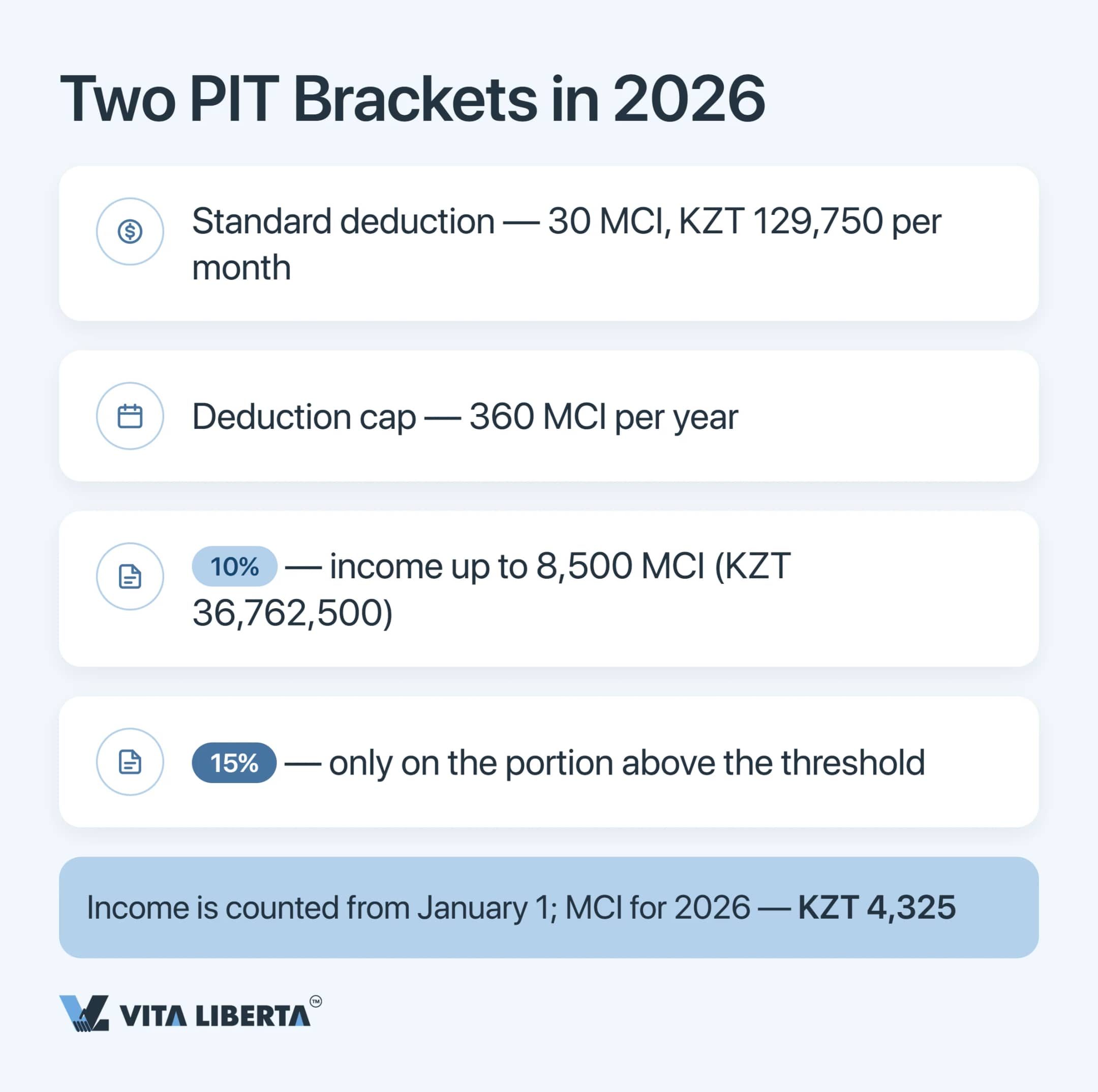
TC Art. 363(1) now splits individual income tax (PIT, IPN in local usage) into two steps. Up to 8,500 MCI of yearly taxable income, which is 36,762,500 tenge at the current index, the rate is 10%. Whatever lies beyond that mark is taxed at 15%, and only that excess. A running January-to-date total of each worker’s taxable income shows the exact moment the mark is passed.
The monthly basic deduction is now more than twice as large: 30 MCI instead of 14 MCI, or 129,750 tenge this year. TC Art. 403 limits the annual total to 360 MCI. An unused monthly allowance is lost rather than rolled forward: the KGD, the Finance Ministry’s revenue committee (KGD MF RK), has confirmed that each 30 MCI belongs to one calendar month only. As a result, pay of up to about 147,000 tenge a month carries no PIT at all.
The monthly basic deduction is now more than twice as large: 30 MCI instead of 14 MCI, or 129,750 tenge this year. TC Art. 403 limits the annual total to 360 MCI. An unused monthly allowance is lost rather than rolled forward: the KGD, the Finance Ministry’s revenue committee (KGD MF RK), has confirmed that each 30 MCI belongs to one calendar month only. As a result, pay of up to about 147,000 tenge a month carries no PIT at all.
The worker’s own share: OPV and VOSMS
Two insurance payments come straight out of the payslip.
- OPV, the obligatory pension contribution (OPC), takes 10% of earnings. No more than 50 MMW, or 4,250,000 tenge, counts as the monthly base.
- VOSMS, the obligatory medical insurance contribution (OMIC), takes another 2%. Its ceiling went from 10 MMW to 20 MMW, which puts the biggest possible monthly VOSMS at 34,000 tenge.
What the employer adds to the payroll bill
| Charge | 2026 formula | Where it goes wrong |
| Social tax | A rate of 6%, applied to pay once OPV and VOSMS have been taken out (TC Art. 557) | Any object under 14 MCI is lifted to 60,550 tenge (TC Art. 556). The month of hiring or dismissal is the only exception |
| OOSMS, the employer’s health insurance deduction | A rate of 3%, with the base limited to 40 MMW | Software left on the old 10 MMW ceiling undercounts the charge for top staff. This year’s monthly maximum per person is 102,000 tenge |
| SO, social contributions | A rate of 5%. The base is earnings net of OPV, kept between 1 MMW and 7 MMW (Social Code Art. 244) | Part-timers and half-rate staff still count from a base of at least 1 MMW |
| OPVR, the employer’s pension contribution | A rate of 3.5%, with the base kept between 1 MMW and 50 MMW | Skip it for staff born before 1975, old-age pensioners, holders of group I or II disability set with no review date, and military or equivalent personnel. By 2028 the rate climbs to 5% |
Halving social tax sounds like a gift, but the company’s bill hardly changes: the load was shifted, not removed. The KGD MF RK puts it bluntly. Since 2026, SO is no longer subtracted from social tax, so the state budget and the GFSS, the social insurance fund, each receive their sums in full.
Cost check: a 350,000-tenge salary
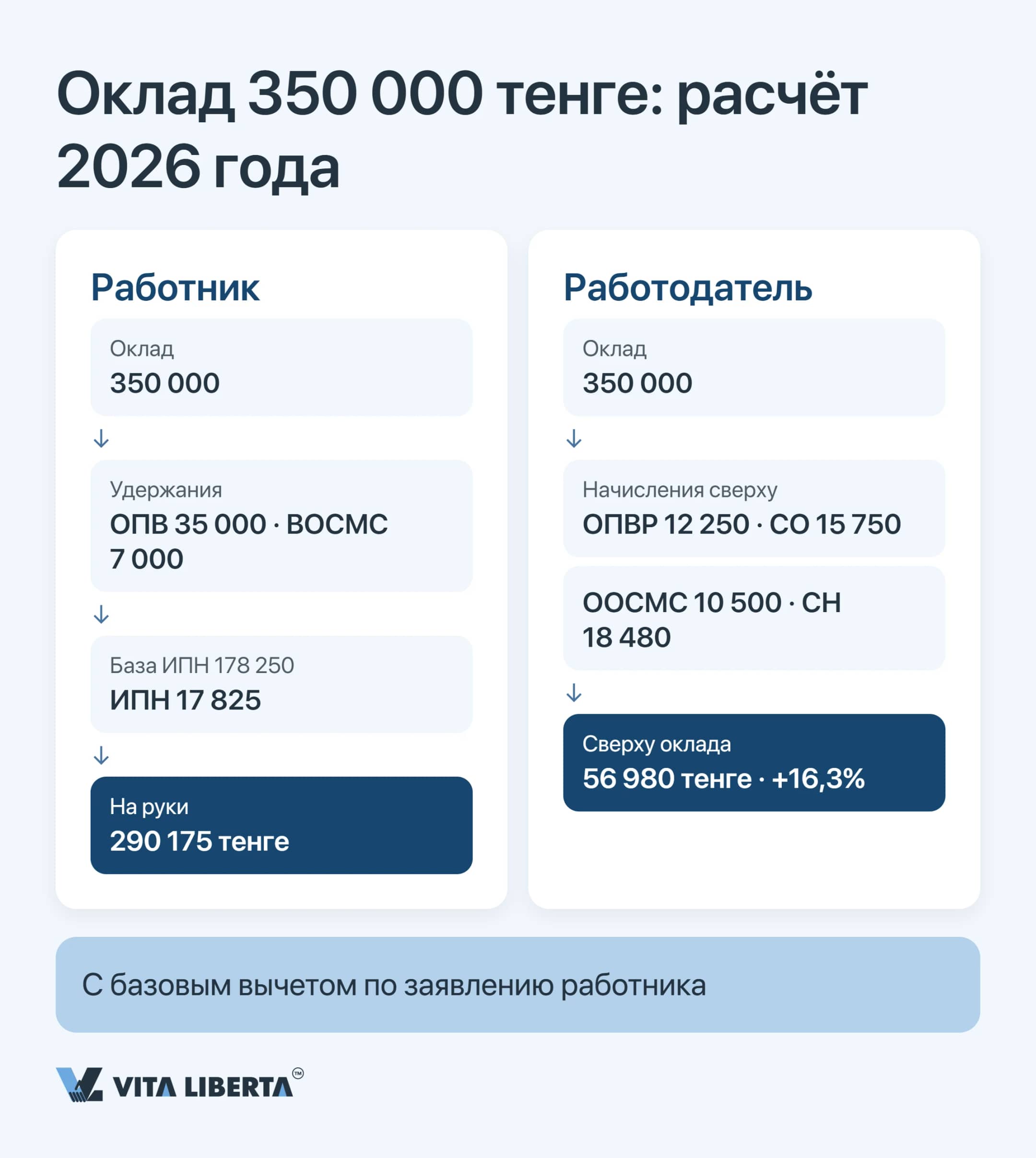
Take a gross monthly salary of 350,000 tenge. The worker loses 35,000 to OPV and 7,000 to VOSMS. Subtract the basic deduction and 178,250 tenge is left to tax; at 10%, PIT comes to 17,825 tenge.
The company then pays four more charges from its own funds.
Minimum-wage control case. On 85,000 tenge, PIT drops to nil and the employer adds 14,263 tenge. SO is computed from the floor here, since pay minus OPV falls below one MMW.
No application, no deduction. The 30 MCI relief needs a written request from the worker, filed with a single employer. If none is on file, the withholding agent taxes the whole amount.
Executives cost more. Where monthly pay reaches 3,400,000 tenge or more, the wider OOSMS ceiling alone lifts annual spending by 918,000 tenge per person.
Deducted from the worker | Tenge |
| Gross pay | 350,000 |
| OPV at 10% | −35,000 |
| VOSMS at 2% | −7,000 |
| PIT at 10% on 178,250 | −17,825 |
| Paid out to the worker | 290,175 |
The company then pays four more charges from its own funds.
| Paid by the company | Tenge |
| OPVR | 12,250 |
| SO | 15,750 |
| OOSMS | 10,500 |
| Social tax | 18,480 |
| Extra cost beyond gross pay | 56,980, or 16.3% of the salary |
Minimum-wage control case. On 85,000 tenge, PIT drops to nil and the employer adds 14,263 tenge. SO is computed from the floor here, since pay minus OPV falls below one MMW.
No application, no deduction. The 30 MCI relief needs a written request from the worker, filed with a single employer. If none is on file, the withholding agent taxes the whole amount.
Executives cost more. Where monthly pay reaches 3,400,000 tenge or more, the wider OOSMS ceiling alone lifts annual spending by 918,000 tenge per person.
Hiring foreigners: the status decides, not the passport
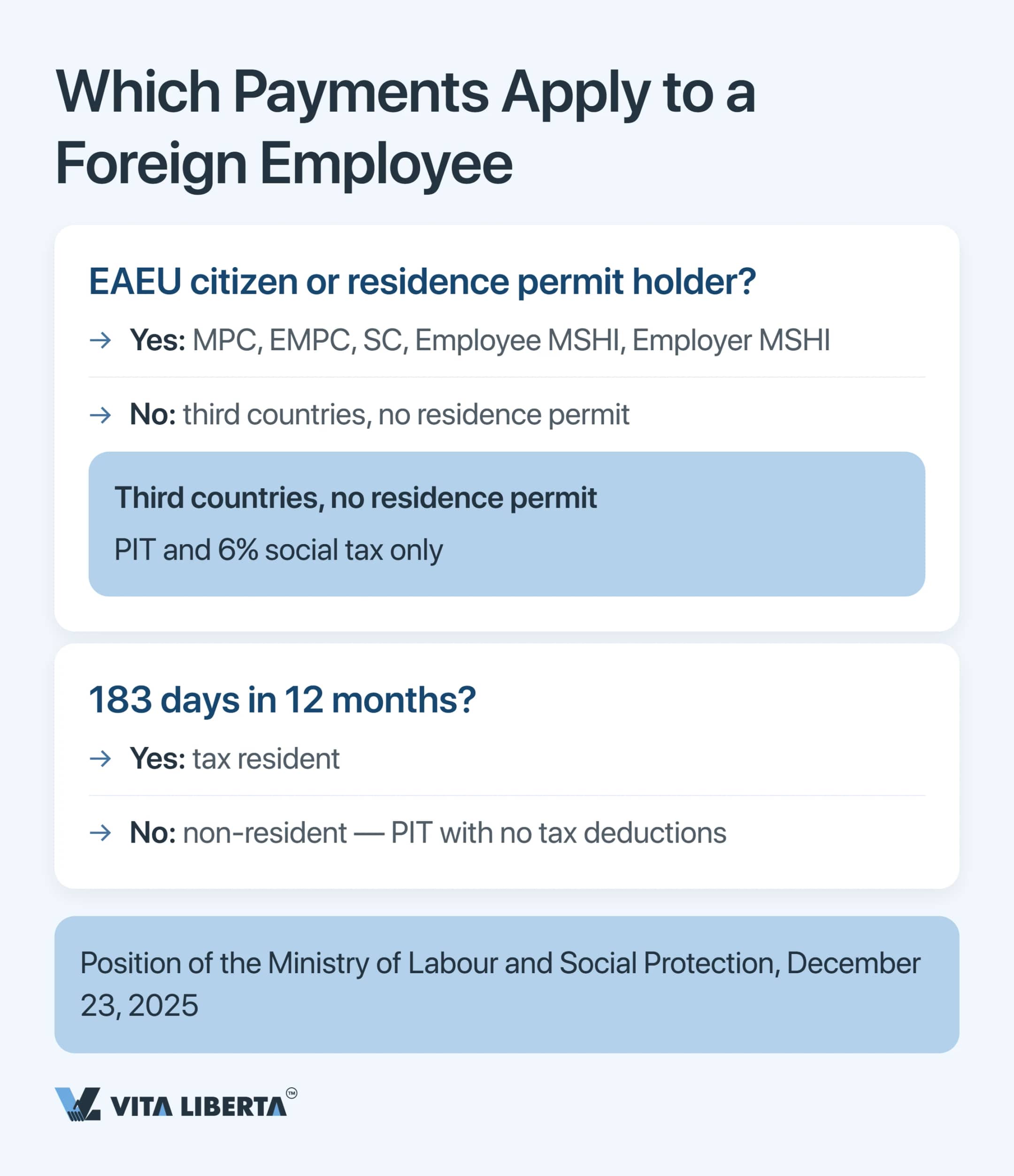
Which charges apply to a non-Kazakh employee hinges on two factors, migration status and tax residency, rather than on nationality. Tax residency arises after 183 or more calendar days in Kazakhstan within any rolling twelve-month window that ends in the current tax period; the arrival and departure days count. A centre of vital interests located in Kazakhstan is the alternative test.
EAEU nationals and residence-permit holders
Someone from Russia, Belarus, Armenia or Kyrgyzstan who signs a Kazakh employment contract and works inside the country is handled like any Kazakh worker: OPV, OPVR, SO, VOSMS and OOSMS are all due. A foreigner holding a residence permit gets identical treatment.
The picture flips when an EAEU national works remotely from home. OPV, OPVR and SO then fall away, as follows from the 23 December 2025 clarification of the Ministry of Labour and Social Protection of the Population (MTSZN RK). Access to PIT deductions depends on the worker’s own residency, not on whether their country belongs to the EAEU.
The picture flips when an EAEU national works remotely from home. OPV, OPVR and SO then fall away, as follows from the 23 December 2025 clarification of the Ministry of Labour and Social Protection of the Population (MTSZN RK). Access to PIT deductions depends on the worker’s own residency, not on whether their country belongs to the EAEU.
Short-stay foreigners from outside the EAEU
The same MTSZN RK clarification of 23 December 2025 removes OPV, OPVR and SO for foreigners with no residence permit. OSMS charges do not arise for them either, though the reason sits in a different act, the Law “On Compulsory Social Medical Insurance”. Temporarily staying foreigners join that scheme only if an international treaty says so, as is the case for EAEU citizens. What survives is social tax at 6% and PIT.
A frequent mistake among foreign founders is granting a non-resident the basic deduction. Non-residents get no deductions at all, even though their scale is identical: 10% up to 8,500 MCI of income and 15% on the rest. Practical advice: have the HR system flag day 175 of a worker’s stay, since crossing day 183 changes both their status and the whole calculation.
A frequent mistake among foreign founders is granting a non-resident the basic deduction. Non-residents get no deductions at all, even though their scale is identical: 10% up to 8,500 MCI of income and 15% on the rest. Practical advice: have the HR system flag day 175 of a worker’s stay, since crossing day 183 changes both their status and the whole calculation.
Check your payroll against the 2026 rules
- Audit of outdated templates
- Status check for foreign staff
- New ceilings and deductions

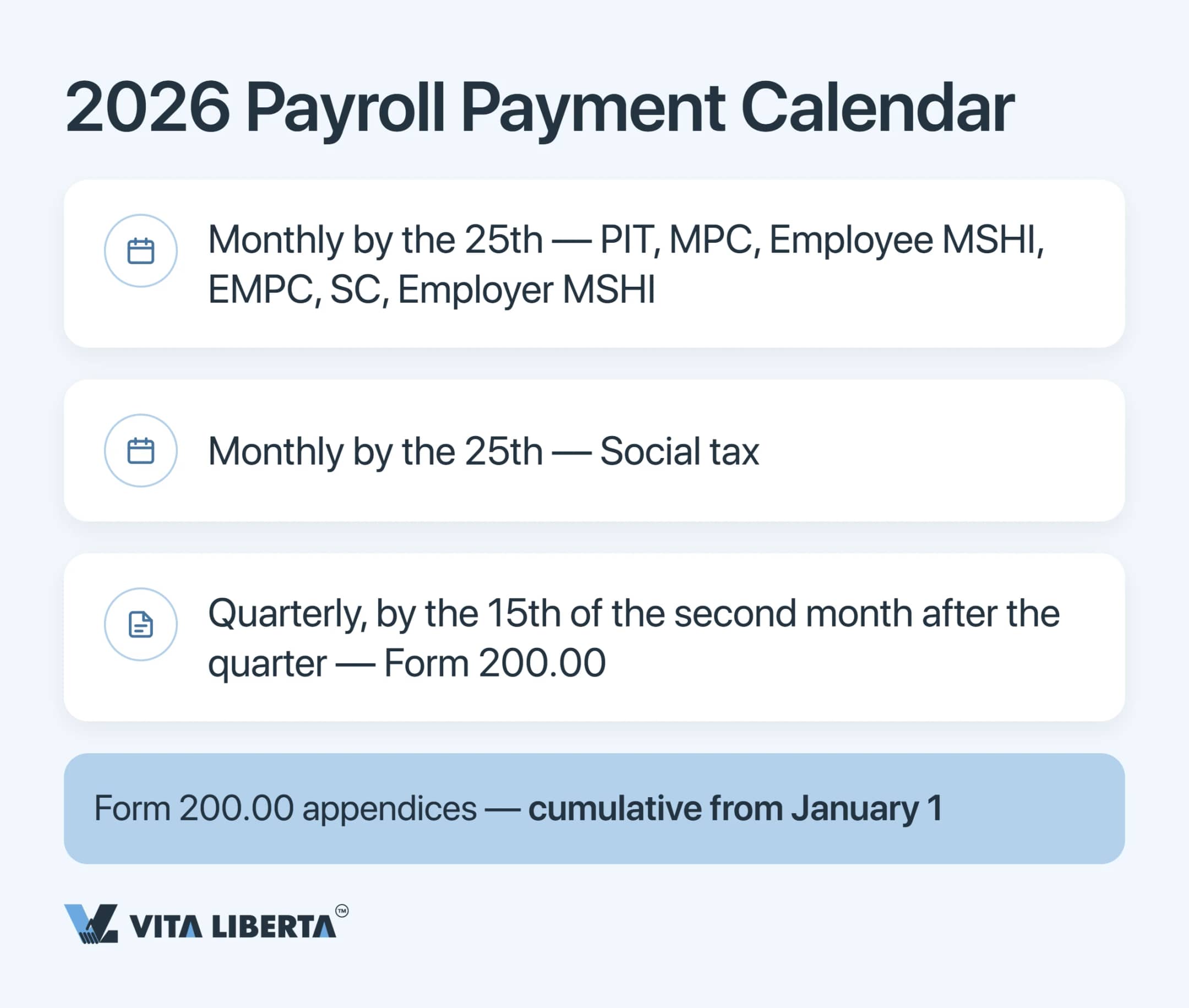
Deadlines: money by the 25th, return 200.00 every quarter
| Obligation | Cut-off date | If you miss it |
| Return 200.00 | The 15th day of the second month after quarter-end (TC Art. 445(1) for PIT, TC Art. 562(1) for social tax) | A notice from the tax office after desk review |
| Social tax | Day 25 of the month after the tax period, at the latest (TC Art. 560) | Extra tax assessed under the return, plus penalty interest |
| PIT, OPV and VOSMS deducted from staff, plus OPVR, SO and OOSMS funded by the company | Day 25 of the month after the payout month, at the latest | Penalty interest builds up daily until the arrears are cleared |
In short, annexes 200.05 and 200.06 keep their quarterly rhythm, but since 2026 every figure in them is a running total counted from 1 January.
Let our specialists run your payroll
- Monthly calculations and payments
- Filing of return 200.00
- Support when hiring foreigners
2026 payroll taxes: conclusions for decision-makers
Lower rates, higher costs. The reform contains a contradiction: rates have fallen, yet keeping a strong team in Astana or Almaty has become more expensive. The caps, not the rates, pushed costs up.
2025 reference tables are out of date. Anyone who estimates the 2026 burden with the previous Code’s rates is almost certain to get it wrong.
A foreign employee’s status is set on the day of hiring. EAEU citizenship, a residence permit and tax residency are three fields in the personnel record, and five payments depend on them.
Budget for senior managers separately. The 20 MMW VOSMS cap and the 40 MMW OOSMS cap affect what an executive costs more than PIT progression does.
Payroll taxes in 2026 have stopped being mechanical work for the accounts department. A correctly built calculation helps manage the cost of the team and protects the company from additional assessments.
Payroll taxes in Kazakhstan: five employer questions
My LLP is taking on a Russian national with no residence permit. What do I charge?
I’m a non-resident founder bringing in a third-country specialist for a short project. How does the calculation differ?
Social tax dropped to 6%, so why is my payroll bill no lower, and what should I recheck?
When does my company pay payroll taxes and file reports?
Вся представленная на сайте информация, касающаяся стоимости оказываемых услуг носит информационный характер и ни при каких условиях не является публичной офертой, определяемой положениями ст. 395 ГК РК. Интернет-сайт vitaliberta.kz составлен с вниманием к деталям в отношении законодательных требований, в том числе путем анализа судебной практики. Несмотря на это, компания ТОО "Вита Либерта" не может гарантировать безошибочность и точность содержащейся на сайте информации.