

Kazakhstan’s New Tax Code 2026: The New Bill for Foreign-Owned Companies
20 октября, 2026
A 16% VAT, a registration bar at half its former height and only three special regimes left standing. The 2026 code rewrites the numbers for any LLP with foreign shareholders, from salaries to transfers abroad.
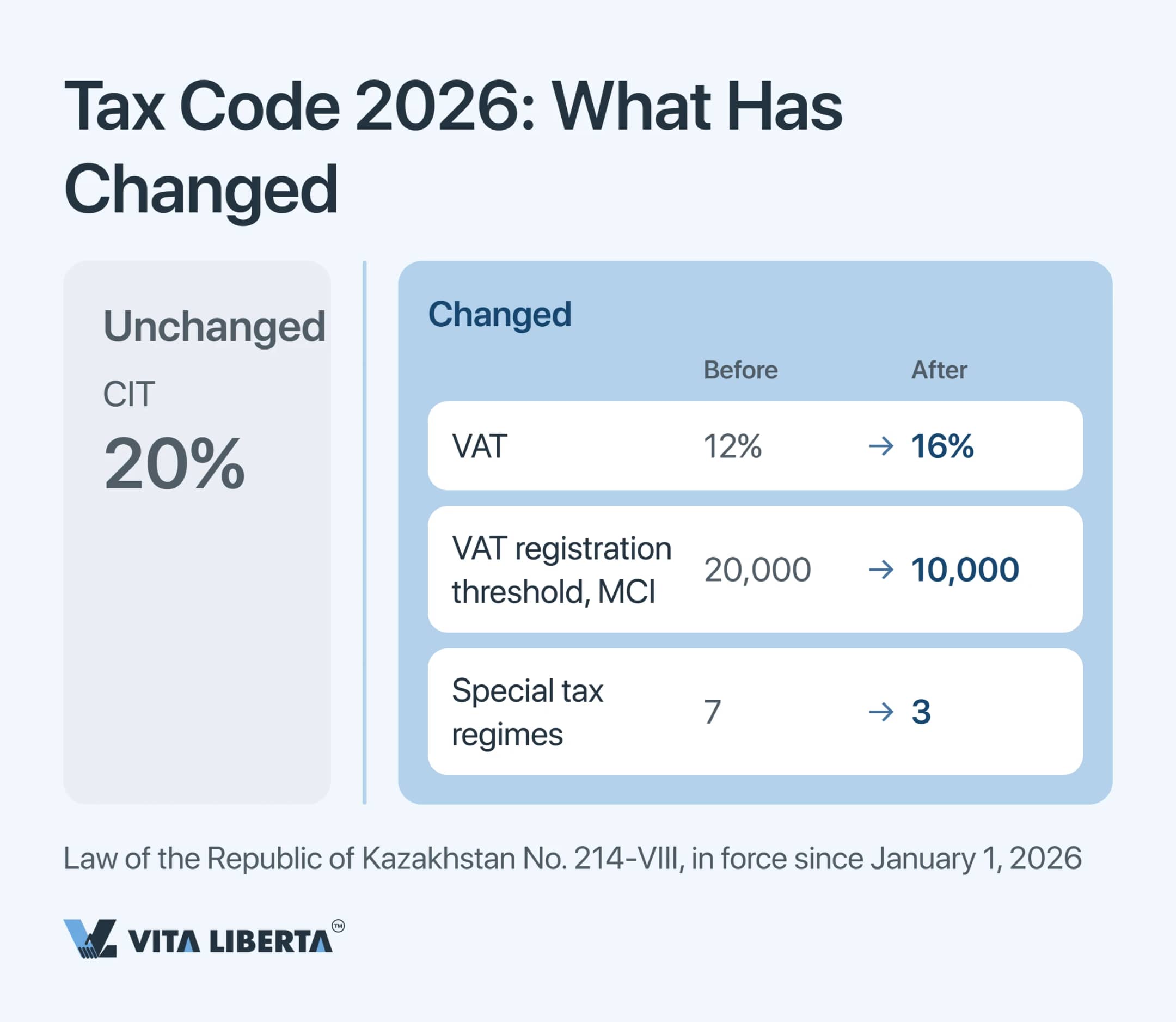
Sixteen percent VAT instead of twelve. A registration bar half as high. Three special regimes where seven used to exist. That is the picture Kazakh businesses woke up to in January 2026.
Look only at profit tax, and an LLP (the local TOO) seems untouched: the rate is still 20%. The real shift lies in the links between companies. Whether a buyer may deduct a cost now hinges on its supplier’s regime. A partnership that sends money to non-residents or orders services from abroad also carries duties it did not have before.
The core problem
“Our LLP in Almaty was bought off the shelf and reports under the simplified declaration. In March our biggest client said it can no longer count our invoices as expenses. We still pay 3%, yet the client now wants a price cut or it leaves. What changed?”
Few questions reach advisers from foreign owners of Kazakh LLPs as often as this one.
Sixteen percent VAT instead of twelve. A registration bar half as high. Three special regimes where seven used to exist. That is the picture Kazakh businesses woke up to in January 2026.
Look only at profit tax, and an LLP (the local TOO) seems untouched: the rate is still 20%. The real shift lies in the links between companies. Whether a buyer may deduct a cost now hinges on its supplier’s regime. A partnership that sends money to non-residents or orders services from abroad also carries duties it did not have before.
The core problem
“Our LLP in Almaty was bought off the shelf and reports under the simplified declaration. In March our biggest client said it can no longer count our invoices as expenses. We still pay 3%, yet the client now wants a price cut or it leaves. What changed?”
Few questions reach advisers from foreign owners of Kazakh LLPs as often as this one.

Why Is 1 January 2026 the Date That Matters, and What Is an MCI?
Everything hinges on 1 January 2026, when Code No. 214-VIII ZRK of 18 July 2025 “On Taxes and Other Mandatory Payments to the Budget (Tax Code)” took effect. Its predecessor, No. 120-VI ZRK of 25 December 2017, lost force, and the familiar article numbers went with it. Nor is the new code static: lawmakers changed it during 2026. Before relying on any rule, open the version that applied on the date of your transaction at adilet.zan.kz.
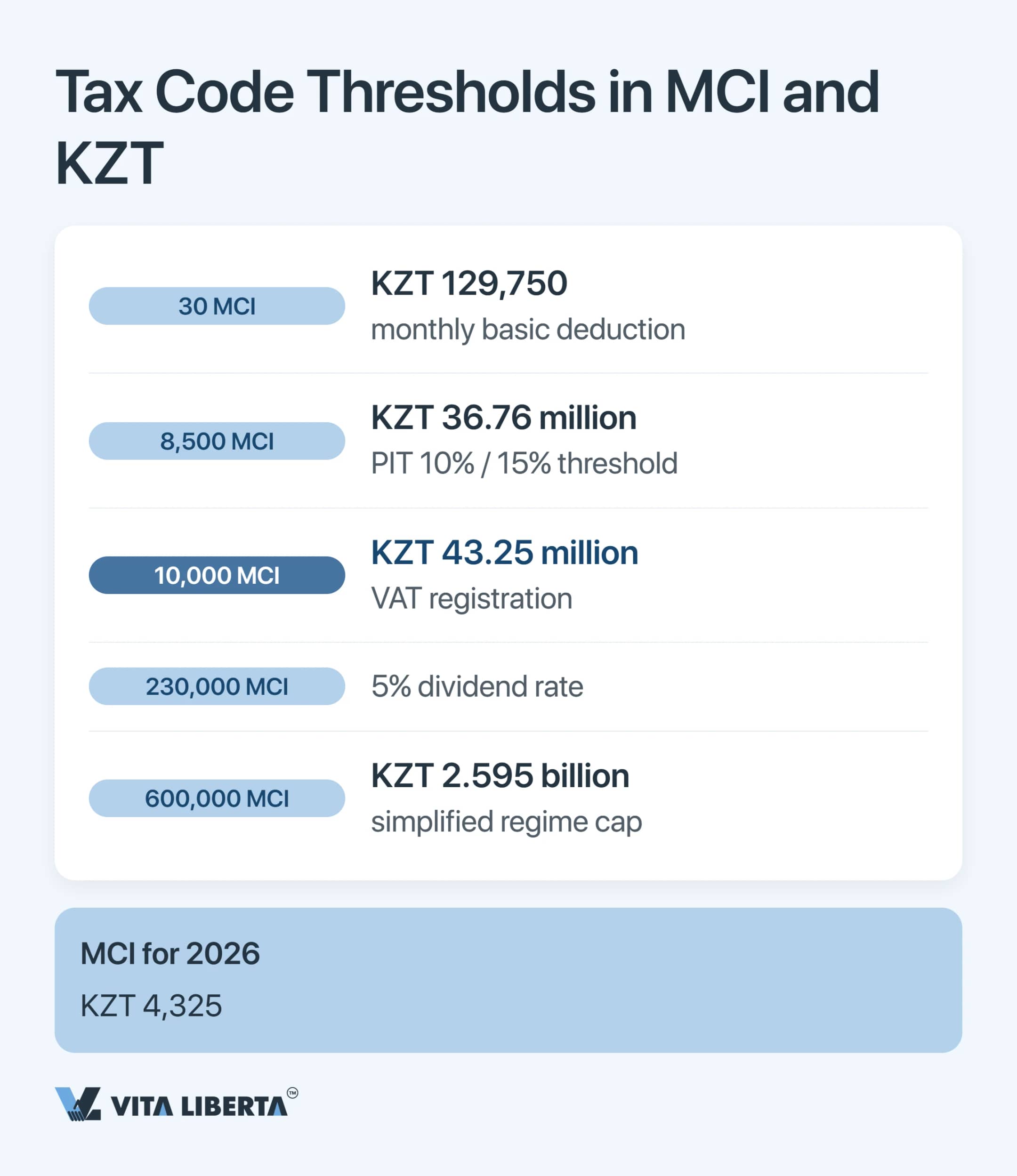
Thresholds are mostly counted in monthly calculation indices (MCI). The MCI is reset every year in the republican budget law; for 2026 it stands at 4,325 tenge. Foreign owners often make an expensive error here: they model their tax load on 2024–2025 reviews, whose rates and article citations come from a repealed statute.
Thresholds are mostly counted in monthly calculation indices (MCI). The MCI is reset every year in the republican budget law; for 2026 it stands at 4,325 tenge. Foreign owners often make an expensive error here: they model their tax load on 2024–2025 reviews, whose rates and article citations come from a repealed statute.
Kazakhstan Taxes for an LLP: How the Three Core Taxes Moved
Each of them went its own way. VAT rose, profit tax split by sector, and income tax on individuals acquired a second step.
Kazakhstan VAT 16%: Higher Rate, Lower Bar
The headline rate climbed from 12% to 16%. Those four extra points land either in the price list or in the margin.
The duty to register now arrives sooner. Crossing 10,000 MCI of turnover in a year (43.25 million tenge with the 2026 MCI) triggers it, while the old code let a business stay outside VAT up to double that figure.
Medicine got a softer landing. Drugs, medical devices and healthcare services that do not qualify for exemption carry 5% for 2026 and move to 10% in 2027. Kazakhstan’s own periodical press already pays a reduced 10%.
No e-invoice (ESF), no credit for input tax. The credit is flagged in the information system ahead of filing the Form 300.00 return.
The duty to register now arrives sooner. Crossing 10,000 MCI of turnover in a year (43.25 million tenge with the 2026 MCI) triggers it, while the old code let a business stay outside VAT up to double that figure.
Medicine got a softer landing. Drugs, medical devices and healthcare services that do not qualify for exemption carry 5% for 2026 and move to 10% in 2027. Kazakhstan’s own periodical press already pays a reduced 10%.
No e-invoice (ESF), no credit for input tax. The credit is flagged in the information system ahead of filing the Form 300.00 return.
Profit Tax: 20% for Most, Different Numbers by Sector
The bulk of companies keep paying corporate income tax (CIT) at 20%. Beyond that, the code links the rate to the line of business:
- banks and gambling operators: 25%, although bank earnings from loans to entrepreneurs stay at the ordinary 20%;
- the social sector, education and healthcare included: 5% for 2026 and 10% starting 2027;
- farm cooperatives: 6%;
- agricultural producers and aquaculture: 3%.
Salaries and Payroll Charges: What the Employer Must Rework
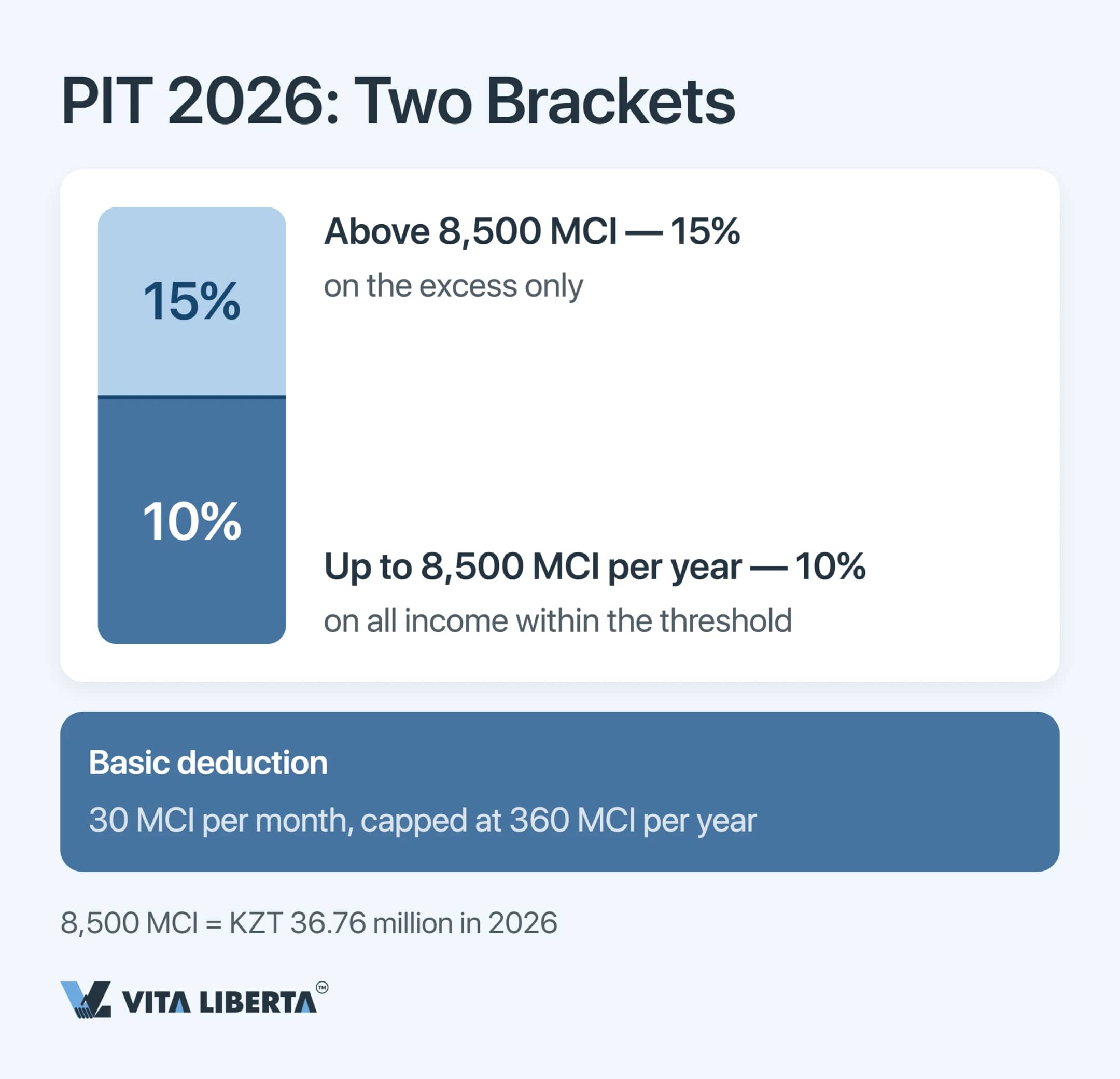
Income tax on individuals (PIT) is no longer flat. The step sits at 8,500 MCI of yearly income, which is 36.76 million tenge in 2026. Earnings below it bear 10%, and 15% applies only to the slice above.
The standard monthly deduction jumped from 14 to 30 MCI (129,750 tenge), more than twice the old amount. It is capped at 360 MCI a year, and only one tax agent may apply it: the one holding the employee’s application.
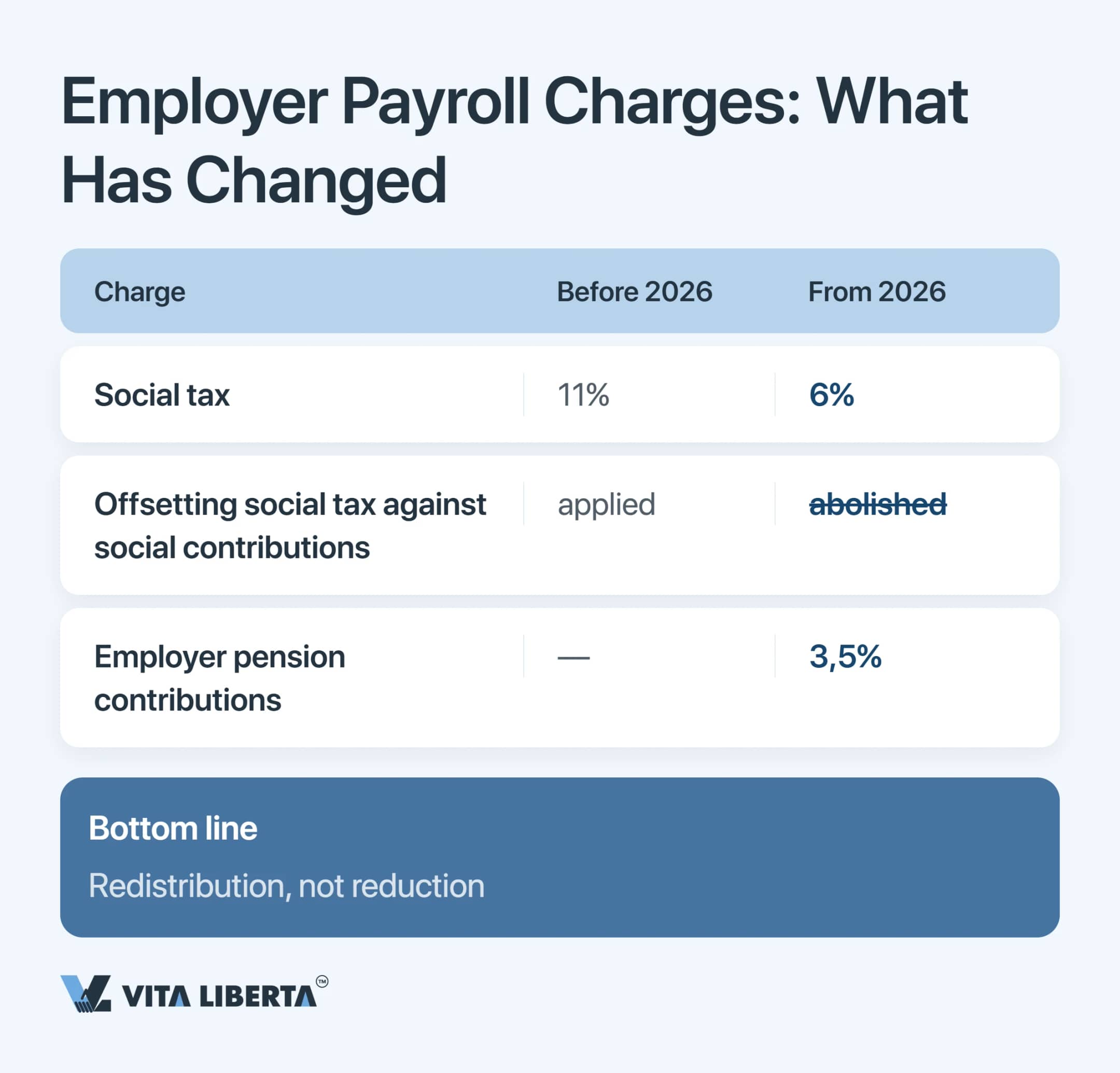
For the employer, social tax dropped from 11% to 6%, yet social contributions may no longer reduce it. Employer pension contributions are being raised in stages and reach 3.5% in 2026. Social contributions and OSMS (compulsory social health insurance) payments still come on top, paid separately as before. Bottom line: the cost of wages was reshuffled rather than cut.
The standard monthly deduction jumped from 14 to 30 MCI (129,750 tenge), more than twice the old amount. It is capped at 360 MCI a year, and only one tax agent may apply it: the one holding the employee’s application.
For the employer, social tax dropped from 11% to 6%, yet social contributions may no longer reduce it. Employer pension contributions are being raised in stages and reach 3.5% in 2026. Social contributions and OSMS (compulsory social health insurance) payments still come on top, paid separately as before. Bottom line: the cost of wages was reshuffled rather than cut.
| Tax | What applies in 2026 | Adviser’s verdict |
| Social tax | 6%, with no reduction for social contributions | Rework needed: rebuild the payroll estimate |
| VAT | 16%; registration compulsory past 10,000 MCI of turnover | Rework needed: price lists and contracts |
| PIT | 10% on yearly income up to 8,500 MCI, 15% beyond | Holds; high salaries fall into both steps |
| CIT | 20%; 25%, 6%, 5% or 3% in specific sectors | Holds; the real business line sets the rate |
Money Going Abroad and Goods from the EAEU: The LLP’s New Duties
The reform is felt most sharply at the border: when funds are transferred abroad or goods travel between member states of the Eurasian Economic Union (EAEU).
Withholding Tax in Kazakhstan on Services, Dividends and Royalties
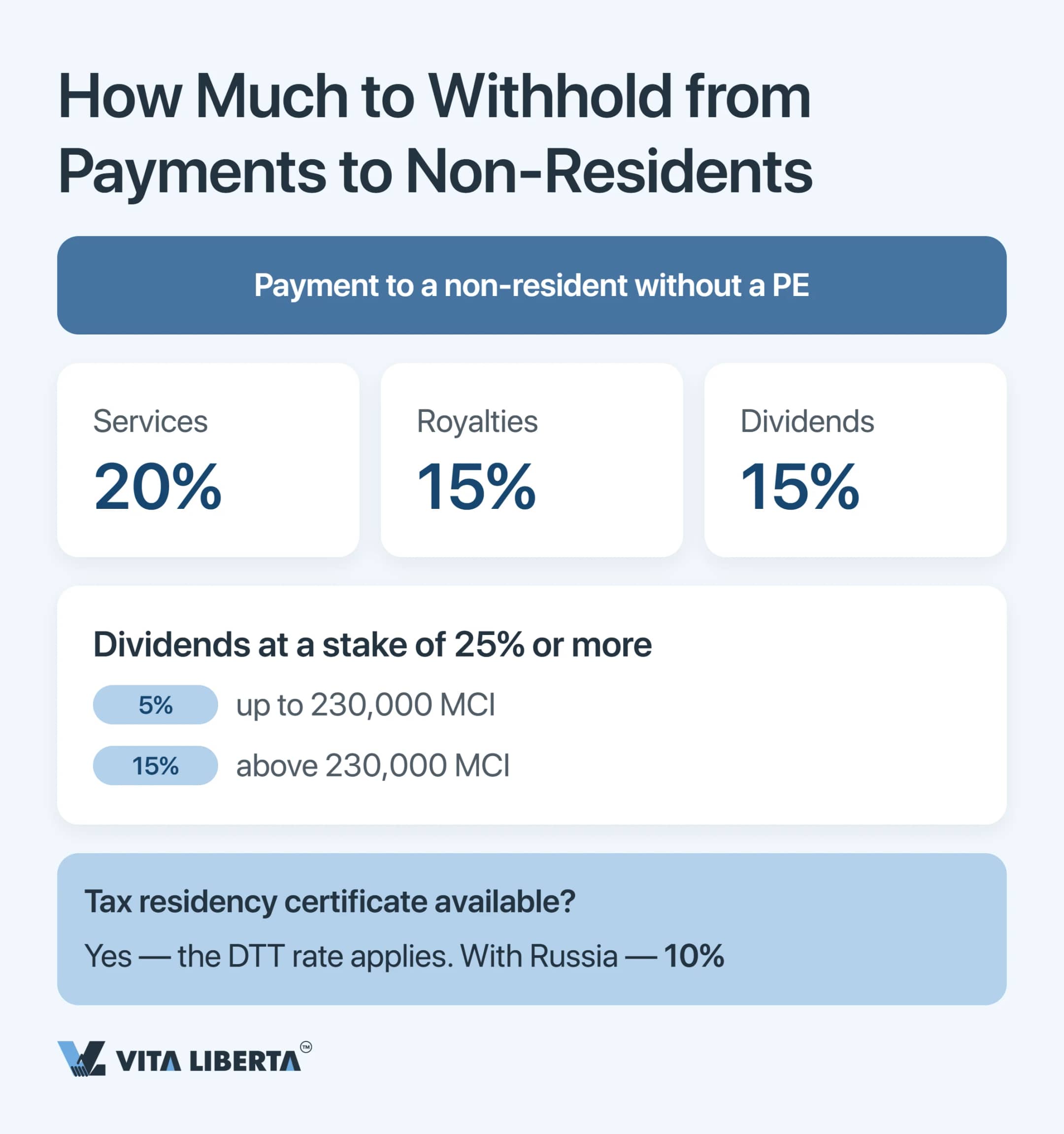
A foreign payee without a permanent establishment in Kazakhstan does not settle the tax itself. The Kazakh LLP, as tax agent, computes it and remits it to the budget.
Fees for services lose 20% at payment, and the place of performance offers no shelter. Legal help, marketing, consulting, audit, design, advertising, engineering, information processing, management and financial services are all treated as income from Kazakhstan, even if the contractor never visited. Only notarial work and representation in court are carved out.
Royalties and dividends start lower, at 15%. Article 682 grants a holder of a stake of 25% or more a reduced band: 5% on dividends up to 230,000 MCI (994.75 million tenge with the 2026 MCI) and 15% on the remainder. The old relief for stakes held longer than three years is gone.
A double taxation agreement only helps if the agent receives the payee’s residency certificate on time. The treaty with Russia (Convention of 18 October 1996), to take one example, caps dividends, interest and royalties at 10%. Treaties may also cut or cancel tax on service fees.
Tip: collect a fresh certificate from the founder each January, before any decision to pay out profit.
Fees for services lose 20% at payment, and the place of performance offers no shelter. Legal help, marketing, consulting, audit, design, advertising, engineering, information processing, management and financial services are all treated as income from Kazakhstan, even if the contractor never visited. Only notarial work and representation in court are carved out.
Royalties and dividends start lower, at 15%. Article 682 grants a holder of a stake of 25% or more a reduced band: 5% on dividends up to 230,000 MCI (994.75 million tenge with the 2026 MCI) and 15% on the remainder. The old relief for stakes held longer than three years is gone.
A double taxation agreement only helps if the agent receives the payee’s residency certificate on time. The treaty with Russia (Convention of 18 October 1996), to take one example, caps dividends, interest and royalties at 10%. Treaties may also cut or cancel tax on service fees.
Tip: collect a fresh certificate from the founder each January, before any decision to pay out profit.
Foreign Services and EAEU Imports: How the VAT Credit Slips Away
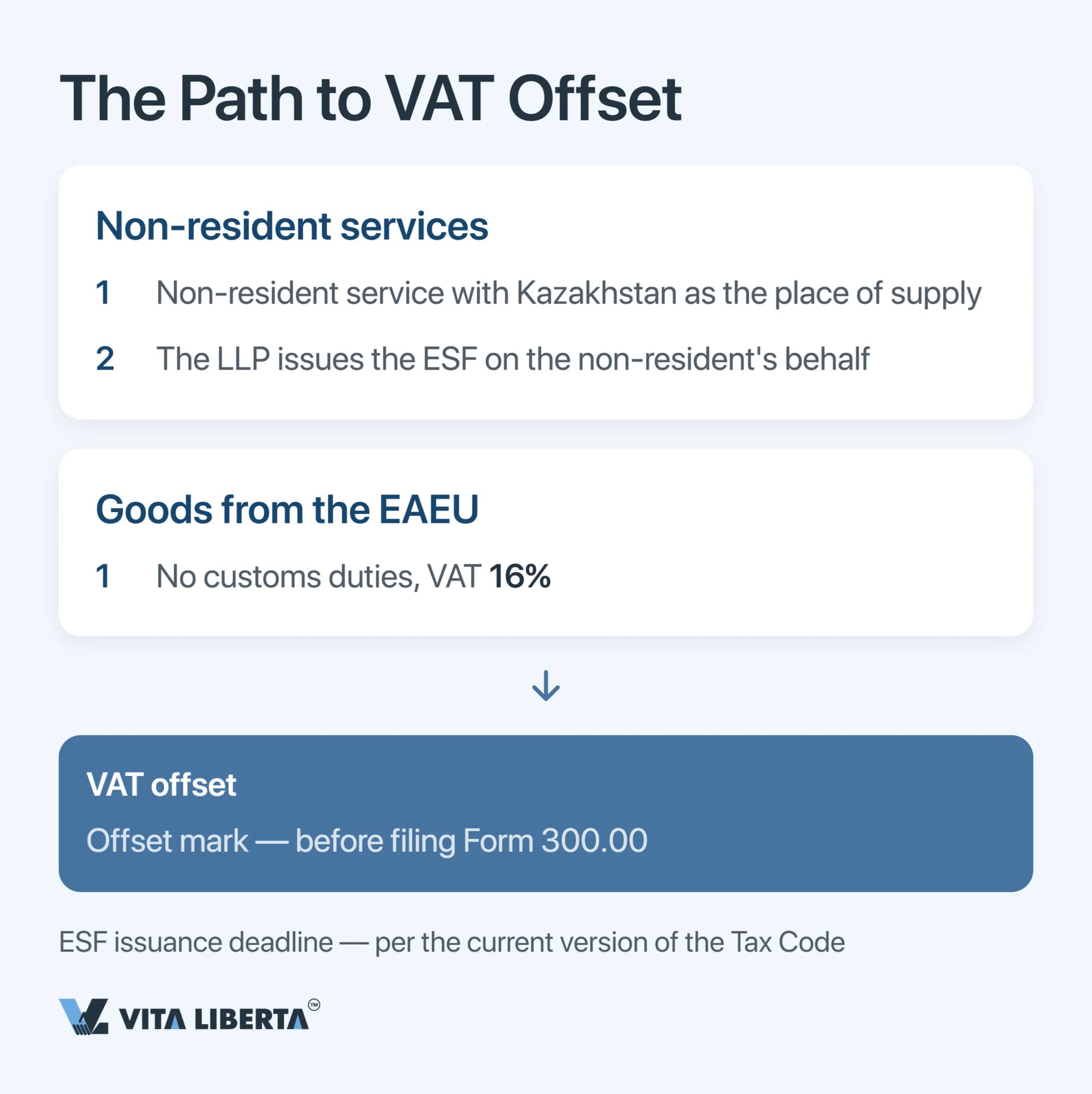
When the place-of-supply rules locate a foreign company’s work or services in Kazakhstan, the buyer now writes the ESF instead of the seller, provided the buyer is registered for VAT. Without that document there is no credit.
The steps go in this order. First, VAT for the non-resident goes to the budget. After that, the code as currently worded allows five calendar days from payment to issue the ESF. A longer deadline was floated in 2026, but it exists only as draft amendments, so stick to five days and confirm the wording in force at adilet.zan.kz.
The EAEU common market waives customs duties, not tax. Goods brought in from member states attract VAT, and since 2026 that means 16%.
The steps go in this order. First, VAT for the non-resident goes to the budget. After that, the code as currently worded allows five calendar days from payment to issue the ESF. A longer deadline was floated in 2026, but it exists only as draft amendments, so stick to five days and confirm the wording in force at adilet.zan.kz.
The EAEU common market waives customs duties, not tax. Goods brought in from member states attract VAT, and since 2026 that means 16%.
Check Your Tax Load Before the Auditors Do
- Your LLP’s regime and rates reviewed
- Withholding on payments to foreign recipients
- ESFs issued without losing the VAT credit

Simplified Declaration After the Reform: The B2B Price of a 4% Rate
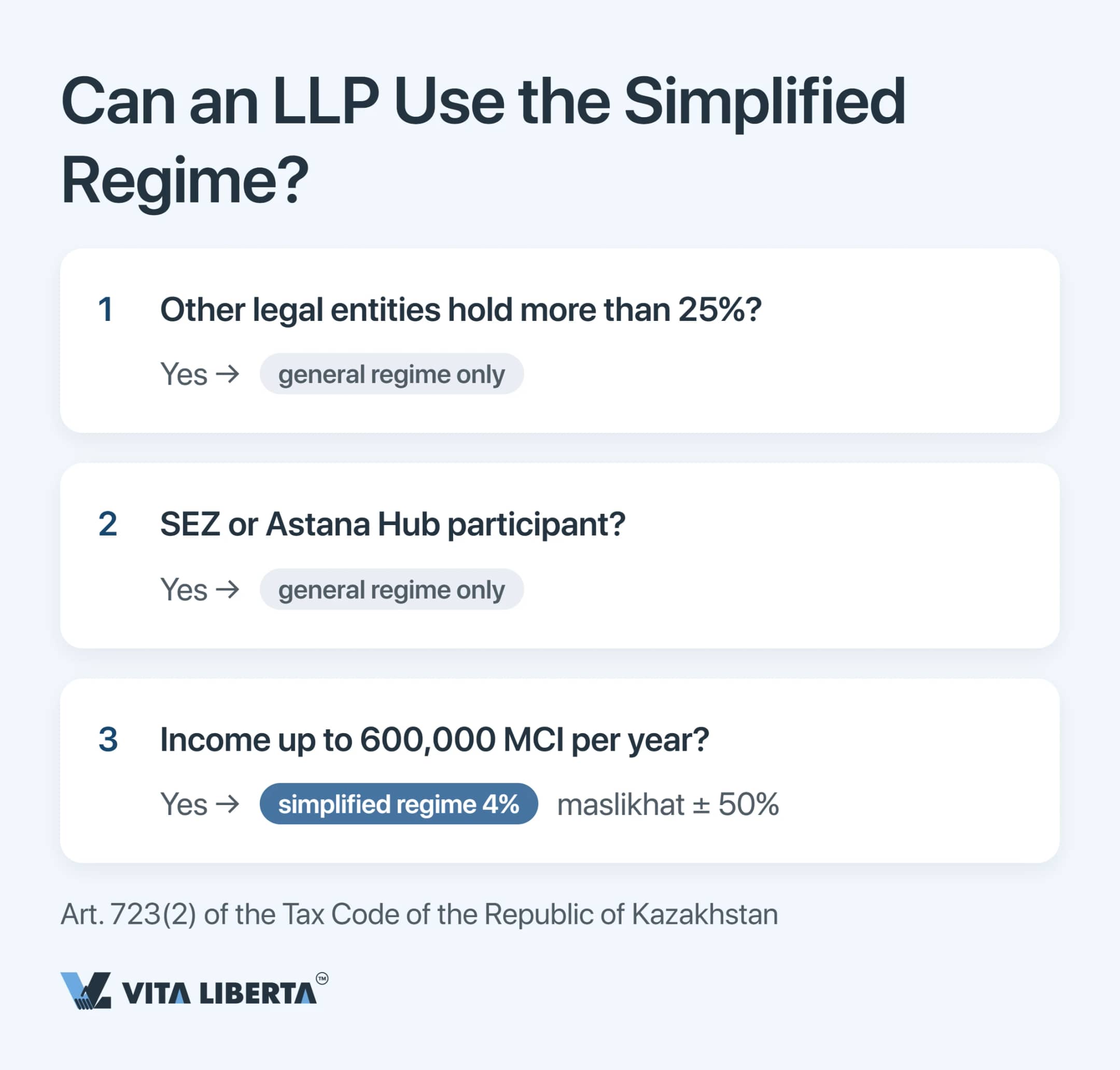
Seven special tax regimes existed before; three survived. The new code drops the patent and the retail tax altogether. The self-employed and peasant or farm households now have dedicated regimes, and other small businesses are left with one option: the simplified declaration. Individual entrepreneurs and resident legal entities may use it while yearly income stays within 600,000 MCI (2.595 billion tenge with the 2026 MCI).
Article 726 fixes the PIT or CIT rate at 4%. However, the rate actually paid is set by the local maslikhat, the elected council of a region, city or district. It can move the rate down or up by half, so anywhere from 2% to 6%. For 2026 most councils went lower: simplified filers in Astana and Almaty pay 3%. A dedicated breakdown of the simplified declaration covers the details.
What matters more to a foreign investor is Article 723, paragraph 2, subparagraph 1. A legal entity whose capital is more than 25% owned by other legal entities cannot use the simplified declaration. That shuts the door on any LLP owned by a foreign company. SEZ and Astana Hub participants are excluded by a separate subparagraph.
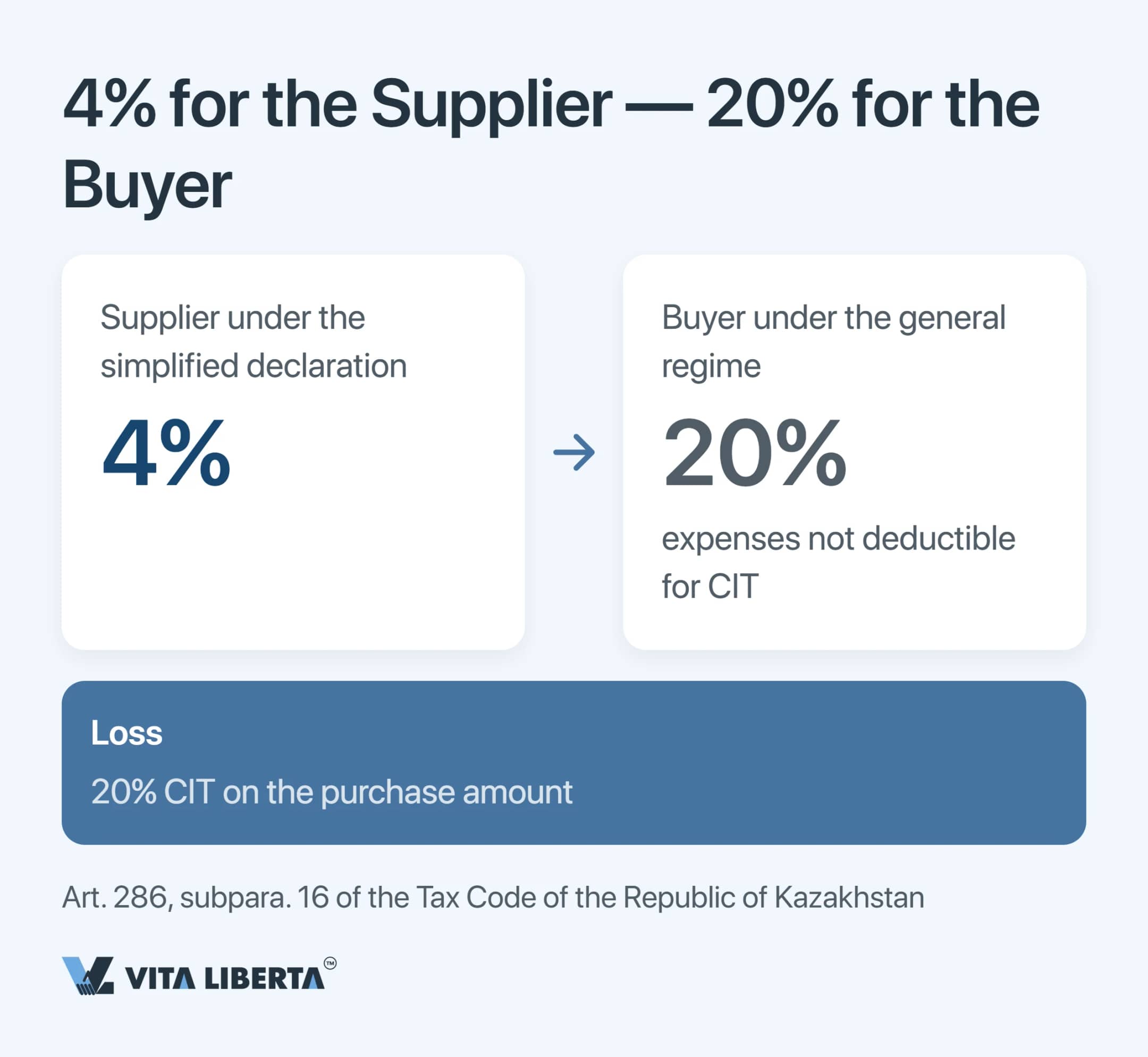
Important: Article 286, subparagraph 16, bars a buyer under the general regime from deducting a purchase for CIT if its supplier was filing the simplified declaration on the date the goods, works or services arrived. The supplier’s cheap rate (4% under the code) is therefore funded by the customer: the purchase amount stays in the customer’s taxable base and bears 20% CIT.
Article 726 fixes the PIT or CIT rate at 4%. However, the rate actually paid is set by the local maslikhat, the elected council of a region, city or district. It can move the rate down or up by half, so anywhere from 2% to 6%. For 2026 most councils went lower: simplified filers in Astana and Almaty pay 3%. A dedicated breakdown of the simplified declaration covers the details.
What matters more to a foreign investor is Article 723, paragraph 2, subparagraph 1. A legal entity whose capital is more than 25% owned by other legal entities cannot use the simplified declaration. That shuts the door on any LLP owned by a foreign company. SEZ and Astana Hub participants are excluded by a separate subparagraph.
Important: Article 286, subparagraph 16, bars a buyer under the general regime from deducting a purchase for CIT if its supplier was filing the simplified declaration on the date the goods, works or services arrived. The supplier’s cheap rate (4% under the code) is therefore funded by the customer: the purchase amount stays in the customer’s taxable base and bears 20% CIT.
Kazakhstan Taxes 2026: What It Means for Strategy
Here is the paradox. CIT stands still, yet many foreign-owned companies now pay more, through 16% VAT, the lower registration bar, deductions lost by customers of simplified-regime suppliers and fresh duties on cross-border payments.
Rework the financial model. Prices, contracts and payroll estimates drawn up on 2025 figures must be redone for 16% VAT and a 6% social tax that nothing reduces any more.
Screen every supplier. Whether a purchase lowers your CIT base depends on the counterparty’s regime on the delivery date.
Keep a file on each non-resident. Gather the residency certificate and evidence of beneficial ownership ahead of the payment, not once a tax audit begins.
The 2026 code, then, is less about new percentages and more about a new design for dealing with counterparties. Companies that have rebuilt their contracts and supply chains to fit it can use the tax obligation as a lever on business value.
Rework the financial model. Prices, contracts and payroll estimates drawn up on 2025 figures must be redone for 16% VAT and a 6% social tax that nothing reduces any more.
Screen every supplier. Whether a purchase lowers your CIT base depends on the counterparty’s regime on the delivery date.
Keep a file on each non-resident. Gather the residency certificate and evidence of beneficial ownership ahead of the payment, not once a tax audit begins.
The 2026 code, then, is less about new percentages and more about a new design for dealing with counterparties. Companies that have rebuilt their contracts and supply chains to fit it can use the tax obligation as a lever on business value.
Get Your Tax Accounting Ready for the New Code
- Picking the regime that fits your LLP
- Checking suppliers for special tax regimes
- Support with payouts to non-residents
Foreign-Owned LLP Taxes in Kazakhstan: Five Questions Owners Ask
At what point must my LLP register for VAT in Kazakhstan, and how do I protect the input tax credit?
How much is withheld from dividends I receive from Kazakhstan as a foreign founder?
Paying a foreign consultant: does my LLP withhold tax, and how does VAT accounting change?
What happened to my staff’s income tax, and how much does payroll cost my LLP now?
Вся представленная на сайте информация, касающаяся стоимости оказываемых услуг носит информационный характер и ни при каких условиях не является публичной офертой, определяемой положениями ст. 395 ГК РК. Интернет-сайт vitaliberta.kz составлен с вниманием к деталям в отношении законодательных требований, в том числе путем анализа судебной практики. Несмотря на это, компания ТОО "Вита Либерта" не может гарантировать безошибочность и точность содержащейся на сайте информации.