

Does a foreign citizen permanently residing in Kazakhstan with a residence permit have the right to register a legal entity without obtaining a category C5 visa?
Business Visa C5 to Kazakhstan: A Complete Guide to Requirements and Application
20 May, 2026
Entering the Kazakhstani market by establishing a separate subdivision is an important stage of development for any international company. This form of presence opens up broad opportunities for doing business, establishing partnerships, and strengthening positions in a new market. At the same time, it is crucial to understand the specifics of the operation of a branch and representative office, as well as to strictly comply with all necessary registration procedures. This article will examine how to properly open a subdivision in Kazakhstan: what documents are needed, what the costs will be, and what tax obligations will arise.

Contents
Judicial Practice
Procedure for Obtaining the First C5 Visa
Business Visa C5
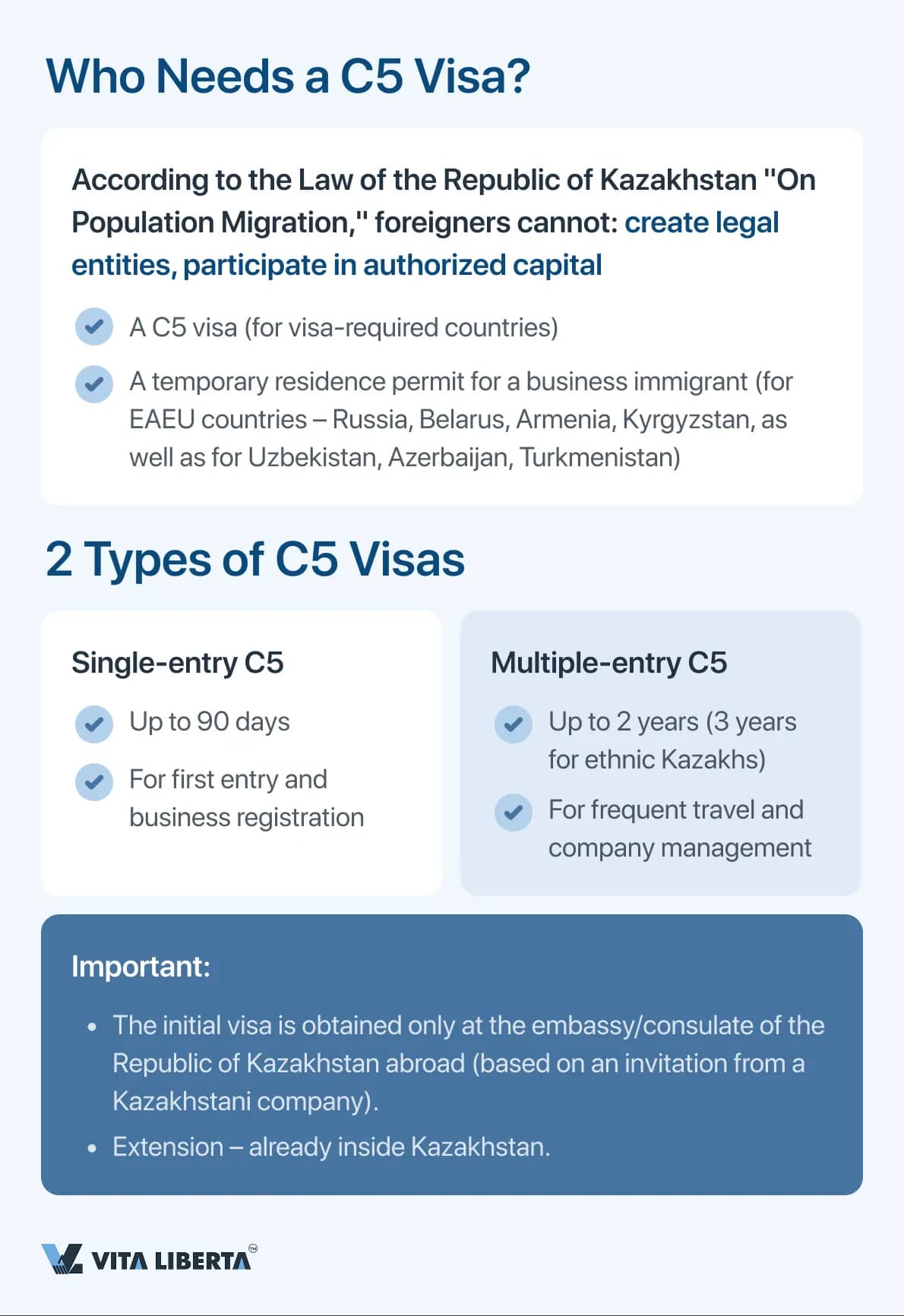
According to the provisions of the Law of the Republic of Kazakhstan "On Population Migration," foreign citizens cannot create legal entities or participate in the authorized capital of commercial organizations unless they have obtained:
Thus, before registering a company or joining the participants of an existing organization, a foreign citizen must obtain:
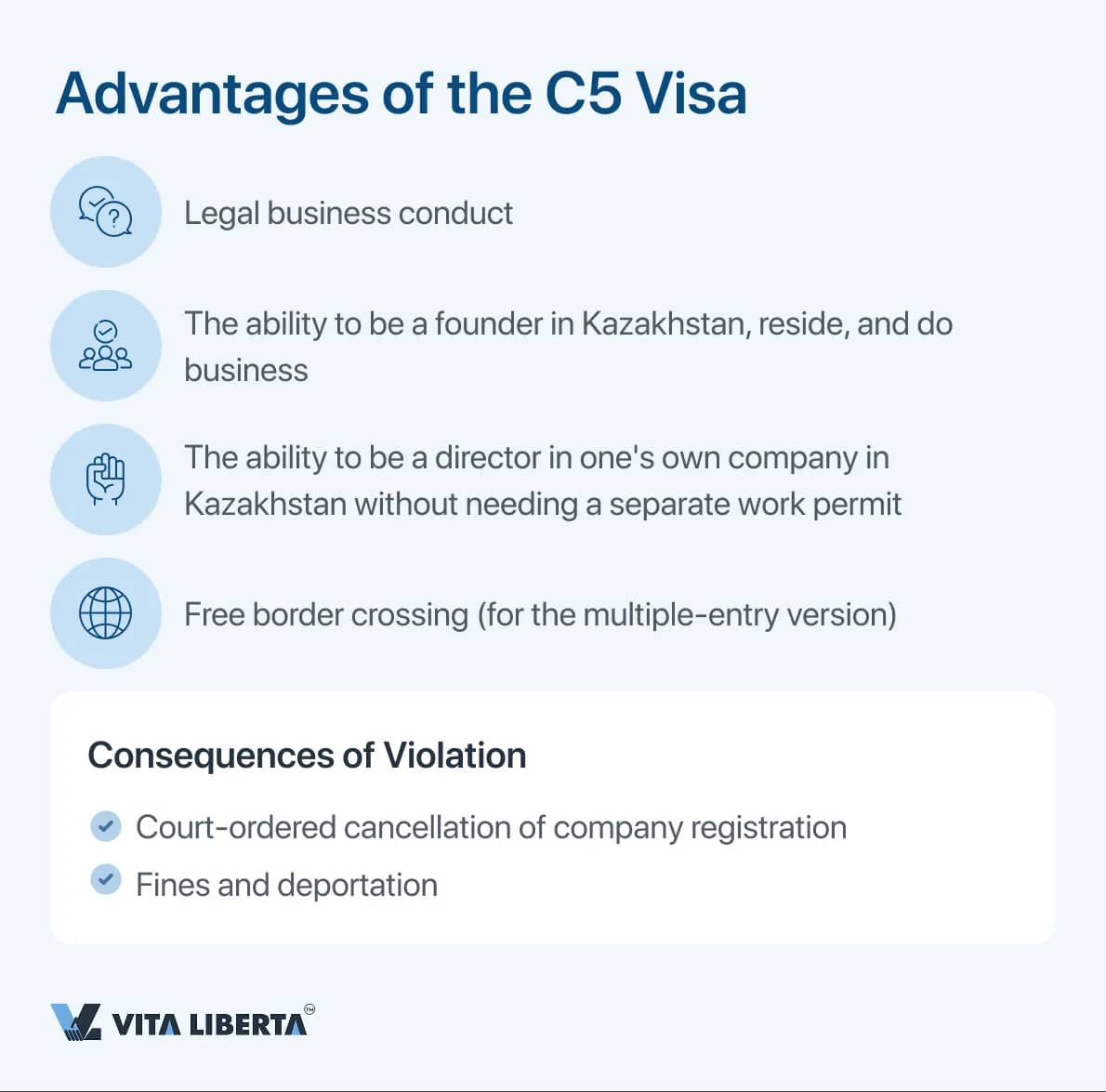
The C5 visa category is intended for entrepreneurs from countries with which Kazakhstan has a visa regime and who plan to register their own business or become a founder of a company in Kazakhstan. This visa provides the opportunity to legally reside in the country and engage in entrepreneurial activities.
Registering a company or joining the participants without first obtaining a C5 visa may become grounds for canceling the company's registration through a court order.
There are two types of C5 visas:
It is only possible to obtain the initial single-entry visa abroad, at Kazakhstani embassies or consulates, provided there is an invitation from a local company. Later, while already inside the country, the document can be extended.
The C5 visa allows not only for establishing or purchasing a business but also for officially holding a managerial position in one's own organization, without the need for a separate work permit.
Special conditions apply to ethnic Kazakhs – the validity period of a C5 visa for them can reach up to three years.
- an entry visa
- or a temporary residence permit as a business immigrant.
Thus, before registering a company or joining the participants of an existing organization, a foreign citizen must obtain:
- either a temporary residence permit for a business immigrant (for citizens of EAEU countries – Russia, Belarus, Armenia, Kyrgyzstan, as well as for citizens of Azerbaijan, Uzbekistan, and Turkmenistan)
- or a category C5 visa for citizens from other countries.
The C5 visa category is intended for entrepreneurs from countries with which Kazakhstan has a visa regime and who plan to register their own business or become a founder of a company in Kazakhstan. This visa provides the opportunity to legally reside in the country and engage in entrepreneurial activities.
Registering a company or joining the participants without first obtaining a C5 visa may become grounds for canceling the company's registration through a court order.
There are two types of C5 visas:
- Single-entry C5: Valid for up to 90 days and intended for the first arrival to start business registration.
- Multiple-entry C5: Can be issued for up to 2 years, allowing frequent border crossings for business purposes.
It is only possible to obtain the initial single-entry visa abroad, at Kazakhstani embassies or consulates, provided there is an invitation from a local company. Later, while already inside the country, the document can be extended.
The C5 visa allows not only for establishing or purchasing a business but also for officially holding a managerial position in one's own organization, without the need for a separate work permit.
Special conditions apply to ethnic Kazakhs – the validity period of a C5 visa for them can reach up to three years.
Procedure for Obtaining the First C5 Visa
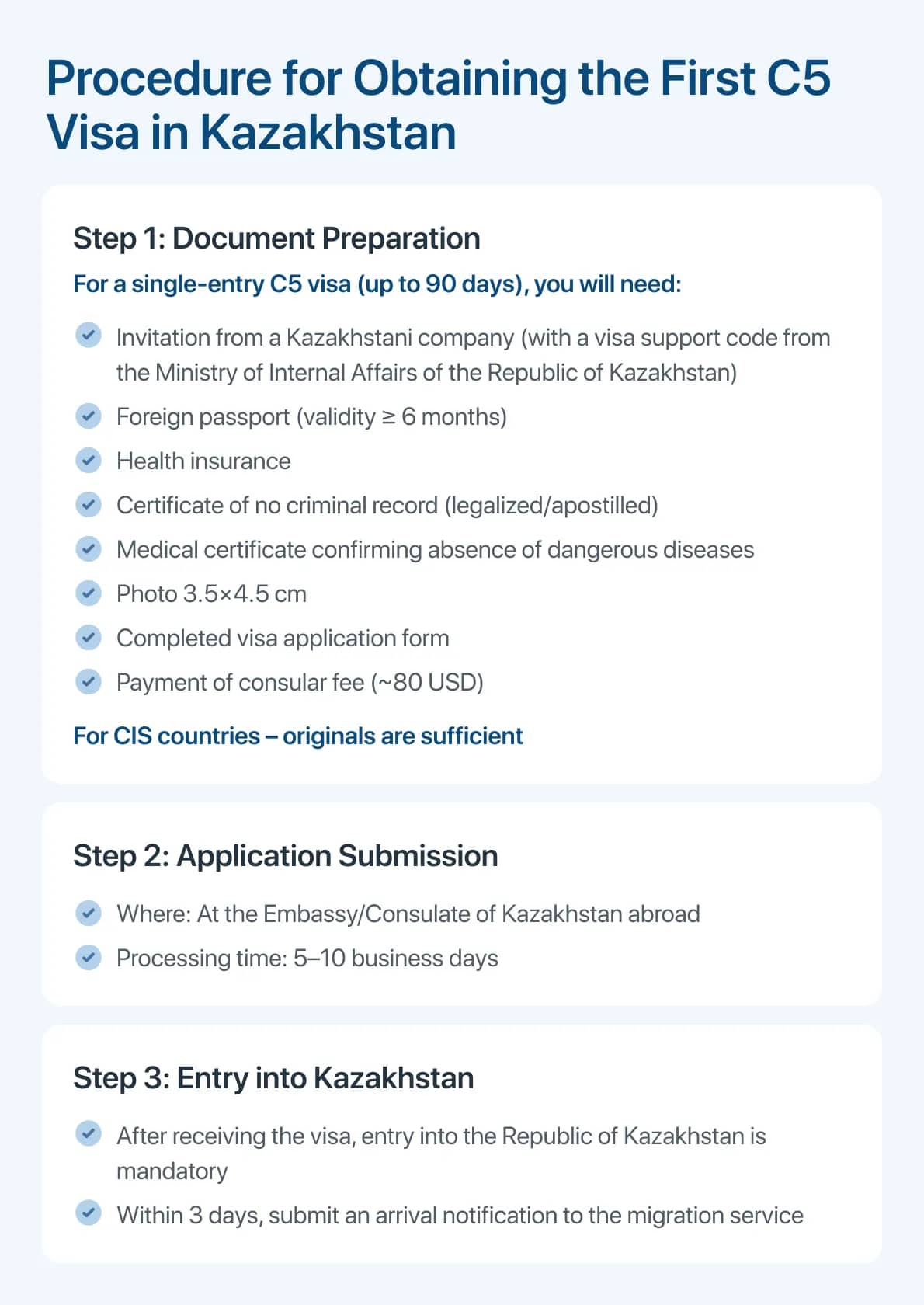
Before registering a legal entity, a foreign citizen must obtain a single-entry C5 visa, which is issued for a period of up to 90 days.
Conditions for issuing a category C5 business immigrant visa to a foreign citizen:
The invitation is issued by any commercial organization, business partners, clients, or a law firm. The invitation letter from the Kazakhstani organization must contain a special visa support code, which must be approved by the relevant structures of the Ministry of Internal Affairs of Kazakhstan.
It is important to consider that the inviting party bears a certain responsibility for the invitee regarding their compliance with laws and must guarantee payment of deportation expenses if such a need arises and the invitee does not have the means to leave.
All documents issued outside Kazakhstan must undergo a legalization or apostille procedure, except for cases when they are issued in CIS countries – in such cases, presenting the originals is sufficient.
When submitting documents for company registration or joining a company at the Public Service Center (PSC), the foreign citizen's crossing of the Republic of Kazakhstan border at the time of submission is mandatory.
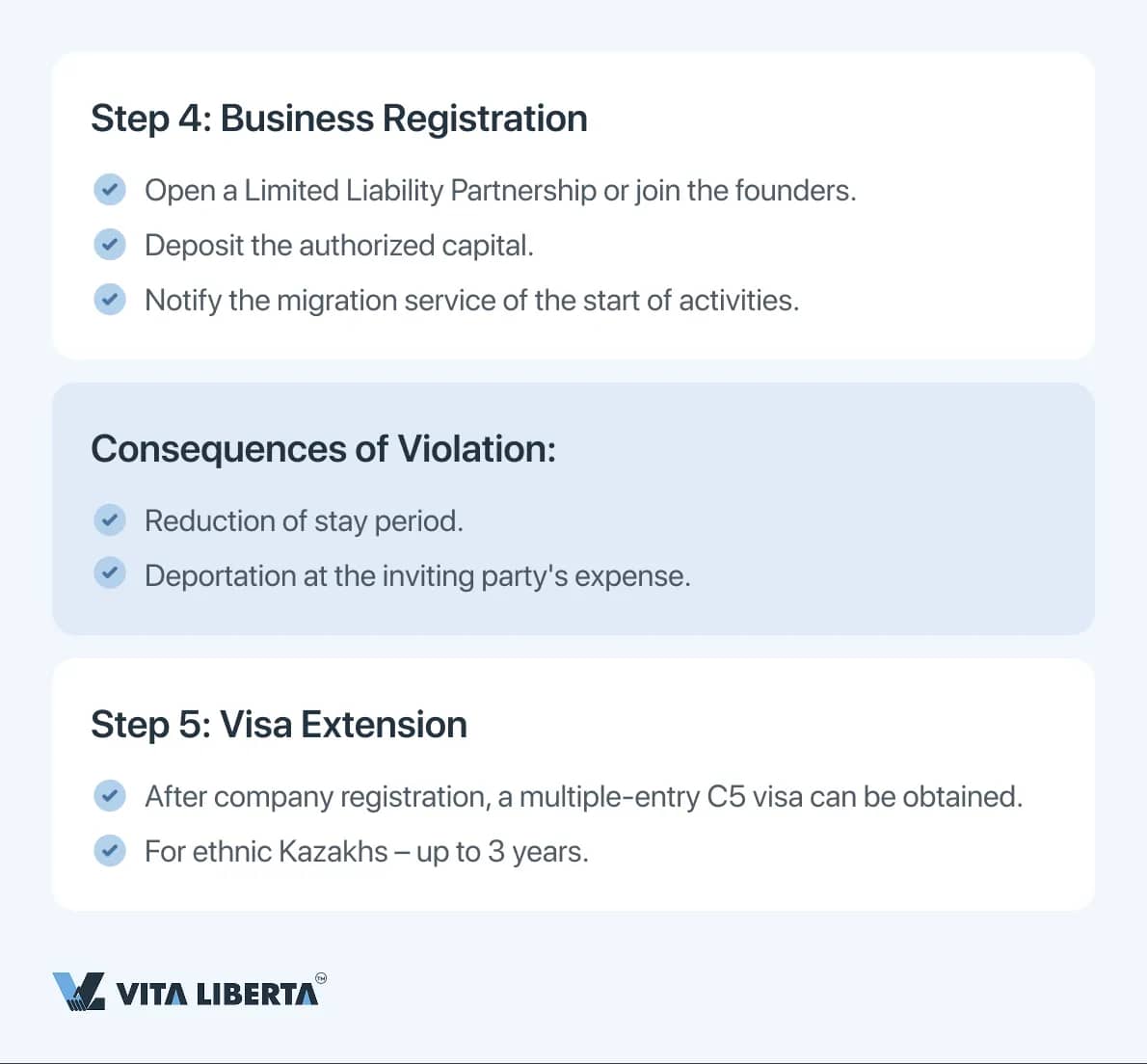
Furthermore, within two months from the date of entry into the Republic of Kazakhstan, the foreign citizen is obliged to perform the following actions:
In case of failure to fulfill these obligations, the internal affairs bodies, upon the request of local executive bodies, may shorten the foreign citizen's period of stay in the Republic of Kazakhstan to the date necessary for their voluntary departure.
Conditions for issuing a category C5 business immigrant visa to a foreign citizen:
- Invitation from a local company, with a number obtained from the migration service.
- Applicant's age of majority.
- Health insurance.
- Certificate of criminal record / no criminal record.
- Provision of a medical certificate confirming the absence of diseases that hinder work activity.
- Completed and signed visa application.
- Photograph of the established format.
- Payment of a consular fee of approximately 80 US dollars.
The invitation is issued by any commercial organization, business partners, clients, or a law firm. The invitation letter from the Kazakhstani organization must contain a special visa support code, which must be approved by the relevant structures of the Ministry of Internal Affairs of Kazakhstan.
It is important to consider that the inviting party bears a certain responsibility for the invitee regarding their compliance with laws and must guarantee payment of deportation expenses if such a need arises and the invitee does not have the means to leave.
All documents issued outside Kazakhstan must undergo a legalization or apostille procedure, except for cases when they are issued in CIS countries – in such cases, presenting the originals is sufficient.
When submitting documents for company registration or joining a company at the Public Service Center (PSC), the foreign citizen's crossing of the Republic of Kazakhstan border at the time of submission is mandatory.
Furthermore, within two months from the date of entry into the Republic of Kazakhstan, the foreign citizen is obliged to perform the following actions:
- Register a commercial organization or join the participants (shareholders) of existing organizations.
- Deposit into a second-tier bank of the Republic of Kazakhstan an amount not less than the minimum established by law for the formation of the authorized capital.
- Timely notify the migration authorities of their arrival.
In case of failure to fulfill these obligations, the internal affairs bodies, upon the request of local executive bodies, may shorten the foreign citizen's period of stay in the Republic of Kazakhstan to the date necessary for their voluntary departure.
How a Foreigner Can Extend Their Visa and Obtain a Multiple-Entry C5 Visa
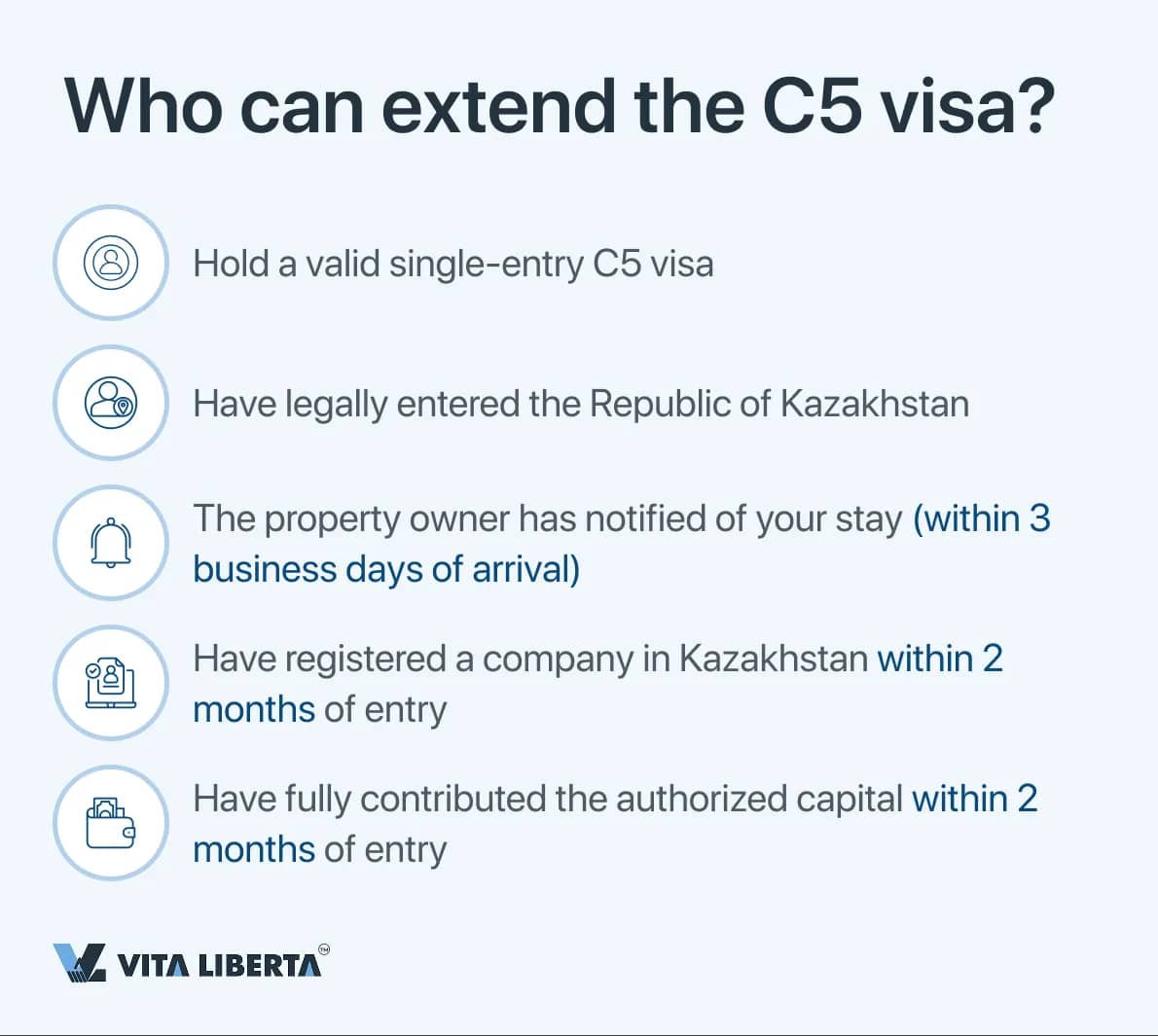
When a foreign entrepreneur completes the procedure of registering their enterprise in Kazakhstan and contributes the authorized capital in full, they may stay in the country for a longer period. To this end, the possibility of extending the C5 visa while simultaneously obtaining its multiple-entry version is provided.
In most cases, the multiple-entry C5 visa is issued for a period of up to two years. However, for representatives of the Kazakh diaspora of ethnic origin, the permit can be issued for a period of up to three years.
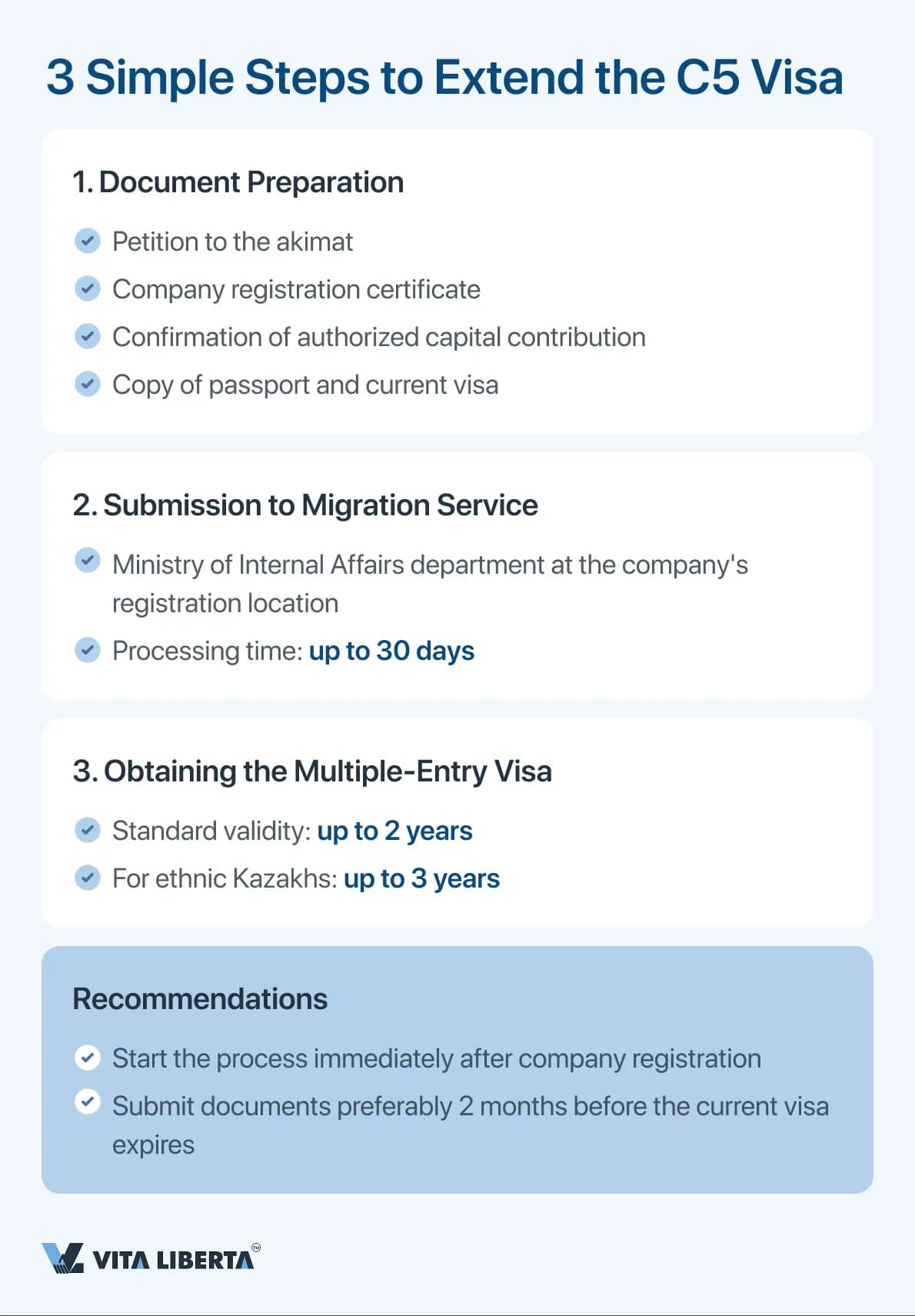
The procedure consists of several key steps:
Previously, under the old version of the rules, the extension of the C5 visa could only be initiated by the inviting party that had issued the initial invitation. This led to the need for a double visa entry: first for 90 days from the inviting company, and then from the legal entity of which the foreigner becomes a founder.
The new version of Rule No. 53 eliminated this ambiguity. Now, the extension of the C5 visa can be processed at the migration service of the Republic of Kazakhstan within the country, without the need to travel abroad. This simplifies the procedure and makes it more logical.
In most cases, the multiple-entry C5 visa is issued for a period of up to two years. However, for representatives of the Kazakh diaspora of ethnic origin, the permit can be issued for a period of up to three years.
The procedure consists of several key steps:
- Filing an official request. The prospective applicant prepares a petition letter to the local akimat where the company was registered. The package also includes documents confirming the state registration of the enterprise and the contribution of the authorized capital in accordance with established requirements.
- Submitting documents to the migration department. After the akimat reviews the documents and gives its consent, the foreigner submits all supporting materials to the migration service for further processing of the application.
Previously, under the old version of the rules, the extension of the C5 visa could only be initiated by the inviting party that had issued the initial invitation. This led to the need for a double visa entry: first for 90 days from the inviting company, and then from the legal entity of which the foreigner becomes a founder.
The new version of Rule No. 53 eliminated this ambiguity. Now, the extension of the C5 visa can be processed at the migration service of the Republic of Kazakhstan within the country, without the need to travel abroad. This simplifies the procedure and makes it more logical.
In terms of timing, the review of petitions can take a considerable amount of time, and it is recommended to address this issue immediately after registering the legal entity and contributing the authorized capital, without delay.
Obtaining a Visa for Family Members Accompanying the Business Immigrant
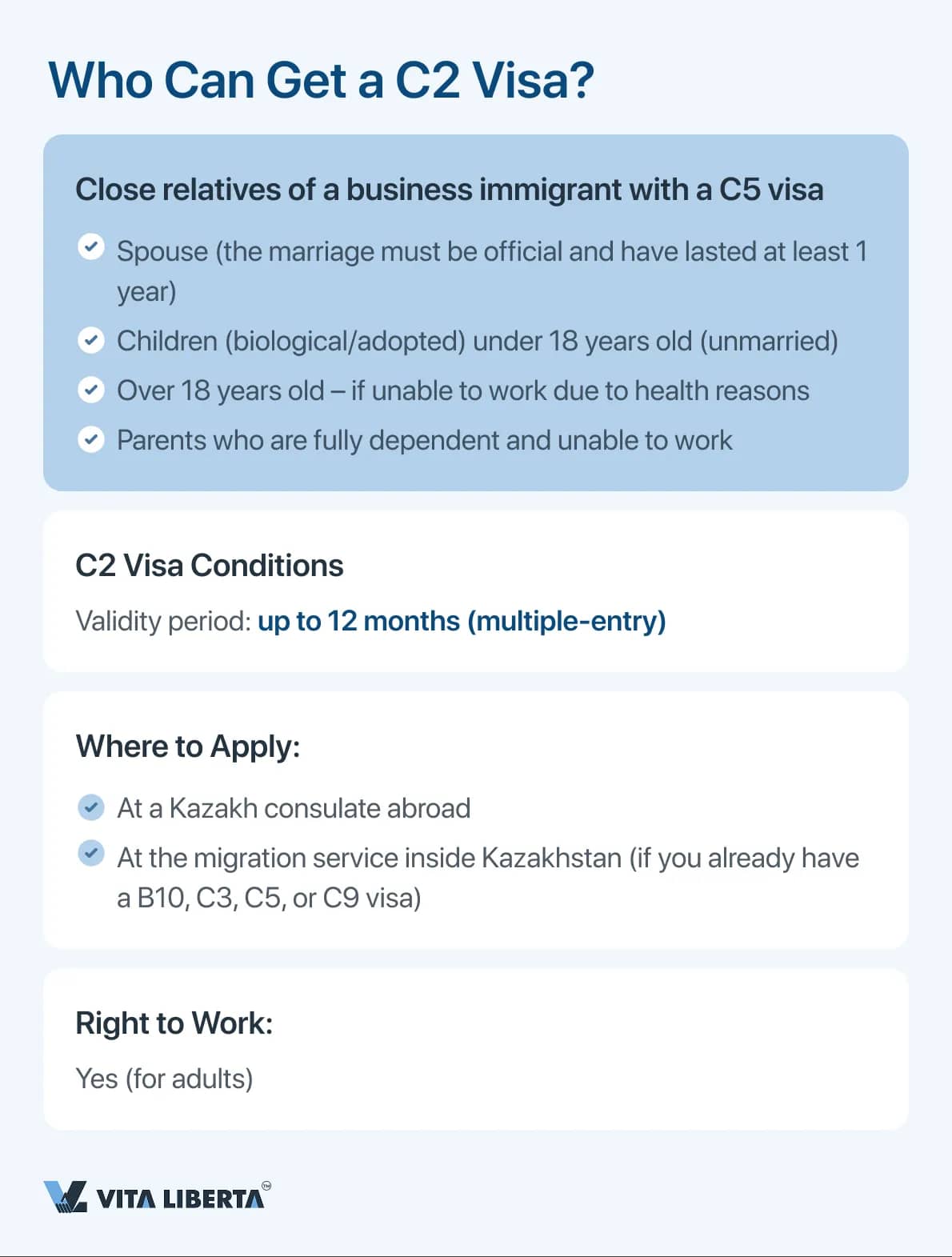
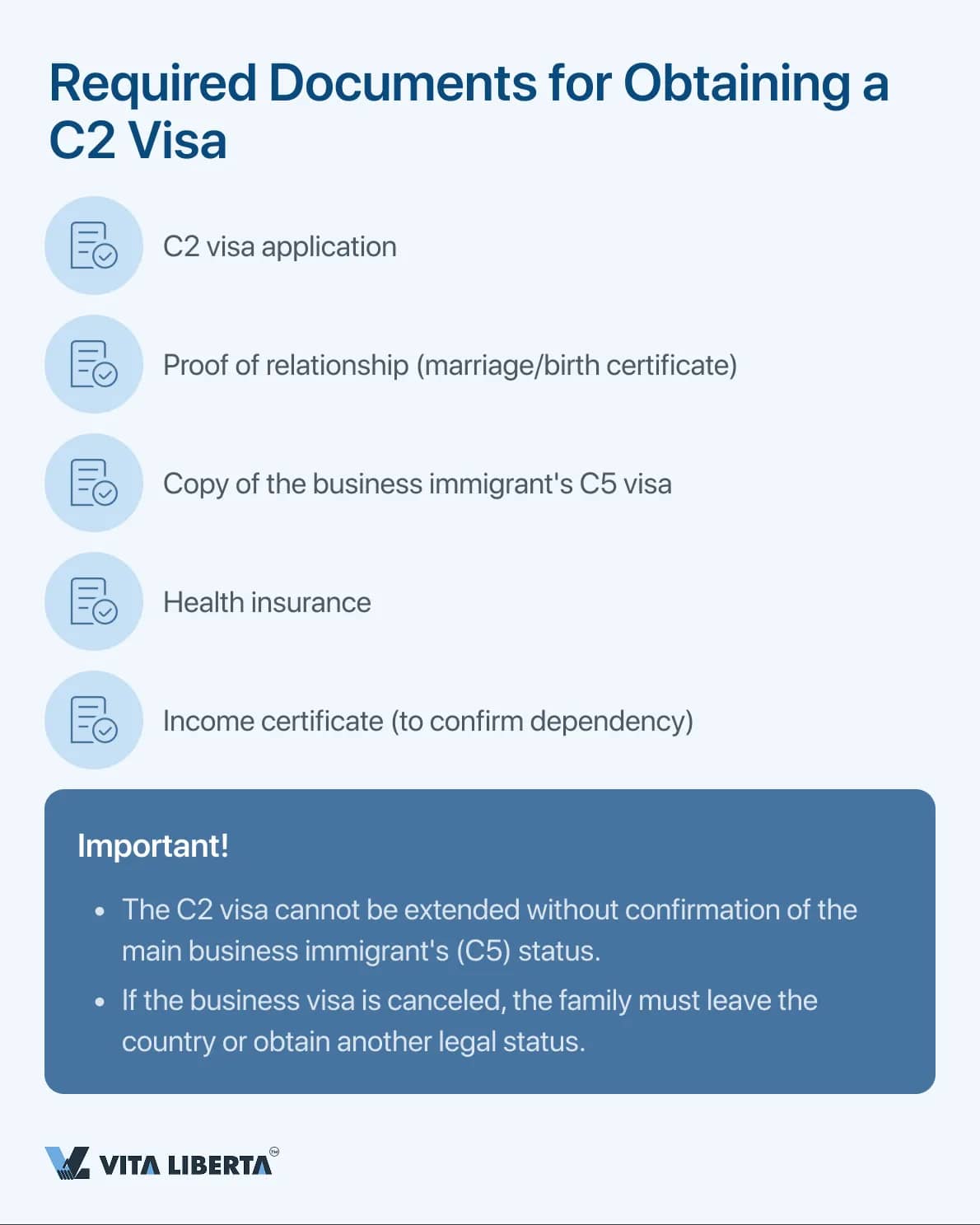
Close relatives of a business immigrant also have the opportunity to legally stay in Kazakhstan after obtaining a visa for family reunification – this permit falls under category C2. However, to exercise this right, certain conditions must be met. It is recommended to clarify the detailed nuances of registration with specialized migration professionals.
Who Can Qualify for a C2 Visa:
Conditions for Stay under a C2 Visa:
- Husband or wife, if the marriage has lasted at least one year.
- Biological and adopted children under the age of majority (under 18), unmarried.
- Adult children, including adopted ones, if they are over 18, unmarried, and due to health reasons cannot support themselves.
- Parents who are fully dependent on the immigrant and are unable to work.
Conditions for Stay under a C2 Visa:
- The multiple-entry C2 visa is usually issued for a period of up to 12 months.
- It is possible to obtain a residence permit under this category not only through a consulate but also while already inside the country, holding a B10 (private trip), C3 (employment), C5, or C9 (study) visa.
- Foreign citizens who are of legal age and are in Kazakhstan on a C2 visa have the right to engage in work activities.
Judicial Practice
Ruling of the Judicial Collegium for Civil Cases of the Supreme Court of the Republic of Kazakhstan No. 6001-23-00-3г/6340 of January 15, 2024
The RSU "Department of State Revenues for Alatau District of the State Revenues Department for Almaty City of the State Revenues Committee of the Ministry of Finance of the Republic of Kazakhstan" (hereinafter referred to as the Department) filed a lawsuit with the court for the forced liquidation of LLP "N...", citing violations committed during its registration. The claim was satisfied by both the court of first instance and the appellate instance.
The petitioner requesting the review of the judicial acts stated the following arguments:
However, after examining the case materials and the arguments of the petition, the judge came to the following conclusions:
The court concludes that the liquidation lawsuit was filed within the competence of the tax authority and complies with the current legislation. Therefore, the decision and ruling of the courts of first instance and the appellate instance are to be upheld.
In accordance with subparagraph 2) of part 1 of Article 444 of the Civil Procedure Code of the Republic of Kazakhstan, the judge ruled: To deny the transfer of the petition of the representative acting in the interests of LLP "N..." for the review of the decision of the Specialized Interdistrict Economic Court of Almaty dated July 25, 2023, and the ruling of the Judicial Collegium for Civil Cases of Almaty City Court dated November 6, 2023, for consideration in the Supreme Court of the Republic of Kazakhstan.
The RSU "Department of State Revenues for Alatau District of the State Revenues Department for Almaty City of the State Revenues Committee of the Ministry of Finance of the Republic of Kazakhstan" (hereinafter referred to as the Department) filed a lawsuit with the court for the forced liquidation of LLP "N...", citing violations committed during its registration. The claim was satisfied by both the court of first instance and the appellate instance.
The petitioner requesting the review of the judicial acts stated the following arguments:
- The Law "On State Registration of Legal Entities" does not require the presence of a C5 business immigrant visa;
- The partnership has been paying taxes since its registration, is not concealing its activities, and is not fictitious;
- For citizens who have concluded visa-free agreements with the Republic of Kazakhstan, a C5 visa is not mandatory;
- The plaintiff should have sought to have the registration declared invalid, rather than initiating liquidation.
However, after examining the case materials and the arguments of the petition, the judge came to the following conclusions:
- In accordance with Part 5 of Article 438 of the Civil Procedure Code of the Republic of Kazakhstan, a review of judicial acts is possible only in the presence of significant violations of legal norms that affected the legality of the decision. No such violations were found in this case.
- The courts of first instance and the appellate instance acted within the law, guided by the provisions of the Law "On Population Migration" and the explanations of the Supreme Court.
- The absence of a C5 business immigrant visa for the founder is an irremediable violation, as it indicates that the foreigner did not have the right to create a legal entity for the purpose of carrying out entrepreneurial activities.
- Even if the LLP pays taxes and conducts activities, this does not negate the requirements of the legislation regarding the admissibility of foreign citizens' participation in the creation of legal entities.
- In accordance with paragraph 10 of Regulatory Resolution No. 4 of the Supreme Court, tax authorities have the right to file lawsuits for the liquidation of legal entities in the event of irremediable violations during registration.
The court concludes that the liquidation lawsuit was filed within the competence of the tax authority and complies with the current legislation. Therefore, the decision and ruling of the courts of first instance and the appellate instance are to be upheld.
In accordance with subparagraph 2) of part 1 of Article 444 of the Civil Procedure Code of the Republic of Kazakhstan, the judge ruled: To deny the transfer of the petition of the representative acting in the interests of LLP "N..." for the review of the decision of the Specialized Interdistrict Economic Court of Almaty dated July 25, 2023, and the ruling of the Judicial Collegium for Civil Cases of Almaty City Court dated November 6, 2023, for consideration in the Supreme Court of the Republic of Kazakhstan.
Visa Categories C3 and C5: Key Differences
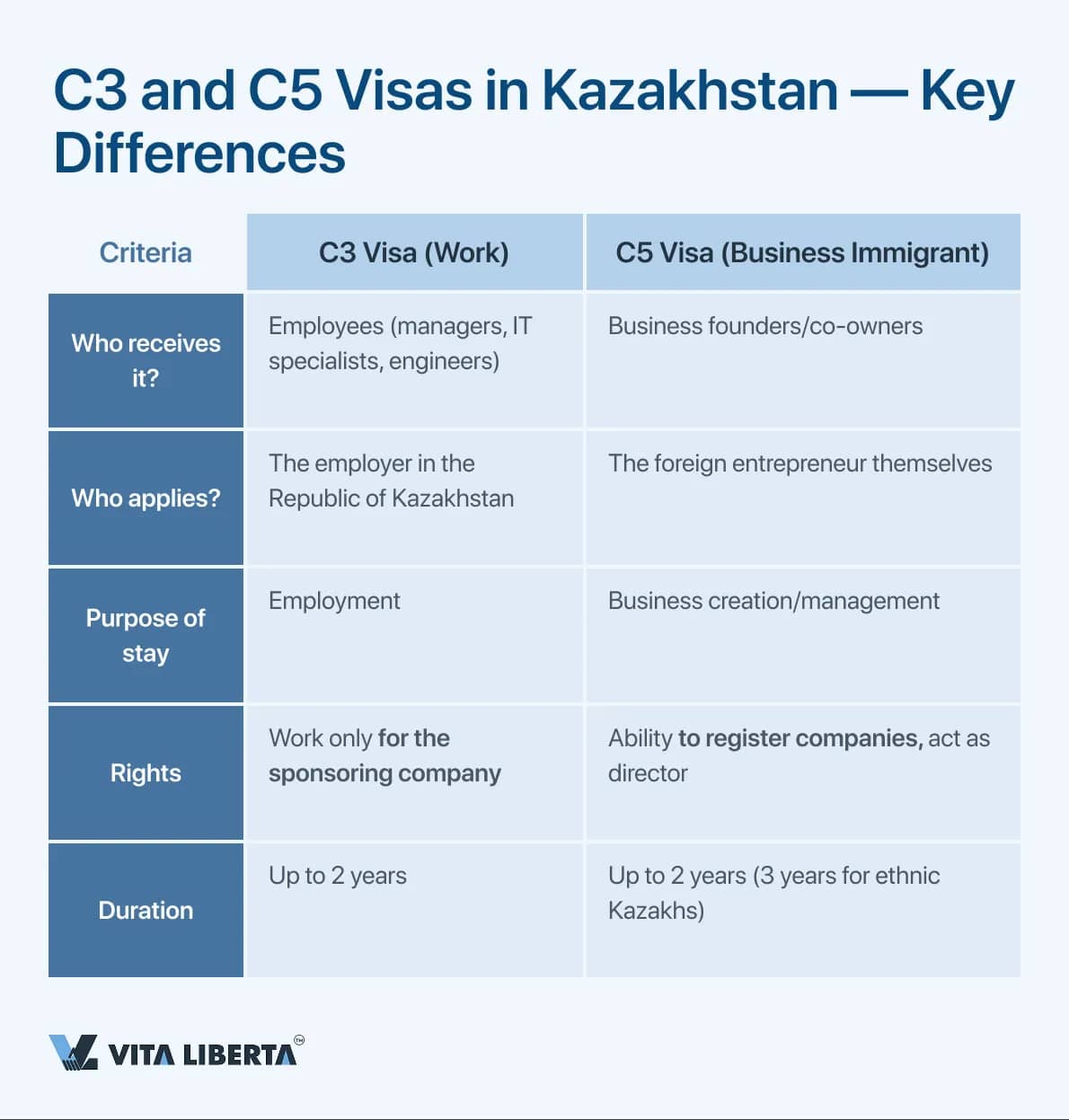
The status of a business immigrant implies opening one's own business or becoming a founder of a Kazakhstani company. A labor migrant is a person hired for employment. The work visa, which is category C3, is issued for foreigners arriving for employment. This may include heads of organizations, heads of branches, as well as qualified specialists of various profiles: engineers, technical workers, managers, IT experts, and others.
The C3 visa is arranged by the employer company that wishes to attract a specialist from abroad. To obtain a C5 business visa, all documents are submitted personally by the applicant planning to create a new enterprise or purchase a stake in an existing business.
In practice, the business community often confuses these two categories, leading to situations where a foreign founder uses a C3 visa issued for work in one organization to open another company, which contradicts the established rules.
It should be noted: if a foreign citizen becomes the head of their own registered company in Kazakhstan, a C5 visa is sufficient. A C3 work visa is not required in this case.
The C3 visa is arranged by the employer company that wishes to attract a specialist from abroad. To obtain a C5 business visa, all documents are submitted personally by the applicant planning to create a new enterprise or purchase a stake in an existing business.
In practice, the business community often confuses these two categories, leading to situations where a foreign founder uses a C3 visa issued for work in one organization to open another company, which contradicts the established rules.
It should be noted: if a foreign citizen becomes the head of their own registered company in Kazakhstan, a C5 visa is sufficient. A C3 work visa is not required in this case.
Advantages of the C5 Business Visa
The C5 visa for businessmen opens up various advantages that facilitate legal entrepreneurial activity in Kazakhstan:
- Possibility of long-term stay. After extension, this type of visa allows legal residence in the country for up to two years, which is important for strategic business development and the implementation of long-term projects.
- Legal conduct of commercial activities. Holders of the C5 visa can officially open their own enterprises or acquire equity stakes in existing companies, providing flexibility in choosing a business model.
- Direct access to the Kazakhstani market. Owners of this visa have the right to independently manage their business in Kazakhstan, use local infrastructure and resources, as well as establish logistics links and interaction with Kazakhstani suppliers.
- Simplified access to EAEU markets. Since Kazakhstan is a member of the Eurasian Economic Union, entrepreneurs with a C5 visa can build business relationships with companies from other member states without obtaining additional visas.
- Protection from the consequences of violating visa status. If a foreigner neglects to obtain the appropriate business visa, it can lead to a refusal to extend the residence permit and the need for an urgent departure from the republic. Obtaining a C5 visa minimizes the risks of such problems.
Difficulties Foreigners Face When Applying for a C5 Visa
Not everyone manages to correctly prepare all the documents and successfully navigate the entire visa application process.
Problems Obtaining the Invitation Letter for the Initial Visa
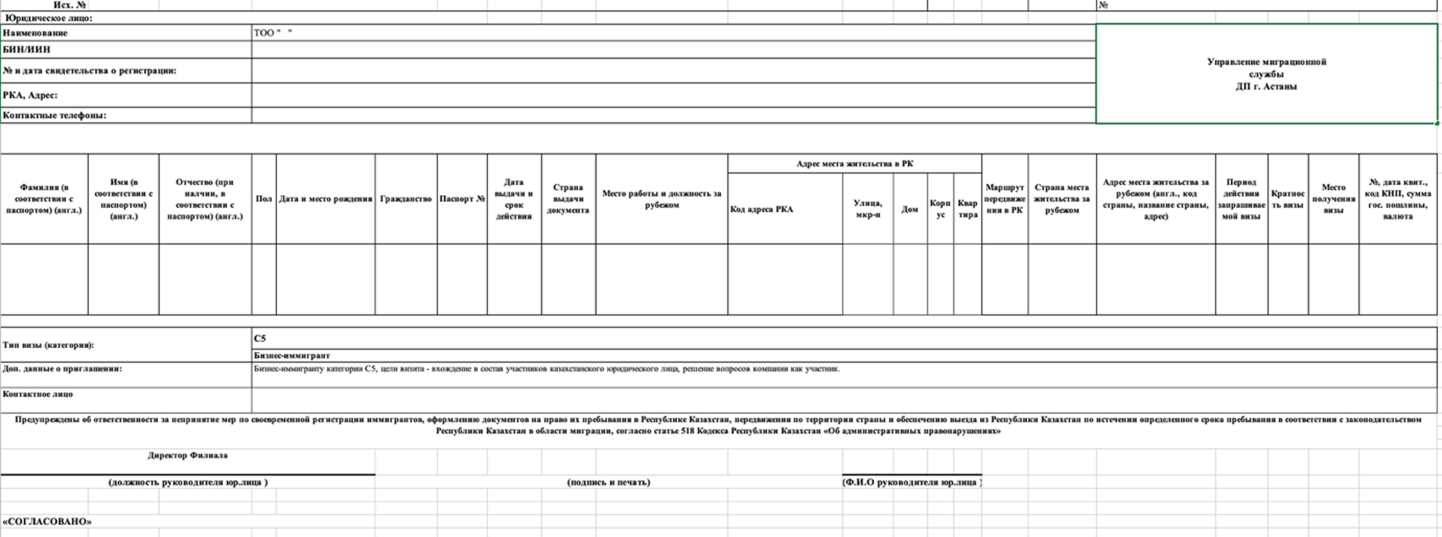
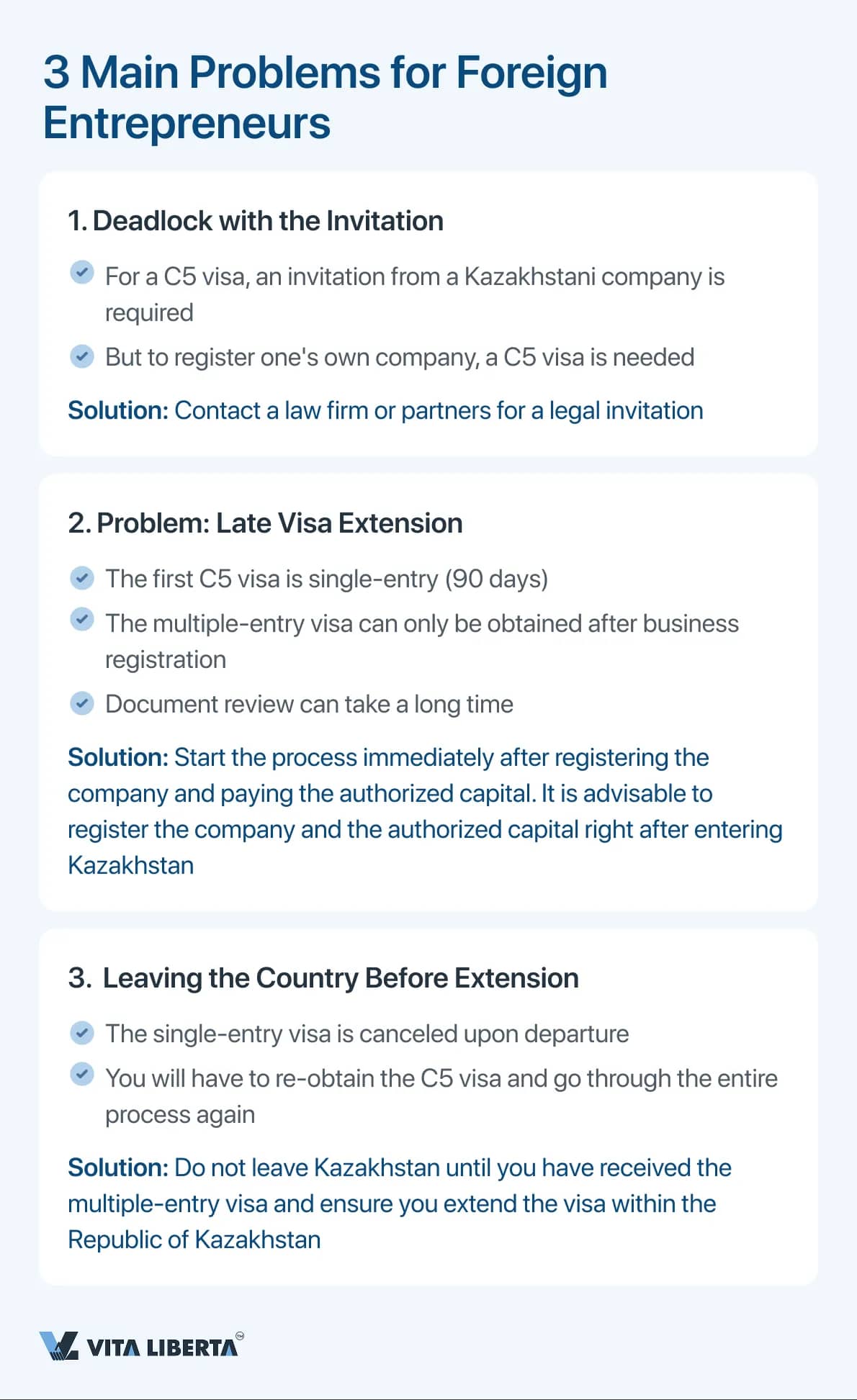
One of the main difficulties is preparing the invitation letter for the C5 visa. It is impossible to obtain such a visa without an invitation from an existing Kazakhstani company; however, to create a new enterprise, the foreigner must first enter on this visa. To break this deadlock, applicants often turn to specialized law firms that legally help obtain the necessary invitation and guide them through the procedure according to the requirements.
Format of the Invitation Letter:
Problems Obtaining the Invitation Letter for the Initial Visa
One of the main difficulties is preparing the invitation letter for the C5 visa. It is impossible to obtain such a visa without an invitation from an existing Kazakhstani company; however, to create a new enterprise, the foreigner must first enter on this visa. To break this deadlock, applicants often turn to specialized law firms that legally help obtain the necessary invitation and guide them through the procedure according to the requirements.
Format of the Invitation Letter:
Difficulty with Visa Extension: Transitioning from Single-Entry to Multiple-Entry
The initial C5 visa is valid for up to 90 days, and obtaining a multiple-entry visa is only possible after registering the company. However, many applicants start the extension process too late. Since a single-entry visa can only be extended if documents are submitted no later than 5 days before its expiration, and obtaining confirmation from the Entrepreneurship Department takes up to 15 business days, it is recommended to begin preparing all necessary documents immediately after creating the legal entity. This will allow for timely submission – documents are accepted starting 30 days before the initial visa expires.
Mistakes When Leaving the Country
Another common problem arises when a foreign founder leaves Kazakhstan after registering their enterprise, planning to return later to extend the visa. It is important to remember that the first C5 visa is single-entry, and it loses its validity upon departure. In such a case, it would be necessary to re-submit documents to obtain a new single-entry visa, and only after that – to apply for the long-term one. Therefore, to avoid unnecessary difficulties and time loss, it is recommended not to leave the country until all stages of visa processing are completed.
The initial C5 visa is valid for up to 90 days, and obtaining a multiple-entry visa is only possible after registering the company. However, many applicants start the extension process too late. Since a single-entry visa can only be extended if documents are submitted no later than 5 days before its expiration, and obtaining confirmation from the Entrepreneurship Department takes up to 15 business days, it is recommended to begin preparing all necessary documents immediately after creating the legal entity. This will allow for timely submission – documents are accepted starting 30 days before the initial visa expires.
Mistakes When Leaving the Country
Another common problem arises when a foreign founder leaves Kazakhstan after registering their enterprise, planning to return later to extend the visa. It is important to remember that the first C5 visa is single-entry, and it loses its validity upon departure. In such a case, it would be necessary to re-submit documents to obtain a new single-entry visa, and only after that – to apply for the long-term one. Therefore, to avoid unnecessary difficulties and time loss, it is recommended not to leave the country until all stages of visa processing are completed.
Additional Aspects to Consider
National security bodies have the right not to disclose the reason that served as the basis for refusing to approve the entry of immigrants into the Republic of Kazakhstan.
- Diplomatic missions and consular offices of Kazakhstan may refuse to issue a single-entry C5 visa if the applicant has serious obstacles to entry into the country, such as a criminal record or an official ban on entrepreneurial activity.
- If a business immigrant who arrived in Kazakhstan fails to fulfill the obligations of registering the company and transferring investments within the established deadlines, the Ministry of Internal Affairs, upon the application of the akimat, has the right to limit the period of their stay, providing only time for voluntary departure.
- Local self-government bodies, particularly akimats, may refuse to approve a multiple-entry C5 visa if the documents are submitted incompletely or the business plan does not meet the requirements set by the relevant departments.
- For citizens of certain states, there may be specific difficulties in obtaining documents necessary for entrepreneurship in Kazakhstan. For example, certificates confirming the absence of restrictions on commercial activity or the authenticity of other legal certificates from their country of citizenship.
National security bodies have the right not to disclose the reason that served as the basis for refusing to approve the entry of immigrants into the Republic of Kazakhstan.
New Visa Categories
Category A6 Visa
Designed for foreign businessmen who have invested at least 300,000 US dollars in the economy of Kazakhstan. The visa can be issued for up to 10 years based on an invitation from a local company.
Category B9-1 Visa (Digital Nomad Visa)
Intended for individuals with in-demand professions planning to obtain permanent residency in Kazakhstan. A single-entry electronic visa is issued through the visa and migration portal based on an invitation. A multiple-entry visa for up to one year is issued by the Ministry of Internal Affairs of the Republic of Kazakhstan upon request from the authorized body in the field of informatization and provided that a single-entry visa has been previously obtained.
Category B12-1 Visa (Neo Nomad Visa)
Designed for so-called "new nomads" – foreign tourists who combine work and leisure, traveling and working remotely. The visa can be issued for up to one year. Conditions for obtaining:
Designed for foreign businessmen who have invested at least 300,000 US dollars in the economy of Kazakhstan. The visa can be issued for up to 10 years based on an invitation from a local company.
Category B9-1 Visa (Digital Nomad Visa)
Intended for individuals with in-demand professions planning to obtain permanent residency in Kazakhstan. A single-entry electronic visa is issued through the visa and migration portal based on an invitation. A multiple-entry visa for up to one year is issued by the Ministry of Internal Affairs of the Republic of Kazakhstan upon request from the authorized body in the field of informatization and provided that a single-entry visa has been previously obtained.
Category B12-1 Visa (Neo Nomad Visa)
Designed for so-called "new nomads" – foreign tourists who combine work and leisure, traveling and working remotely. The visa can be issued for up to one year. Conditions for obtaining:
- Availability of a regular income from foreign sources;
- A bank statement for the last 6 months confirming a stable monthly income exceeding 3,000 US dollars;
- Tax declaration from the competent authority of the country of citizenship;
- Document confirming no criminal record;
- Health insurance covering the entire period of stay.
Frequently Asked Questions (FAQ)
Can a Limited Liability Partnership with foreign founders (who hold a C5 visa) include them on the staff as a sales manager?
Does the head of a foreign legal entity need to obtain a C5 visa to acquire a stake in a Kazakhstani Limited Liability Partnership?
What liability is provided for foreigners who violate the terms of their visa?
What migration requirements exist in Kazakhstan for registering a company or participating in the authorized capital of a Kazakhstani Limited Liability Partnership?
Business Visa C5 for Kazakhstan: Comprehensive Guide to Requirements and Application
Disclaimer
All service pricing and information provided on vitaliberta.kz are for informational purposes only and do not constitute a public offer under Article 395 of the Civil Code of the Republic of Kazakhstan.
While the website has been prepared with due regard to current legislation and relevant case law, LLP “Vita Liberta” does not guarantee the absolute accuracy, completeness, or timeliness of the content. For definitive guidance, please consult with our team directly.
All service pricing and information provided on vitaliberta.kz are for informational purposes only and do not constitute a public offer under Article 395 of the Civil Code of the Republic of Kazakhstan.
While the website has been prepared with due regard to current legislation and relevant case law, LLP “Vita Liberta” does not guarantee the absolute accuracy, completeness, or timeliness of the content. For definitive guidance, please consult with our team directly.